以下内容是基于Redis 6.2.6 版本整理总结
Redis中hash数据类型使用了两种编码格式:ziplist(压缩列表)、hashtable(哈希表)
在redis.conf配置文件中,有以下两个参数,意思为:当节点数量小于512并且字符串的长度小于等于64时,会使用ziplist编码。
hash-max-ziplist-entries 512
hash-max-ziplist-value 64
ziplist 我们整理在下一篇文章。
Redis中的字典(dict)使用哈希表作为的底层实现,一个哈希表里可以有多个哈希表的节点,每个节点保存字典中的一个键值对。
哈希表结构定义如下:
typedef struct dictht {
    dictEntry **table;  // 哈希表数组 每个元素都是 dictEntry 的指针,指向 dictEntry;
    unsigned long size; // 哈希表大小
    unsigned long sizemask; // 用来计算索引值 always: sizemask = size - 1
    unsigned long used; // 哈希表已有节点的数量
} dictht;
哈希表节点定义如下:
哈希表节点使用 dictEntry 结构表示,每个 dictEntry 结构都保存着一个键值对和冲突后的链表的下一个节点。
typedef struct dictEntry {
    void *key;
    union {
        void *val;
        uint64_t u64;
        int64_t s64;
        double d;
    } v;
    struct dictEntry *next; // 保存下一个 dictEntry 的地址,形成链表
} dictEntry;
其中,value 是一个联合体,可以保存多种数据类型。当value类型为 uint64_t 、int64_t 或 double时可以直接存储。其他类型需要在其他位置申请一段空间来存放,并用val指向这段空间来使用。
字典结构定义如下:
// location: dict.h
typedef struct dict {
    dictType *type;  // 指向 dictType 结构的指针
    void *privdata;  // 存储私有数据的指针,在 dictType 里面的函数会用到
    dictht ht[2];    // 两个哈希表,扩容时使用,后面会结合源码详细说明
    long rehashidx;  // 值为-1时,表示没有进行rehash,否则保存rehash执行到那个元素的数组下标
    int16_t pauserehash; // >0 表示rehash暂停,<0 表示编码错误
} dict;
dictType 结构定义如下
dictType 结构体定义了一系列操作key-value键值对的方法的函数指针,在实际运行时传入指定函数,就能实现预期的功能,有点运行时多态绑定的味道。
// 操作特性键值对的函数簇
typedef struct dictType {
    uint64_t (*hashFunction)(const void *key); // 计算哈希值的函数
    void *(*keyDup)(void *privdata, const void *key);  // 复制key的函数
    void *(*valDup)(void *privdata, const void *obj);  // 复制value的函数
    int (*keyCompare)(void *privdata, const void *key1, const void *key2); // 对比key的函数
    void (*keyDestructor)(void *privdata, void *key);  // 销毁key的函数
    void (*valDestructor)(void *privdata, void *obj);  // 销毁value的函数
    int (*expandAllowed)(size_t moreMem, double usedRatio); // 扩容
} dictType;
字典整体结构可以用下图来描述:
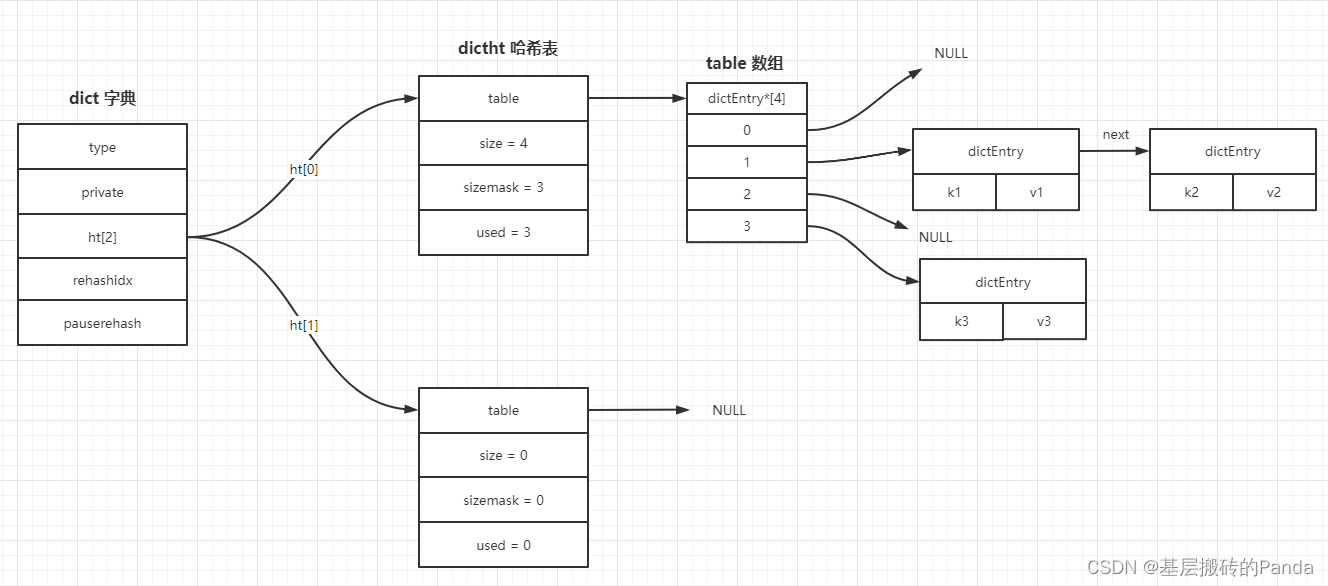
当两个或两个以上的键被分配到哈希数组的同一个索引上面时,我们称这些键发生了冲突。Redis的哈希表使用拉链法解决hash冲突。
负载因子 = used / size ; used 是哈希数组存储的元素个数,size 是哈希数组的长度。
负载因子越小,冲突越小;负载因子越大,冲突越大。
随着命令的不断执行,哈希表保存的减值对会逐渐增加或者减少,为了让哈希表的负载因子维持在一个合理的范围内,当哈希表中的键值对过多或过少时,需要对哈希表的大小进行相应的扩展和收缩。而哈希表的扩展和收缩可以通过rehash来执行。rehash 就是将 ht[0] 中的节点,通过重新计算哈希值和索引值放到 ht[1] 哈希表指定的位置上。
扩容
缩容
如果负载因子小于0.1,就会触发缩容。缩容的规则是:恰好包含used的2^n。
当哈希表中的元素过多时,如果一次性rehash到ht[1],庞大的计算量,可能导致redis服务在一段时间不可用。为了避免rehash对服务器带来的影响,redis分多次、慢慢的将ht[0]哈希表中的键值对rehash到ht[1]哈希表,这就是渐进式rehash。
核心思想:将整个rehash过程均摊到每次命令的执行中。
rehash的详细步骤:
// 创建字典
dict *dictCreate(dictType *type, void *privDataPtr);
// 将键值对 key-val 插入到字典
int dictAdd(dict *d, void *key, void *val);
// 删除字典中指定 key 的键值对
int dictDelete(dict *d, const void *key);
// 获取指定key的value值
void *dictFetchValue(dict *d, const void *key);
// 将键值对 key-val 插入到字典,如果该key已经存在,则只更新val
int dictReplace(dict *d, void *key, void *val);
// 1. 通过hash函数得到hash值
hash = dict->type->hashFunction(key);
// 2. 将hash值与对应哈希表的sizemask 进行 & 操作得到index
index= hash & d->ht[x].sizemask; // x = 0 or 1
// 3. 创建 dictEntry 节点,头插法插入到对应哈希表的index的位置
entry = zmalloc(sizeof(*entry));
entry->next = ht->table[index];
ht->table[index] = entry;
redis使用 dictAdd() 方法往哈希表中添加元素。dictAdd 调用的是 dictAddRaw 方法,它会先通过_dictKeyIndex() 函数计算出table的index;再通过头插法将该节点插入到目标位置。
dictAdd() 函数
/* Add an element to the target hash table */
int dictAdd(dict *d, void *key, void *val)
{
    dictEntry *entry = dictAddRaw(d,key,NULL);

    if (!entry) return DICT_ERR;

	// 将 val 保存到 entry 节点
    dictSetVal(d, entry, val);
    return DICT_OK;
}
dictAddRaw() 函数
dictEntry *dictAddRaw(dict *d, void *key, dictEntry **existing)
{
    long index;
    dictEntry *entry;
    dictht *ht;

    if (dictIsRehashing(d)) _dictRehashStep(d);

    /* Get the index of the new element, or -1 if
     * the element already exists. */
    // 计算index
    if ((index = _dictKeyIndex(d, key, dictHashKey(d,key), existing)) == -1)
        return NULL;

    /* Allocate the memory and store the new entry.
     * Insert the element in top, with the assumption that in a database
     * system it is more likely that recently added entries are accessed
     * more frequently. */
    ht = dictIsRehashing(d) ? &d->ht[1] : &d->ht[0];
    entry = zmalloc(sizeof(*entry));
    // 头插法 最快
    entry->next = ht->table[index];
    ht->table[index] = entry;
    ht->used++;

    // 将 key 保存在 entry 节点中
    dictSetKey(d, entry, key);
    return entry;
}
其中,在_dictKeyIndex() 函数计算index的时候,会调用 _dictExpandIfNeeded() 函数判断是否满足扩容的条件。其中有个条件是依赖于 dictTypeExpandAllowed(d) 的返回值。
_dictKeyIndex() 函数
static long _dictKeyIndex(dict *d, const void *key, uint64_t hash, dictEntry **existing)
{
    unsigned long idx, table;
    dictEntry *he;
    if (existing) *existing = NULL;

    /* Expand the hash table if needed */
    if (_dictExpandIfNeeded(d) == DICT_ERR)
        return -1;
    for (table = 0; table <= 1; table++) {
        idx = hash & d->ht[table].sizemask;
        /* Search if this slot does not already contain the given key */
        he = d->ht[table].table[idx];
        while(he) {
            if (key==he->key || dictCompareKeys(d, key, he->key)) {
                if (existing) *existing = he;
                return -1;
            }
            he = he->next;
        }
        if (!dictIsRehashing(d)) break;
    }
    return idx;
}
_dictExpandIfNeeded() 函数
/* Expand the hash table if needed */
static int _dictExpandIfNeeded(dict *d)
{
    /* Incremental rehashing already in progress. Return. */
    if (dictIsRehashing(d)) return DICT_OK;

    /* If the hash table is empty expand it to the initial size. */
    if (d->ht[0].size == 0) return dictExpand(d, DICT_HT_INITIAL_SIZE);

    /* If we reached the 1:1 ratio, and we are allowed to resize the hash
     * table (global setting) or we should avoid it but the ratio between
     * elements/buckets is over the "safe" threshold, we resize doubling
     * the number of buckets. */
    if (d->ht[0].used >= d->ht[0].size &&
        (dict_can_resize ||
         d->ht[0].used/d->ht[0].size > dict_force_resize_ratio) &&
        dictTypeExpandAllowed(d))
    {
        return dictExpand(d, d->ht[0].used + 1);
    }
    return DICT_OK;
}
dictTypeExpandAllowed() 函数
static int dictTypeExpandAllowed(dict *d) {
    if (d->type->expandAllowed == NULL) return 1;
    return d->type->expandAllowed(
                    _dictNextPower(d->ht[0].used + 1) * sizeof(dictEntry*),
                    (double)d->ht[0].used / d->ht[0].size);
}
可以看到,如果 dictType 中没有设置 expandAllowed 函数,则直接返回真;如果设置了expandAllowed 函数,就需要执行完相应的函数才能确定是否可以扩缩容。这就是 dictType 的一个典型的应用场景。
该函数每次从rehashidx开始的位置,固定扫描 10 个bucket,如果对应的bucket中有数据就 rehash 到 ht[1]中。
static void _dictRehashStep(dict *d) {
    if (d->pauserehash == 0) dictRehash(d,1);
}

int dictRehash(dict *d, int n) {
    int empty_visits = n*10; /* Max number of empty buckets to visit. */
    if (!dictIsRehashing(d)) return 0;

    while(n-- && d->ht[0].used != 0) {
        dictEntry *de, *nextde;

        /* Note that rehashidx can't overflow as we are sure there are more
         * elements because ht[0].used != 0 */
        assert(d->ht[0].size > (unsigned long)d->rehashidx);

        // 跳过空的槽位
        while(d->ht[0].table[d->rehashidx] == NULL) {
            d->rehashidx++;
            // 如果 经过 n*10 次,还是为空,本次rehash结束
            if (--empty_visits == 0) return 1;
        }

        // 找到要rehash的bucket
        de = d->ht[0].table[d->rehashidx];

        // 遍历该bucket对应的dictEntry链表
        while(de) {
            uint64_t h;

            nextde = de->next;
            // 为该dictEntry 获取在ht[1]中的index
            h = dictHashKey(d, de->key) & d->ht[1].sizemask;

            // 头插法 de->next 指向 ht[1].table[h]的第一个元素 (可能为NULL,可能有元素)
            de->next = d->ht[1].table[h];

            // 更新ht[1].table[h]的值指向该 dictEntry
            d->ht[1].table[h] = de;
            d->ht[0].used--;
            d->ht[1].used++;

            de = nextde; // 更新de,继续遍历,直至为空
        }
        // 将ht[0]中 d->rehashidx 对应的bucket清空
        d->ht[0].table[d->rehashidx] = NULL;
        // 更新rehashidx
        d->rehashidx++;
    }

    // 检查整个ht[0]表,rehash是否完成
    if (d->ht[0].used == 0) {
        zfree(d->ht[0].table); // 释放ht[0]
        d->ht[0] = d->ht[1];   // 让ht[0] 指向 rehash后的 ht[1]
        _dictReset(&d->ht[1]); // 重置 ht[0], 以备下次rehash
        d->rehashidx = -1;
        return 0;
    }

    /* More to rehash... */
    return 1;
}
我想将html转换为纯文本。不过,我不想只删除标签,我想智能地保留尽可能多的格式。为插入换行符标签,检测段落并格式化它们等。输入非常简单,通常是格式良好的html(不是整个文档,只是一堆内容,通常没有anchor或图像)。我可以将几个正则表达式放在一起,让我达到80%,但我认为可能有一些现有的解决方案更智能。 最佳答案 首先,不要尝试为此使用正则表达式。很有可能你会想出一个脆弱/脆弱的解决方案,它会随着HTML的变化而崩溃,或者很难管理和维护。您可以使用Nokogiri快速解析HTML并提取文本:require'nokogiri'h
我主要使用Ruby来执行此操作,但到目前为止我的攻击计划如下:使用gemsrdf、rdf-rdfa和rdf-microdata或mida来解析给定任何URI的数据。我认为最好映射到像schema.org这样的统一模式,例如使用这个yaml文件,它试图描述数据词汇表和opengraph到schema.org之间的转换:#SchemaXtoschema.orgconversion#data-vocabularyDV:name:namestreet-address:streetAddressregion:addressRegionlocality:addressLocalityphoto:i
在rails源中:https://github.com/rails/rails/blob/master/activesupport/lib/active_support/lazy_load_hooks.rb可以看到以下内容@load_hooks=Hash.new{|h,k|h[k]=[]}在IRB中,它只是初始化一个空哈希。和做有什么区别@load_hooks=Hash.new 最佳答案 查看rubydocumentationforHashnew→new_hashclicktotogglesourcenew(obj)→new_has
我有一个对象has_many应呈现为xml的子对象。这不是问题。我的问题是我创建了一个Hash包含此数据,就像解析器需要它一样。但是rails自动将整个文件包含在.........我需要摆脱type="array"和我该如何处理?我没有在文档中找到任何内容。 最佳答案 我遇到了同样的问题;这是我的XML:我在用这个:entries.to_xml将散列数据转换为XML,但这会将条目的数据包装到中所以我修改了:entries.to_xml(root:"Contacts")但这仍然将转换后的XML包装在“联系人”中,将我的XML代码修改为
我有一个围绕一些对象的包装类,我想将这些对象用作散列中的键。包装对象和解包装对象应映射到相同的键。一个简单的例子是这样的:classAattr_reader:xdefinitialize(inner)@inner=innerenddefx;@inner.x;enddef==(other)@inner.x==other.xendenda=A.new(o)#oisjustanyobjectthatallowso.xb=A.new(o)h={a=>5}ph[a]#5ph[b]#nil,shouldbe5ph[o]#nil,shouldbe5我试过==、===、eq?并散列所有无济于事。
我真的很习惯使用Ruby编写以下代码:my_hash={}my_hash['test']=1Java中对应的数据结构是什么? 最佳答案 HashMapmap=newHashMap();map.put("test",1);我假设? 关于java-等价于Java中的RubyHash,我们在StackOverflow上找到一个类似的问题: https://stackoverflow.com/questions/22737685/
有时我需要处理键/值数据。我不喜欢使用数组,因为它们在大小上没有限制(很容易不小心添加超过2个项目,而且您最终需要稍后验证大小)。此外,0和1的索引变成了魔数(MagicNumber),并且在传达含义方面做得很差(“当我说0时,我的意思是head...”)。散列也不合适,因为可能会不小心添加额外的条目。我写了下面的类来解决这个问题:classPairattr_accessor:head,:taildefinitialize(h,t)@head,@tail=h,tendend它工作得很好并且解决了问题,但我很想知道:Ruby标准库是否已经带有这样一个类? 最佳
给定一个复杂的对象层次结构,幸运的是它不包含循环引用,我如何实现支持各种格式的序列化?我不是来讨论实际实现的。相反,我正在寻找可能会派上用场的设计模式提示。更准确地说:我正在使用Ruby,我想解析XML和JSON数据以构建复杂的对象层次结构。此外,应该可以将该层次结构序列化为JSON、XML和可能的HTML。我可以为此使用Builder模式吗?在任何提到的情况下,我都有某种结构化数据-无论是在内存中还是文本中-我想用它来构建其他东西。我认为将序列化逻辑与实际业务逻辑分开会很好,这样我以后就可以轻松支持多种XML格式。 最佳答案 我最
我正在尝试使用Curbgem执行以下POST以解析云curl-XPOST\-H"X-Parse-Application-Id:PARSE_APP_ID"\-H"X-Parse-REST-API-Key:PARSE_API_KEY"\-H"Content-Type:image/jpeg"\--data-binary'@myPicture.jpg'\https://api.parse.com/1/files/pic.jpg用这个:curl=Curl::Easy.new("https://api.parse.com/1/files/lion.jpg")curl.multipart_form_
无论您是想搭建桌面端、WEB端或者移动端APP应用,HOOPSPlatform组件都可以为您提供弹性的3D集成架构,同时,由工业领域3D技术专家组成的HOOPS技术团队也能为您提供技术支持服务。如果您的客户期望有一种在多个平台(桌面/WEB/APP,而且某些客户端是“瘦”客户端)快速、方便地将数据接入到3D应用系统的解决方案,并且当访问数据时,在各个平台上的性能和用户体验保持一致,HOOPSPlatform将帮助您完成。利用HOOPSPlatform,您可以开发在任何环境下的3D基础应用架构。HOOPSPlatform可以帮您打造3D创新型产品,HOOPSSDK包含的技术有:快速且准确的CAD
