最近在忙我的省创,是有关于知识图谱的,其中有一个内容是使用rgcn的链接预测方法跑自己的数据集,我是用的dgl库中给出的在pytorch环境下实现rgcn的链接预测的代码,相关链接贴在这里:
dgl库中在pytorch环境下实现rgcn的链接预测的代码
这个代码给的示例就是使用FB15k237数据集,调用方法是这样的:
from dgl.data.knowledge_graph import FB15k237Dataset
data = FB15k237Dataset(reverse=False)
graph = data[0]
print("graph",graph)
这里就调用了FB15k237数据集,返回的的data[0]就是使用dgl库使用该数据集构建的图g。
我一开始想用自己的数据构图,然后使用rgcn的代码跑我自己的数据集,但是我不知道它的构图是如何实现的,于是我修改了rgcn的代码,实现了自己的构图方式如下,就是使用入结点出节点和边的编号列表构图:
g = dgl.graph((src, dst), num_nodes=num_nodes)
g.edata[dgl.ETYPE] = rel
鉴于rgcn示例里使用的FB15k237数据集的图的属性有'train_mask'和'test_mask'等属性,我就把rgcn代码里有关构图的部分全改成我自己的了,修改过后的完整可运行rgcn代码如下。
这个代码需要自己提供entity.txt,relation.txt,train.txt,valid.txt,test.txt五个文件,entity.txt和relation.txt分别代表实体编号到实体描述的映射,关系编号到关系描述的映射,类似这样:
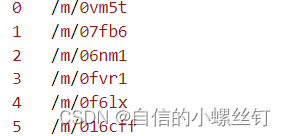
train.txt,valid.txt,test.txt这三个文件就代表训练集,验证集和测试集的已经被映射为编号的(h,r,t)格式的三元组,类似这样:
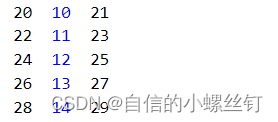
在代码中写入对应的自己的数据集已经处理好的这五个文件的地址,运行下面的文件就可以运行完整的rgcn代码了:
import numpy as np
import torch
import torch.nn as nn
import scipy as sp
import torch.nn.functional as F
import dgl
from dgl.data.knowledge_graph import FB15k237Dataset
from dgl.data.knowledge_graph import FB15kDataset
from dgl.dataloading import GraphDataLoader
from dgl.nn.pytorch import RelGraphConv
import tqdm

# for building training/testing graphs
def get_subset_g(g, mask, num_rels, bidirected=False):
    src, dst = g.edges()
    sub_src = src[mask]
    sub_dst = dst[mask]
    sub_rel = g.edata['etype'][mask]

    if bidirected:
        sub_src, sub_dst = torch.cat([sub_src, sub_dst]), torch.cat([sub_dst, sub_src])
        sub_rel = torch.cat([sub_rel, sub_rel + num_rels])

    sub_g = dgl.graph((sub_src, sub_dst), num_nodes=g.num_nodes())
    sub_g.edata[dgl.ETYPE] = sub_rel
    return sub_g

class GlobalUniform:
    def __init__(self, g, sample_size):
        self.sample_size = sample_size
        self.eids = np.arange(g.num_edges(),dtype='int64')
    def sample(self):
        return torch.from_numpy(np.random.choice(self.eids, self.sample_size))

class NegativeSampler:
    def __init__(self, k=10): # negative sampling rate = 10
        self.k = k

    def sample(self, pos_samples, num_nodes):
        batch_size = len(pos_samples)
        neg_batch_size = batch_size * self.k
        neg_samples = np.tile(pos_samples, (self.k, 1))

        values = np.random.randint(num_nodes, size=neg_batch_size)
        choices = np.random.uniform(size=neg_batch_size)
        subj = choices > 0.5
        obj = choices <= 0.5
        neg_samples[subj, 0] = values[subj]
        neg_samples[obj, 2] = values[obj]
        samples = np.concatenate((pos_samples, neg_samples))

        # binary labels indicating positive and negative samples
        labels = np.zeros(batch_size * (self.k + 1), dtype=np.float32)
        labels[:batch_size] = 1

        return torch.from_numpy(samples), torch.from_numpy(labels)

class SubgraphIterator:
    def __init__(self, g, num_rels, sample_size=30000, num_epochs=6000):
        self.g = g
        self.num_rels = num_rels
        self.sample_size = sample_size
        self.num_epochs = num_epochs
        self.pos_sampler = GlobalUniform(g, sample_size)
        self.neg_sampler = NegativeSampler()

    def __len__(self):
        return self.num_epochs

    def __getitem__(self, i):
        eids = self.pos_sampler.sample()
        src, dst = self.g.find_edges(eids)
        src, dst = src.numpy(), dst.numpy()
        rel = self.g.edata[dgl.ETYPE][eids].numpy()

        # relabel nodes to have consecutive node IDs
        uniq_v, edges = np.unique((src, dst), return_inverse=True)
        num_nodes = len(uniq_v)
        # edges is the concatenation of src, dst with relabeled ID
        src, dst = np.reshape(edges, (2, -1))
        relabeled_data = np.stack((src, rel, dst)).transpose()

        samples, labels = self.neg_sampler.sample(relabeled_data, num_nodes)

        # use only half of the positive edges
        chosen_ids = np.random.choice(np.arange(self.sample_size),
                                      size=int(self.sample_size / 2),
                                      replace=False)
        src = src[chosen_ids]
        dst = dst[chosen_ids]
        rel = rel[chosen_ids]
        src, dst = np.concatenate((src, dst)), np.concatenate((dst, src))
        rel = np.concatenate((rel, rel + self.num_rels))
        sub_g = dgl.graph((src, dst), num_nodes=num_nodes)
        sub_g.edata[dgl.ETYPE] = torch.from_numpy(rel)
        sub_g.edata['norm'] = dgl.norm_by_dst(sub_g).unsqueeze(-1)
        uniq_v = torch.from_numpy(uniq_v).view(-1).long()

        return sub_g, uniq_v, samples, labels

class RGCN(nn.Module):
    def __init__(self, num_nodes, h_dim, num_rels):
        super().__init__()
        # two-layer RGCN
        self.emb = nn.Embedding(num_nodes, h_dim)
        self.conv1 = RelGraphConv(h_dim, h_dim, num_rels, regularizer='bdd',
                                  num_bases=100, self_loop=True)
        self.conv2 = RelGraphConv(h_dim, h_dim, num_rels, regularizer='bdd',
                                  num_bases=100, self_loop=True)
        self.dropout = nn.Dropout(0.2)

    def forward(self, g, nids):
        x = self.emb(nids)
        h = F.relu(self.conv1(g, x, g.edata[dgl.ETYPE], g.edata['norm']))
        h = self.dropout(h)
        h = self.conv2(g, h, g.edata[dgl.ETYPE], g.edata['norm'])
        return self.dropout(h)

class LinkPredict(nn.Module):
    def __init__(self, num_nodes, num_rels, h_dim = 500, reg_param=0.01):
        super().__init__()
        self.rgcn = RGCN(num_nodes, h_dim, num_rels * 2)
        self.reg_param = reg_param
        self.w_relation = nn.Parameter(torch.Tensor(num_rels, h_dim))
        nn.init.xavier_uniform_(self.w_relation,
                                gain=nn.init.calculate_gain('relu'))

    def calc_score(self, embedding, triplets):
        s = embedding[triplets[:,0]]
        r = self.w_relation[triplets[:,1]]
        o = embedding[triplets[:,2]]
        score = torch.sum(s * r * o, dim=1)
        return score

    def forward(self, g, nids):
        return self.rgcn(g, nids)

    def regularization_loss(self, embedding):
        return torch.mean(embedding.pow(2)) + torch.mean(self.w_relation.pow(2))

    def get_loss(self, embed, triplets, labels):
        # each row in the triplets is a 3-tuple of (source, relation, destination)
        score = self.calc_score(embed, triplets)
        predict_loss = F.binary_cross_entropy_with_logits(score, labels)
        reg_loss = self.regularization_loss(embed)
        return predict_loss + self.reg_param * reg_loss

def filter(triplets_to_filter, target_s, target_r, target_o, num_nodes, filter_o=True):
    """Get candidate heads or tails to score"""
    target_s, target_r, target_o = int(target_s), int(target_r), int(target_o)
    # Add the ground truth node first
    if filter_o:
        candidate_nodes = [target_o]
    else:
        candidate_nodes = [target_s]
    for e in range(num_nodes):
        triplet = (target_s, target_r, e) if filter_o else (e, target_r, target_o)
        # Do not consider a node if it leads to a real triplet
        if triplet not in triplets_to_filter:
            candidate_nodes.append(e)
    return torch.LongTensor(candidate_nodes)

def perturb_and_get_filtered_rank(emb, w, s, r, o, test_size, triplets_to_filter, filter_o=True):
    """Perturb subject or object in the triplets"""
    num_nodes = emb.shape[0]
    ranks = []
    for idx in tqdm.tqdm(range(test_size), desc="Evaluate"):
        target_s = s[idx]
        target_r = r[idx]
        target_o = o[idx]
        candidate_nodes = filter(triplets_to_filter, target_s, target_r,
                                 target_o, num_nodes, filter_o=filter_o)
        if filter_o:
            emb_s = emb[target_s]
            emb_o = emb[candidate_nodes]
        else:
            emb_s = emb[candidate_nodes]
            emb_o = emb[target_o]
        target_idx = 0
        emb_r = w[target_r]
        emb_triplet = emb_s * emb_r * emb_o
        scores = torch.sigmoid(torch.sum(emb_triplet, dim=1))

        _, indices = torch.sort(scores, descending=True)
        rank = int((indices == target_idx).nonzero())
        ranks.append(rank)
    return torch.LongTensor(ranks)

def calc_mrr(emb, w,  triplets_to_filter, batch_size=100, filter=True):
    with torch.no_grad():
        test_triplets = triplets_to_filter
        s, r, o = test_triplets[:,0], test_triplets[:,1], test_triplets[:,2]
        test_size = len(s)
        triplets_to_filter = {tuple(triplet) for triplet in triplets_to_filter.tolist()}
        ranks_s = perturb_and_get_filtered_rank(emb, w, s, r, o, test_size,
                                                triplets_to_filter, filter_o=False)
        ranks_o = perturb_and_get_filtered_rank(emb, w, s, r, o,
                                                test_size, triplets_to_filter)
        ranks = torch.cat([ranks_s, ranks_o])
        ranks += 1 # change to 1-indexed
        mrr = torch.mean(1.0 / ranks.float()).item()
        mr = torch.mean(ranks.float()).item()
        print("MRR (filtered): {:.6f}".format(mrr))
        print("MR (filtered): {:.6f}".format(mr))
        hits=[1,3,10]
        for hit in hits:
            avg_count = torch.mean((ranks <= hit).float())
            print("Hits (filtered) @ {}: {:.6f}".format(hit, avg_count.item()))
    return mrr

def train(dataloader, test_g, test_nids, triplets, device, model_state_file, model):
    optimizer = torch.optim.Adam(model.parameters(), lr=1e-2)
    best_mrr = 0
    for epoch, batch_data in enumerate(dataloader): # single graph batch
        model.train()
        g, train_nids, edges, labels = batch_data
        g = g.to(device)
        train_nids = train_nids.to(device)
        edges = edges.to(device)
        labels = labels.to(device)
        embed = model(g, train_nids)
        loss = model.get_loss(embed, edges, labels)
        optimizer.zero_grad()
        loss.backward()
        nn.utils.clip_grad_norm_(model.parameters(), max_norm=1.0) # clip gradients
        optimizer.step()
        print("Epoch {:04d} | Loss {:.4f} | Best MRR {:.4f}".format(epoch, loss.item(), best_mrr))
        if (epoch + 1) % 500 == 0:
            # perform validation on CPU because full graph is too large
            model = model.cpu()
            model.eval()
            embed = model(test_g, test_nids)
            mrr = calc_mrr(embed, model.w_relation,  triplets,
                           batch_size=500)
            # save best model
            if best_mrr < mrr:
                best_mrr = mrr
                torch.save({'state_dict': model.state_dict(), 'epoch': epoch}, model_state_file)
            model = model.to(device)

if __name__ == '__main__':
    device = torch.device('cuda' if torch.cuda.is_available() else 'cpu')
    print(f'Training with DGL built-in RGCN module')

    # load and preprocess dataset
    # data = FB15k237Dataset(reverse=False)
    # data = FB15kDataset(reverse=False)
    entityfile=r'data/entity.txt'
    relationfile=r'data/relation.txt'
    f1 = open(entityfile, 'r')
    f2 = open(relationfile, 'r')
    entity=[]
    relation=[]
    for line in f1:
        l=line.strip().split("\t")
        entity.append(int(l[0]))
    for line in f2:
        l=line.strip().split("\t")
        relation.append(int(l[0]))
    num_nodes=len(entity)
    num_rels=len(relation)
    n_entities=num_nodes
    print("# entities:",num_nodes)
    print("# relations:",num_rels)

    trainfile=r'data/train.txt'
    f3 = open(trainfile, 'r')
    src_train=[]
    rel_train=[]
    dst_train=[]
    for line in f3:
        l=line.strip().split("\t")
        h=int(l[0])
        r=int(l[1])
        t=int(l[2])
        src_train.append(h)
        rel_train.append(r)
        dst_train.append(t)
    print("# training edges: ",len(src_train))
    src_train=torch.LongTensor(src_train)
    rel_train=torch.LongTensor(rel_train)
    dst_train=torch.LongTensor(dst_train)
    train_g = dgl.graph((src_train, dst_train), num_nodes=num_nodes)
    train_g.edata[dgl.ETYPE] = rel_train

    src_test, dst_test = torch.cat([src_train, dst_train]), torch.cat([dst_train,src_train])
    rel_test = torch.cat([rel_train, rel_train + num_rels])
    test_g = dgl.graph((src_test, dst_test), num_nodes=num_nodes)
    test_g.edata[dgl.ETYPE] = rel_test
    test_g.edata['norm'] = dgl.norm_by_dst(test_g).unsqueeze(-1)
    test_nids = torch.arange(0, num_nodes)

    subg_iter = SubgraphIterator(train_g, num_rels) # uniform edge sampling
    dataloader = GraphDataLoader(subg_iter, batch_size=1, collate_fn=lambda x: x[0])

    validfile=r'data/valid.txt'
    f4 = open(validfile, 'r')
    num_valid=0
    for line in f4:
        num_valid+=1
    print("# validation edges: ",num_valid)

    # Prepare data for metric computation
    testfile=r'data/test.txt'
    f5 = open(testfile, 'r')
    src=[]
    rel=[]
    dst=[]
    for line in f5:
        l=line.strip().split("\t")
        h=int(l[0])
        r=int(l[1])
        t=int(l[2])
        src.append(h)
        rel.append(r)
        dst.append(t)
    print("# testing edges: ",len(src))
    src=torch.LongTensor(src)
    rel=torch.LongTensor(rel)
    dst=torch.LongTensor(dst)
    triplets_test = torch.stack([src,rel, dst], dim=1)

    # create RGCN model
    model = LinkPredict(num_nodes, num_rels).to(device)

    # train
    model_state_file = 'model_state.pth'
    train(dataloader, test_g, test_nids, triplets_test, device, model_state_file, model)

    # testing
    print("Testing...")
    checkpoint = torch.load(model_state_file)
    model = model.cpu() # test on CPU
    model.eval()
    model.load_state_dict(checkpoint['state_dict'])
    embed = model(test_g, test_nids)
    best_mrr = calc_mrr(embed, model.w_relation,triplets_test,
                        batch_size=500)
    print("Best MRR {:.4f} achieved using the epoch {:04d}".format(best_mrr, checkpoint['epoch']))
但是,这个代码的效果并不太好,贴在这里只是做个过程记录,同样的数据集,为什么这样简单的构图效果就没有dgl库里自己构图的效果好呢?说实话我也不知道(°ー°〃)我也看了dgl库里处理数据然后构图的代码,确实要精细很多,我就认为是预处理数据的方式不一样导致效果的差别吧。因此下面要说的就是如何在如何在DGL库的链接预测数据集模块定义自己的数据集类,将自己的数据集输入,使用dgl库中处理数据的方法处理我们的数据,再像刚刚调用FB15k237数据集那样调用自己的数据集。
- step 1 :
找到你的dgl.data.knowledge_graph.py文件,(我这里使用的版本是dgl 0.9.0),在这个文件中,定义了FB15k237Dataset,FB15Dataset和WN18Dataset三个常用的知识图谱数据集类,我们添加一个自己的数据集类MyDataset(其实就是copy了一下别的类(°ー°〃))
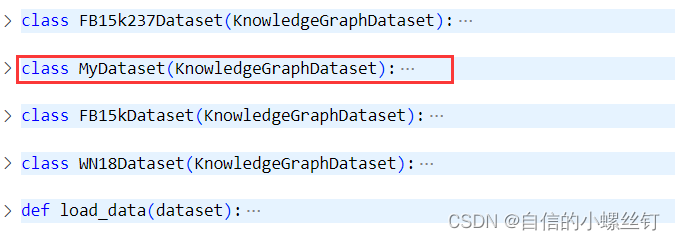
把name改成mydata:
class MyDataset(KnowledgeGraphDataset):

    def __init__(self, reverse=True, raw_dir=None, force_reload=False,
                 verbose=True, transform=None):
        name = 'mydata'
        super(MyDataset, self).__init__(name, reverse, raw_dir,
                                              force_reload, verbose, transform)

    def __getitem__(self, idx):
        r"""Gets the graph object """
        return super(MyDataset, self).__getitem__(idx)

    def __len__(self):
        r"""The number of graphs in the dataset."""
        return super(MyDataset, self).__len__()
- step 2:
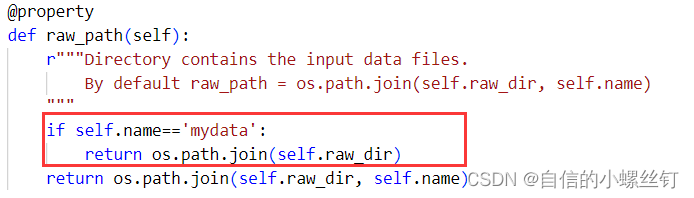
找到你的dgl.data.dgl_dataset.py文件,找到下图对应的代码位置,加入框框内的代码:
(至于为什么要这样呢,,,,自己看代码吧,虽然我也很想做记录,方便自己下次看懂,但是感觉要讲的话将不太清楚,打半天字解释不如自己看看代码咋写的 ┭┮﹏┭┮)
if self.name=='mydata':
     return os.path.join(self.raw_dir)
- step 3:
在rgcn的链接预测代码里调用一下自己的数据就好啦,下面是一个简单的demo,这样就可以调用自己的数据集类了。
from dgl.data.knowledge_graph import MyDataset
dataset = MyDataset(raw_dir=r'你自己装数据集的文件夹位置',reverse=False)

- step 4:
还有十分重要的一点就是,数据集的格式,我是把自己的数据集都设成了和它调用的FB15k237数据集一样的格式,因为step 3中要写入的文件夹地址内要包含的文件有5个:entities.dict,relations.dict,train.txt,valid.txt,test.txt。
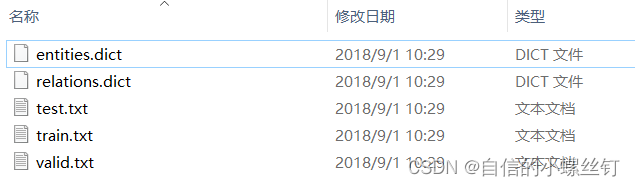
entities.dict和relations.dict分别代表实体编号到实体描述的映射,关系编号到关系描述的映射,类似这样:
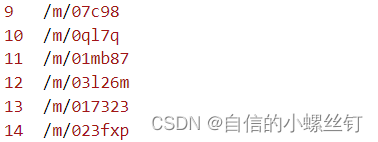
train.txt,valid.txt,test.txt这三个文件代表训练集,验证集和测试集的还没有被映射为编号的(h,r,t)格式的三元组,类似这样:(它们中间的间隔均是'\t')

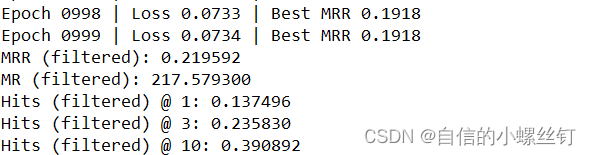
把我改过的最终的rgcn代码贴在下面,做个记录,其中我对calc_mrr函数做了修改的,它原本的代码里只有mrr一个评估指标,我增加了mr,hist@1,hist@3,hist@10这几个指标,在代码里看吧:
import numpy as np
import torch
import torch.nn as nn
import torch.nn.functional as F
import dgl
from dgl.data.knowledge_graph import FB15k237Dataset
from dgl.data.knowledge_graph import FB15kDataset
from dgl.data.knowledge_graph import MyDataset
from dgl.dataloading import GraphDataLoader
from dgl.nn.pytorch import RelGraphConv
import tqdm

# for building training/testing graphs
def get_subset_g(g, mask, num_rels, bidirected=False):
    src, dst = g.edges()
    sub_src = src[mask]
    sub_dst = dst[mask]
    sub_rel = g.edata['etype'][mask]

    if bidirected:
        sub_src, sub_dst = torch.cat([sub_src, sub_dst]), torch.cat([sub_dst, sub_src])
        sub_rel = torch.cat([sub_rel, sub_rel + num_rels])

    sub_g = dgl.graph((sub_src, sub_dst), num_nodes=g.num_nodes())
    sub_g.edata[dgl.ETYPE] = sub_rel
    return sub_g

class GlobalUniform:
    def __init__(self, g, sample_size):
        self.sample_size = sample_size
        self.eids = np.arange(g.num_edges())

    def sample(self):
        return torch.from_numpy(np.random.choice(self.eids, self.sample_size))

class NegativeSampler:
    def __init__(self, k=10): # negative sampling rate = 10
        self.k = k

    def sample(self, pos_samples, num_nodes):
        batch_size = len(pos_samples)
        neg_batch_size = batch_size * self.k
        neg_samples = np.tile(pos_samples, (self.k, 1))

        values = np.random.randint(num_nodes, size=neg_batch_size)
        choices = np.random.uniform(size=neg_batch_size)
        subj = choices > 0.5
        obj = choices <= 0.5
        neg_samples[subj, 0] = values[subj]
        neg_samples[obj, 2] = values[obj]
        samples = np.concatenate((pos_samples, neg_samples))

        # binary labels indicating positive and negative samples
        labels = np.zeros(batch_size * (self.k + 1), dtype=np.float32)
        labels[:batch_size] = 1

        return torch.from_numpy(samples), torch.from_numpy(labels)

class SubgraphIterator:
    def __init__(self, g, num_rels, sample_size=30000, num_epochs=6000):
        self.g = g
        self.num_rels = num_rels
        self.sample_size = sample_size
        self.num_epochs = num_epochs
        self.pos_sampler = GlobalUniform(g, sample_size)
        self.neg_sampler = NegativeSampler()

    def __len__(self):
        return self.num_epochs

    def __getitem__(self, i):
        eids = self.pos_sampler.sample()
        src, dst = self.g.find_edges(eids)
        src, dst = src.numpy(), dst.numpy()
        rel = self.g.edata[dgl.ETYPE][eids].numpy()

        # relabel nodes to have consecutive node IDs
        uniq_v, edges = np.unique((src, dst), return_inverse=True)
        num_nodes = len(uniq_v)
        # edges is the concatenation of src, dst with relabeled ID
        src, dst = np.reshape(edges, (2, -1))
        relabeled_data = np.stack((src, rel, dst)).transpose()

        samples, labels = self.neg_sampler.sample(relabeled_data, num_nodes)

        # use only half of the positive edges
        chosen_ids = np.random.choice(np.arange(self.sample_size),
                                      size=int(self.sample_size / 2),
                                      replace=False)
        src = src[chosen_ids]
        dst = dst[chosen_ids]
        rel = rel[chosen_ids]
        src, dst = np.concatenate((src, dst)), np.concatenate((dst, src))
        rel = np.concatenate((rel, rel + self.num_rels))
        sub_g = dgl.graph((src, dst), num_nodes=num_nodes)
        sub_g.edata[dgl.ETYPE] = torch.from_numpy(rel)
        sub_g.edata['norm'] = dgl.norm_by_dst(sub_g).unsqueeze(-1)
        uniq_v = torch.from_numpy(uniq_v).view(-1).long()

        return sub_g, uniq_v, samples, labels

class RGCN(nn.Module):
    def __init__(self, num_nodes, h_dim, num_rels):
        super().__init__()
        # two-layer RGCN
        self.emb = nn.Embedding(num_nodes, h_dim)
        self.conv1 = RelGraphConv(h_dim, h_dim, num_rels, regularizer='bdd',
                                  num_bases=100, self_loop=True)
        self.conv2 = RelGraphConv(h_dim, h_dim, num_rels, regularizer='bdd',
                                  num_bases=100, self_loop=True)
        self.dropout = nn.Dropout(0.2)

    def forward(self, g, nids):
        x = self.emb(nids)
        h = F.relu(self.conv1(g, x, g.edata[dgl.ETYPE], g.edata['norm']))
        h = self.dropout(h)
        h = self.conv2(g, h, g.edata[dgl.ETYPE], g.edata['norm'])
        return self.dropout(h)

class LinkPredict(nn.Module):
    def __init__(self, num_nodes, num_rels, h_dim = 500, reg_param=0.01):
        super().__init__()
        self.rgcn = RGCN(num_nodes, h_dim, num_rels * 2)
        self.reg_param = reg_param
        self.w_relation = nn.Parameter(torch.Tensor(num_rels, h_dim))
        nn.init.xavier_uniform_(self.w_relation,
                                gain=nn.init.calculate_gain('relu'))

    def calc_score(self, embedding, triplets):
        s = embedding[triplets[:,0]]
        r = self.w_relation[triplets[:,1]]
        o = embedding[triplets[:,2]]
        score = torch.sum(s * r * o, dim=1)
        return score

    def forward(self, g, nids):
        return self.rgcn(g, nids)

    def regularization_loss(self, embedding):
        return torch.mean(embedding.pow(2)) + torch.mean(self.w_relation.pow(2))

    def get_loss(self, embed, triplets, labels):
        # each row in the triplets is a 3-tuple of (source, relation, destination)
        score = self.calc_score(embed, triplets)
        predict_loss = F.binary_cross_entropy_with_logits(score, labels)
        reg_loss = self.regularization_loss(embed)
        return predict_loss + self.reg_param * reg_loss

def filter(triplets_to_filter, target_s, target_r, target_o, num_nodes, filter_o=True):
    """Get candidate heads or tails to score"""
    target_s, target_r, target_o = int(target_s), int(target_r), int(target_o)
    # Add the ground truth node first
    if filter_o:
        candidate_nodes = [target_o]
    else:
        candidate_nodes = [target_s]
    for e in range(num_nodes):
        triplet = (target_s, target_r, e) if filter_o else (e, target_r, target_o)
        # Do not consider a node if it leads to a real triplet
        if triplet not in triplets_to_filter:
            candidate_nodes.append(e)
    return torch.LongTensor(candidate_nodes)

def perturb_and_get_filtered_rank(emb, w, s, r, o, test_size, triplets_to_filter, filter_o=True):
    """Perturb subject or object in the triplets"""
    num_nodes = emb.shape[0]
    ranks = []
    for idx in tqdm.tqdm(range(test_size), desc="Evaluate"):
        target_s = s[idx]
        target_r = r[idx]
        target_o = o[idx]
        candidate_nodes = filter(triplets_to_filter, target_s, target_r,
                                 target_o, num_nodes, filter_o=filter_o)
        if filter_o:
            emb_s = emb[target_s]
            emb_o = emb[candidate_nodes]
        else:
            emb_s = emb[candidate_nodes]
            emb_o = emb[target_o]
        target_idx = 0
        emb_r = w[target_r]
        emb_triplet = emb_s * emb_r * emb_o
        scores = torch.sigmoid(torch.sum(emb_triplet, dim=1))

        _, indices = torch.sort(scores, descending=True)
        rank = int((indices == target_idx).nonzero())
        ranks.append(rank)
    return torch.LongTensor(ranks)

def calc_mrr(emb, w, test_mask, triplets_to_filter, batch_size=100, filter=True):
    with torch.no_grad():
        test_triplets = triplets_to_filter[test_mask]
        s, r, o = test_triplets[:,0], test_triplets[:,1], test_triplets[:,2]
        test_size = len(s)
        triplets_to_filter = {tuple(triplet) for triplet in triplets_to_filter.tolist()}
        ranks_s = perturb_and_get_filtered_rank(emb, w, s, r, o, test_size,
                                                triplets_to_filter, filter_o=False)
        ranks_o = perturb_and_get_filtered_rank(emb, w, s, r, o,
                                                test_size, triplets_to_filter)
        ranks = torch.cat([ranks_s, ranks_o])
        ranks += 1 # change to 1-indexed
        mrr = torch.mean(1.0 / ranks.float()).item()
        mr = torch.mean(ranks.float()).item()
        print("MRR (filtered): {:.6f}".format(mrr))
        print("MR (filtered): {:.6f}".format(mr))
        hits=[1,3,10]
        for hit in hits:
            avg_count = torch.mean((ranks <= hit).float())
            print("Hits (filtered) @ {}: {:.6f}".format(hit, avg_count.item()))
    return mrr

def train(dataloader, test_g, test_nids, test_mask, triplets, device, model_state_file, model):
    optimizer = torch.optim.Adam(model.parameters(), lr=1e-2)
    best_mrr = 0
    for epoch, batch_data in enumerate(dataloader): # single graph batch
        model.train()
        g, train_nids, edges, labels = batch_data
        g = g.to(device)
        train_nids = train_nids.to(device)
        edges = edges.to(device)
        labels = labels.to(device)

        embed = model(g, train_nids)
        loss = model.get_loss(embed, edges, labels)
        optimizer.zero_grad()
        loss.backward()
        nn.utils.clip_grad_norm_(model.parameters(), max_norm=1.0) # clip gradients
        optimizer.step()
        print("Epoch {:04d} | Loss {:.4f} | Best MRR {:.4f}".format(epoch, loss.item(), best_mrr))
        if (epoch + 1) % 500 == 0:
            # perform validation on CPU because full graph is too large
            model = model.cpu()
            model.eval()
            embed = model(test_g, test_nids)
            mrr = calc_mrr(embed, model.w_relation, test_mask, triplets,
                           batch_size=500)
            # save best model
            if best_mrr < mrr:
                best_mrr = mrr
                torch.save({'state_dict': model.state_dict(), 'epoch': epoch}, model_state_file)
            model = model.to(device)

if __name__ == '__main__':
    device = torch.device('cuda' if torch.cuda.is_available() else 'cpu')
    print(f'Training with DGL built-in RGCN module')

    # load and preprocess dataset
    # data = FB15k237Dataset(reverse=False)
    data = MyDataset(raw_dir=r'data/FB15k237',reverse=False)

    g = data[0]
    num_nodes = g.num_nodes()
    num_rels = data.num_rels
    train_g = get_subset_g(g, g.edata['train_mask'], num_rels)
    test_g = get_subset_g(g, g.edata['train_mask'], num_rels, bidirected=True)
    test_g.edata['norm'] = dgl.norm_by_dst(test_g).unsqueeze(-1)
    test_nids = torch.arange(0, num_nodes)
    test_mask = g.edata['test_mask']
    subg_iter = SubgraphIterator(train_g, num_rels) # uniform edge sampling
    dataloader = GraphDataLoader(subg_iter, batch_size=1, collate_fn=lambda x: x[0])

    # Prepare data for metric computation
    src, dst = g.edges()
    triplets = torch.stack([src, g.edata['etype'], dst], dim=1)

    # create RGCN model
    model = LinkPredict(num_nodes, num_rels).to(device)

    # train
    model_state_file = 'model_state.pth'
    train(dataloader, test_g, test_nids, test_mask, triplets, device, model_state_file, model)

    # testing
    print("Testing...")
    checkpoint = torch.load(model_state_file)
    model = model.cpu() # test on CPU
    model.eval()
    model.load_state_dict(checkpoint['state_dict'])
    embed = model(test_g, test_nids)
    best_mrr = calc_mrr(embed, model.w_relation, test_mask, triplets,
                        batch_size=500)
    print("Best MRR {:.4f} achieved using the epoch {:04d}".format(best_mrr, checkpoint['epoch']))
跑代码的输出图如下:
🆗,over!
假设我做了一个模块如下:m=Module.newdoclassCendend三个问题:除了对m的引用之外,还有什么方法可以访问C和m中的其他内容?我可以在创建匿名模块后为其命名吗(就像我输入“module...”一样)?如何在使用完匿名模块后将其删除,使其定义的常量不再存在? 最佳答案 三个答案:是的,使用ObjectSpace.此代码使c引用你的类(class)C不引用m:c=nilObjectSpace.each_object{|obj|c=objif(Class===objandobj.name=~/::C$/)}当然这取决于
出于纯粹的兴趣,我很好奇如何按顺序创建PI,而不是在过程结果之后生成数字,而是让数字在过程本身生成时显示。如果是这种情况,那么数字可以自行产生,我可以对以前看到的数字实现垃圾收集,从而创建一个无限系列。结果只是在Pi系列之后每秒生成一个数字。这是我通过互联网筛选的结果:这是流行的计算机友好算法,类机器算法:defarccot(x,unity)xpow=unity/xn=1sign=1sum=0loopdoterm=xpow/nbreakifterm==0sum+=sign*(xpow/n)xpow/=x*xn+=2sign=-signendsumenddefcalc_pi(digits
作为我的Rails应用程序的一部分,我编写了一个小导入程序,它从我们的LDAP系统中吸取数据并将其塞入一个用户表中。不幸的是,与LDAP相关的代码在遍历我们的32K用户时泄漏了大量内存,我一直无法弄清楚如何解决这个问题。这个问题似乎在某种程度上与LDAP库有关,因为当我删除对LDAP内容的调用时,内存使用情况会很好地稳定下来。此外,不断增加的对象是Net::BER::BerIdentifiedString和Net::BER::BerIdentifiedArray,它们都是LDAP库的一部分。当我运行导入时,内存使用量最终达到超过1GB的峰值。如果问题存在,我需要找到一些方法来更正我的代
如何在buildr项目中使用Ruby?我在很多不同的项目中使用过Ruby、JRuby、Java和Clojure。我目前正在使用我的标准Ruby开发一个模拟应用程序,我想尝试使用Clojure后端(我确实喜欢功能代码)以及JRubygui和测试套件。我还可以看到在未来的不同项目中使用Scala作为后端。我想我要为我的项目尝试一下buildr(http://buildr.apache.org/),但我注意到buildr似乎没有设置为在项目中使用JRuby代码本身!这看起来有点傻,因为该工具旨在统一通用的JVM语言并且是在ruby中构建的。除了将输出的jar包含在一个独特的、仅限ruby
我正在使用的第三方API的文档状态:"[O]urAPIonlyacceptspaddedBase64encodedstrings."什么是“填充的Base64编码字符串”以及如何在Ruby中生成它们。下面的代码是我第一次尝试创建转换为Base64的JSON格式数据。xa=Base64.encode64(a.to_json) 最佳答案 他们说的padding其实就是Base64本身的一部分。它是末尾的“=”和“==”。Base64将3个字节的数据包编码为4个编码字符。所以如果你的输入数据有长度n和n%3=1=>"=="末尾用于填充n%
我主要使用Ruby来执行此操作,但到目前为止我的攻击计划如下:使用gemsrdf、rdf-rdfa和rdf-microdata或mida来解析给定任何URI的数据。我认为最好映射到像schema.org这样的统一模式,例如使用这个yaml文件,它试图描述数据词汇表和opengraph到schema.org之间的转换:#SchemaXtoschema.orgconversion#data-vocabularyDV:name:namestreet-address:streetAddressregion:addressRegionlocality:addressLocalityphoto:i
exe应该在我打开页面时运行。异步进程需要运行。有什么方法可以在ruby中使用两个参数异步运行exe吗?我已经尝试过ruby命令-system()、exec()但它正在等待过程完成。我需要用参数启动exe,无需等待进程完成是否有任何rubygems会支持我的问题? 最佳答案 您可以使用Process.spawn和Process.wait2:pid=Process.spawn'your.exe','--option'#Later...pid,status=Process.wait2pid您的程序将作为解释器的子进程执行。除
我有一个包含模块的模型。我想在模块中覆盖模型的访问器方法。例如:classBlah这显然行不通。有什么想法可以实现吗? 最佳答案 您的代码看起来是正确的。我们正在毫无困难地使用这个确切的模式。如果我没记错的话,Rails使用#method_missing作为属性setter,因此您的模块将优先,阻止ActiveRecord的setter。如果您正在使用ActiveSupport::Concern(参见thisblogpost),那么您的实例方法需要进入一个特殊的模块:classBlah
鉴于我有以下迁移:Sequel.migrationdoupdoalter_table:usersdoadd_column:is_admin,:default=>falseend#SequelrunsaDESCRIBEtablestatement,whenthemodelisloaded.#Atthispoint,itdoesnotknowthatusershaveais_adminflag.#Soitfails.@user=User.find(:email=>"admin@fancy-startup.example")@user.is_admin=true@user.save!ende
我正在为一个项目制作一个简单的shell,我希望像在Bash中一样解析参数字符串。foobar"helloworld"fooz应该变成:["foo","bar","helloworld","fooz"]等等。到目前为止,我一直在使用CSV::parse_line,将列分隔符设置为""和.compact输出。问题是我现在必须选择是要支持单引号还是双引号。CSV不支持超过一个分隔符。Python有一个名为shlex的模块:>>>shlex.split("Test'helloworld'foo")['Test','helloworld','foo']>>>shlex.split('Test"
