核心 Android 系统提供了多种调节音量的方法,这些方法主要包括如下这些。
CarAudioService 最终在 CarAudioDeviceInfo 中 (packages/services/Car/service/src/com/android/car/audio/CarAudioDeviceInfo.java) 通过 AudioManager 直接为设备设置音量: // Input is in millibels
void setCurrentGain(int gainInMillibels) {
// Clamp the incoming value to our valid range. Out of range values ARE legal input
if (gainInMillibels < mMinGain) {
gainInMillibels = mMinGain;
} else if (gainInMillibels > mMaxGain) {
gainInMillibels = mMaxGain;
}
// Push the new gain value down to our underlying port which will cause it to show up
// at the HAL.
AudioGain audioGain = getAudioGain();
if (audioGain == null) {
Slog.e(CarLog.TAG_AUDIO, "getAudioGain() returned null.");
return;
}
// size of gain values is 1 in MODE_JOINT
AudioGainConfig audioGainConfig = audioGain.buildConfig(
AudioGain.MODE_JOINT,
audioGain.channelMask(),
new int[] { gainInMillibels },
0);
if (audioGainConfig == null) {
Slog.e(CarLog.TAG_AUDIO, "Failed to construct AudioGainConfig");
return;
}
int r = AudioManager.setAudioPortGain(getAudioDevicePort(), audioGainConfig);
if (r == AudioManager.SUCCESS) {
// Since we can't query for the gain on a device port later,
// we have to remember what we asked for
mCurrentGain = gainInMillibels;
} else {
Slog.e(CarLog.TAG_AUDIO, "Failed to setAudioPortGain: " + r);
}
}
这里看到的 AudioManager 的 setAudioPortGain(getAudioDevicePort(), audioGainConfig) 方法可以用于调节特定设备的音量,在 AudioManager 中,这个方法的实现 (frameworks/base/media/java/android/media/AudioManager.java) 为:
    /**
     * Set the gain on the specified AudioPort. The AudioGainConfig config is build by
     * AudioGain.buildConfig()
     * @hide
     */
    public static int setAudioPortGain(AudioPort port, AudioGainConfig gain) {
        if (port == null || gain == null) {
            return ERROR_BAD_VALUE;
        }
        AudioPortConfig activeConfig = port.activeConfig();
        AudioPortConfig config = new AudioPortConfig(port, activeConfig.samplingRate(),
                                        activeConfig.channelMask(), activeConfig.format(), gain);
        config.mConfigMask = AudioPortConfig.GAIN;
        return AudioSystem.setAudioPortConfig(config);
    }
AudioManager 的 setAudioPortGain(getAudioDevicePort(), audioGainConfig) 方法通过 AudioSystem 的静态方法 setAudioPortConfig(config) 来给设备设置音量,AudioSystem.setAudioPortConfig(config) 是一个在 frameworks/base/media/java/android/media/AudioSystem.java 中声明,并最终在 frameworks/base/core/jni/android_media_AudioSystem.cpp 中定义的 JNI 本地层方法:
static jint
android_media_AudioSystem_setAudioPortConfig(JNIEnv *env, jobject clazz,
                                 jobject jAudioPortConfig)
{
    ALOGV("setAudioPortConfig");
    if (jAudioPortConfig == NULL) {
        return AUDIO_JAVA_BAD_VALUE;
    }
    if (!env->IsInstanceOf(jAudioPortConfig, gAudioPortConfigClass)) {
        return AUDIO_JAVA_BAD_VALUE;
    }
    struct audio_port_config nAudioPortConfig = {};
    jint jStatus = convertAudioPortConfigToNative(env, &nAudioPortConfig, jAudioPortConfig, true);
    if (jStatus != AUDIO_JAVA_SUCCESS) {
        return jStatus;
    }
    status_t status = AudioSystem::setAudioPortConfig(&nAudioPortConfig);
    ALOGV("AudioSystem::setAudioPortConfig() returned %d", status);
    jStatus = nativeToJavaStatus(status);
    return jStatus;
}
AudioManager 调节某个 STREAM_TYPE 的音量,如: private boolean setStreamVolume(int volume) {
Logging.d(TAG, "setStreamVolume(" + volume + ")");
assertTrue(audioManager != null);
if (isVolumeFixed()) {
Logging.e(TAG, "The device implements a fixed volume policy.");
return false;
}
audioManager.setStreamVolume(AudioManager.STREAM_VOICE_CALL, volume, 0);
return true;
}
这里看到的 setStreamVolume() 方法在 AudioManager 中的实现如下:
    /**
     * Sets the volume index for a particular stream.
     * <p>This method has no effect if the device implements a fixed volume policy
     * as indicated by {@link #isVolumeFixed()}.
     * <p>From N onward, volume adjustments that would toggle Do Not Disturb are not allowed unless
     * the app has been granted Do Not Disturb Access.
     * See {@link NotificationManager#isNotificationPolicyAccessGranted()}.
     * @param streamType The stream whose volume index should be set.
     * @param index The volume index to set. See
     *            {@link #getStreamMaxVolume(int)} for the largest valid value.
     * @param flags One or more flags.
     * @see #getStreamMaxVolume(int)
     * @see #getStreamVolume(int)
     * @see #isVolumeFixed()
     * @throws SecurityException if the volume change triggers a Do Not Disturb change
     *   and the caller is not granted notification policy access.
     */
    public void setStreamVolume(int streamType, int index, int flags) {
        final IAudioService service = getService();
        try {
            service.setStreamVolume(streamType, index, flags, getContext().getOpPackageName());
        } catch (RemoteException e) {
            throw e.rethrowFromSystemServer();
        }
    }
AudioManager 中单步地调大或者调小特定流类型的 adjustStreamVolume(): /**
* Adjusts the volume of a particular stream by one step in a direction.
* <p>
* This method should only be used by applications that replace the platform-wide
* management of audio settings or the main telephony application.
* <p>This method has no effect if the device implements a fixed volume policy
* as indicated by {@link #isVolumeFixed()}.
* <p>From N onward, ringer mode adjustments that would toggle Do Not Disturb are not allowed
* unless the app has been granted Do Not Disturb Access.
* See {@link NotificationManager#isNotificationPolicyAccessGranted()}.
*
* @param streamType The stream type to adjust. One of {@link #STREAM_VOICE_CALL},
* {@link #STREAM_SYSTEM}, {@link #STREAM_RING}, {@link #STREAM_MUSIC},
* {@link #STREAM_ALARM} or {@link #STREAM_ACCESSIBILITY}.
* @param direction The direction to adjust the volume. One of
* {@link #ADJUST_LOWER}, {@link #ADJUST_RAISE}, or
* {@link #ADJUST_SAME}.
* @param flags One or more flags.
* @see #adjustVolume(int, int)
* @see #setStreamVolume(int, int, int)
* @throws SecurityException if the adjustment triggers a Do Not Disturb change
* and the caller is not granted notification policy access.
*/
public void adjustStreamVolume(int streamType, int direction, int flags) {
final IAudioService service = getService();
try {
service.adjustStreamVolume(streamType, direction, flags,
getContext().getOpPackageName());
} catch (RemoteException e) {
throw e.rethrowFromSystemServer();
}
}
AudioManager 中调节最相关的流的音量的 adjustVolume() 和 adjustSuggestedStreamVolume(): /**
* Adjusts the volume of the most relevant stream. For example, if a call is
* active, it will have the highest priority regardless of if the in-call
* screen is showing. Another example, if music is playing in the background
* and a call is not active, the music stream will be adjusted.
* <p>
* This method should only be used by applications that replace the
* platform-wide management of audio settings or the main telephony
* application.
* <p>
* This method has no effect if the device implements a fixed volume policy
* as indicated by {@link #isVolumeFixed()}.
*
* @param direction The direction to adjust the volume. One of
* {@link #ADJUST_LOWER}, {@link #ADJUST_RAISE},
* {@link #ADJUST_SAME}, {@link #ADJUST_MUTE},
* {@link #ADJUST_UNMUTE}, or {@link #ADJUST_TOGGLE_MUTE}.
* @param flags One or more flags.
* @see #adjustSuggestedStreamVolume(int, int, int)
* @see #adjustStreamVolume(int, int, int)
* @see #setStreamVolume(int, int, int)
* @see #isVolumeFixed()
*/
public void adjustVolume(int direction, int flags) {
MediaSessionLegacyHelper helper = MediaSessionLegacyHelper.getHelper(getContext());
helper.sendAdjustVolumeBy(USE_DEFAULT_STREAM_TYPE, direction, flags);
}
/**
* Adjusts the volume of the most relevant stream, or the given fallback
* stream.
* <p>
* This method should only be used by applications that replace the
* platform-wide management of audio settings or the main telephony
* application.
* <p>
* This method has no effect if the device implements a fixed volume policy
* as indicated by {@link #isVolumeFixed()}.
*
* @param direction The direction to adjust the volume. One of
* {@link #ADJUST_LOWER}, {@link #ADJUST_RAISE},
* {@link #ADJUST_SAME}, {@link #ADJUST_MUTE},
* {@link #ADJUST_UNMUTE}, or {@link #ADJUST_TOGGLE_MUTE}.
* @param suggestedStreamType The stream type that will be used if there
* isn't a relevant stream. {@link #USE_DEFAULT_STREAM_TYPE} is
* valid here.
* @param flags One or more flags.
* @see #adjustVolume(int, int)
* @see #adjustStreamVolume(int, int, int)
* @see #setStreamVolume(int, int, int)
* @see #isVolumeFixed()
*/
public void adjustSuggestedStreamVolume(int direction, int suggestedStreamType, int flags) {
MediaSessionLegacyHelper helper = MediaSessionLegacyHelper.getHelper(getContext());
helper.sendAdjustVolumeBy(suggestedStreamType, direction, flags);
}
这两个方法最终通过 media session 服务调节音量 (frameworks/base/media/java/android/media/session/MediaSessionLegacyHelper.java) :
    private MediaSessionLegacyHelper(Context context) {
        mContext = context;
        mSessionManager = (MediaSessionManager) context
                .getSystemService(Context.MEDIA_SESSION_SERVICE);
    }

    public void sendAdjustVolumeBy(int suggestedStream, int delta, int flags) {
        mSessionManager.dispatchAdjustVolume(suggestedStream, delta, flags);
        if (DEBUG) {
            Log.d(TAG, "dispatched volume adjustment");
        }
    }
AudioManager 中为特定 AudioAttributes 设置音量的 setVolumeIndexForAttributes()。 /**
* Sets the volume index for a particular {@link AudioAttributes}.
* @param attr The {@link AudioAttributes} whose volume index should be set.
* @param index The volume index to set. See
* {@link #getMaxVolumeIndexForAttributes(AudioAttributes)} for the largest valid value
* {@link #getMinVolumeIndexForAttributes(AudioAttributes)} for the lowest valid value.
* @param flags One or more flags.
* @see #getMaxVolumeIndexForAttributes(AudioAttributes)
* @see #getMinVolumeIndexForAttributes(AudioAttributes)
* @see #isVolumeFixed()
* @hide
*/
@SystemApi
@RequiresPermission(android.Manifest.permission.MODIFY_AUDIO_ROUTING)
public void setVolumeIndexForAttributes(@NonNull AudioAttributes attr, int index, int flags) {
Preconditions.checkNotNull(attr, "attr must not be null");
final IAudioService service = getService();
try {
service.setVolumeIndexForAttributes(attr, index, flags,
getContext().getOpPackageName());
} catch (RemoteException e) {
throw e.rethrowFromSystemServer();
}
}
AudioManager 中调节最相关流的音量,且会基于所提供的组件名、uid 和 pid 值检查调用者是否有必要权限的 adjustSuggestedStreamVolumeForUid()。 /**
* Adjusts the volume of the most relevant stream, or the given fallback
* stream.
* <p>
* This method should only be used by applications that replace the
* platform-wide management of audio settings or the main telephony
* application.
* <p>
* This method has no effect if the device implements a fixed volume policy
* as indicated by {@link #isVolumeFixed()}.
* <p>This API checks if the caller has the necessary permissions based on the provided
* component name, uid, and pid values.
* See {@link #adjustSuggestedStreamVolume(int, int, int)}.
*
* @param suggestedStreamType The stream type that will be used if there
* isn't a relevant stream. {@link #USE_DEFAULT_STREAM_TYPE} is
* valid here.
* @param direction The direction to adjust the volume. One of
* {@link #ADJUST_LOWER}, {@link #ADJUST_RAISE},
* {@link #ADJUST_SAME}, {@link #ADJUST_MUTE},
* {@link #ADJUST_UNMUTE}, or {@link #ADJUST_TOGGLE_MUTE}.
* @param flags One or more flags.
* @param packageName the package name of client application
* @param uid the uid of client application
* @param pid the pid of client application
* @param targetSdkVersion the target sdk version of client application
* @see #adjustVolume(int, int)
* @see #adjustStreamVolume(int, int, int)
* @see #setStreamVolume(int, int, int)
* @see #isVolumeFixed()
*
* @hide
*/
@SystemApi(client = SystemApi.Client.MODULE_LIBRARIES)
public void adjustSuggestedStreamVolumeForUid(int suggestedStreamType, int direction, int flags,
@NonNull String packageName, int uid, int pid, int targetSdkVersion) {
try {
getService().adjustSuggestedStreamVolumeForUid(suggestedStreamType, direction, flags,
packageName, uid, pid, UserHandle.getUserHandleForUid(uid), targetSdkVersion);
} catch (RemoteException e) {
throw e.rethrowFromSystemServer();
}
}
AudioManager 中单步地调大或者调小特定流类型的音量,且会基于所提供的组件名、uid 和 pid 值检查调用者是否有必要权限的 adjustStreamVolumeForUid(): /**
* Adjusts the volume of a particular stream by one step in a direction.
* <p>
* This method should only be used by applications that replace the platform-wide
* management of audio settings or the main telephony application.
* <p>This method has no effect if the device implements a fixed volume policy
* as indicated by {@link #isVolumeFixed()}.
* <p>From N onward, ringer mode adjustments that would toggle Do Not Disturb are not allowed
* unless the app has been granted Do Not Disturb Access.
* See {@link NotificationManager#isNotificationPolicyAccessGranted()}.
* <p>This API checks if the caller has the necessary permissions based on the provided
* component name, uid, and pid values.
* See {@link #adjustStreamVolume(int, int, int)}.
*
* @param streamType The stream type to adjust. One of {@link #STREAM_VOICE_CALL},
* {@link #STREAM_SYSTEM}, {@link #STREAM_RING}, {@link #STREAM_MUSIC},
* {@link #STREAM_ALARM} or {@link #STREAM_ACCESSIBILITY}.
* @param direction The direction to adjust the volume. One of
* {@link #ADJUST_LOWER}, {@link #ADJUST_RAISE}, or
* {@link #ADJUST_SAME}.
* @param flags One or more flags.
* @param packageName the package name of client application
* @param uid the uid of client application
* @param pid the pid of client application
* @param targetSdkVersion the target sdk version of client application
* @see #adjustVolume(int, int)
* @see #setStreamVolume(int, int, int)
* @throws SecurityException if the adjustment triggers a Do Not Disturb change
* and the caller is not granted notification policy access.
*
* @hide
*/
@SystemApi(client = SystemApi.Client.MODULE_LIBRARIES)
public void adjustStreamVolumeForUid(int streamType, int direction, int flags,
@NonNull String packageName, int uid, int pid, int targetSdkVersion) {
try {
getService().adjustStreamVolumeForUid(streamType, direction, flags, packageName, uid,
pid, UserHandle.getUserHandleForUid(uid), targetSdkVersion);
} catch (RemoteException e) {
throw e.rethrowFromSystemServer();
}
}
AudioManager 中调节某个 STREAM_TYPE 的音量,且会基于所提供的组件名、uid 和 pid 值检查调用者是否有必要权限的 setStreamVolumeForUid(): /**
* Sets the volume index for a particular stream.
* <p>This method has no effect if the device implements a fixed volume policy
* as indicated by {@link #isVolumeFixed()}.
* <p>From N onward, volume adjustments that would toggle Do Not Disturb are not allowed unless
* the app has been granted Do Not Disturb Access.
* See {@link NotificationManager#isNotificationPolicyAccessGranted()}.
* <p>This API checks if the caller has the necessary permissions based on the provided
* component name, uid, and pid values.
* See {@link #setStreamVolume(int, int, int)}.
*
* @param streamType The stream whose volume index should be set.
* @param index The volume index to set. See
* {@link #getStreamMaxVolume(int)} for the largest valid value.
* @param flags One or more flags.
* @param packageName the package name of client application
* @param uid the uid of client application
* @param pid the pid of client application
* @param targetSdkVersion the target sdk version of client application
* @see #getStreamMaxVolume(int)
* @see #getStreamVolume(int)
* @see #isVolumeFixed()
* @throws SecurityException if the volume change triggers a Do Not Disturb change
* and the caller is not granted notification policy access.
*
* @hide
*/
@SystemApi(client = SystemApi.Client.MODULE_LIBRARIES)
public void setStreamVolumeForUid(int streamType, int index, int flags,
@NonNull String packageName, int uid, int pid, int targetSdkVersion) {
try {
getService().setStreamVolumeForUid(streamType, index, flags, packageName, uid, pid,
UserHandle.getUserHandleForUid(uid), targetSdkVersion);
} catch (RemoteException e) {
throw e.rethrowFromSystemServer();
}
}
总结一下,上面这些方法,从功能上来看主要包括这样一些:
STREAM_TYPE 的音量;AudioAttributes 设置音量;STREAM_TYPE 的音量,且会基于所提供的组件名、uid 和 pid 值检查调用者是否有必要权限。AudioManager 主要是运行于 system_server 中的 audio 服务的客户端代理,但其中封装的一些操作也会直接通过 media session 服务或者 audio policy 服务等完成。上面除了第 1 和 第 4 项功能外,其它功能基本上都通过调用 audio 服务的同名方法完成。
接下来,逐个看下上面调用的 AudioService 的方法的实现。
AudioService 中 (frameworks/base/services/core/java/com/android/server/audio/AudioService.java),与 AudioManager 中的方法对应的 setStreamVolume() 方法实现如下: /** @see AudioManager#setStreamVolume(int, int, int)
* Part of service interface, check permissions here */
public void setStreamVolume(int streamType, int index, int flags, String callingPackage) {
if ((streamType == AudioManager.STREAM_ACCESSIBILITY) && !canChangeAccessibilityVolume()) {
Log.w(TAG, "Trying to call setStreamVolume() for a11y without"
+ " CHANGE_ACCESSIBILITY_VOLUME callingPackage=" + callingPackage);
return;
}
if ((streamType == AudioManager.STREAM_VOICE_CALL) && (index == 0)
&& (mContext.checkCallingOrSelfPermission(
android.Manifest.permission.MODIFY_PHONE_STATE)
!= PackageManager.PERMISSION_GRANTED)) {
Log.w(TAG, "Trying to call setStreamVolume() for STREAM_VOICE_CALL and index 0 without"
+ " MODIFY_PHONE_STATE callingPackage=" + callingPackage);
return;
}
if ((streamType == AudioManager.STREAM_ASSISTANT)
&& (mContext.checkCallingOrSelfPermission(
android.Manifest.permission.MODIFY_AUDIO_ROUTING)
!= PackageManager.PERMISSION_GRANTED)) {
Log.w(TAG, "Trying to call setStreamVolume() for STREAM_ASSISTANT without"
+ " MODIFY_AUDIO_ROUTING callingPackage=" + callingPackage);
return;
}
sVolumeLogger.log(new VolumeEvent(VolumeEvent.VOL_SET_STREAM_VOL, streamType,
index/*val1*/, flags/*val2*/, callingPackage));
setStreamVolume(streamType, index, flags, callingPackage, callingPackage,
Binder.getCallingUid(), callingOrSelfHasAudioSettingsPermission());
}
这个操作执行的过程大体为:
(1). 确保调用方具有足够的修改 stream type 的音量的权限;
(2). 为 stream type 设置音量。
这个操作最终回到了为 stream type 设置音量。
    /** @see AudioManager#adjustStreamVolume(int, int, int)
     * Part of service interface, check permissions here */
    public void adjustStreamVolume(int streamType, int direction, int flags,
            String callingPackage) {
        if ((streamType == AudioManager.STREAM_ACCESSIBILITY) && !canChangeAccessibilityVolume()) {
            Log.w(TAG, "Trying to call adjustStreamVolume() for a11y without"
                    + "CHANGE_ACCESSIBILITY_VOLUME / callingPackage=" + callingPackage);
            return;
        }

        sVolumeLogger.log(new VolumeEvent(VolumeEvent.VOL_ADJUST_STREAM_VOL, streamType,
                direction/*val1*/, flags/*val2*/, callingPackage));
        adjustStreamVolume(streamType, direction, flags, callingPackage, callingPackage,
                Binder.getCallingUid(), Binder.getCallingPid(),
                callingHasAudioSettingsPermission(), VOL_ADJUST_NORMAL);
    }
这个操作执行的过程大体为:
(1). 确保调用方具有足够的修改 stream type 的音量的权限;
(2). 调整 stream type 的音量。
这个操作最终回到了调整 stream type 的音量。
调节最相关的流的音量的 adjustVolume() 和 adjustSuggestedStreamVolume() 将经 media session 服务绕一道,最终回到调整 stream type 的音量或设置 stream type 的音量。
为特定 AudioAttributes 设置音量
    /** @see AudioManager#setVolumeIndexForAttributes(attr, int, int) */
    public void setVolumeIndexForAttributes(@NonNull AudioAttributes attr, int index, int flags,
                                            String callingPackage) {
        enforceModifyAudioRoutingPermission();
        Objects.requireNonNull(attr, "attr must not be null");
        final int volumeGroup = getVolumeGroupIdForAttributes(attr);
        if (sVolumeGroupStates.indexOfKey(volumeGroup) < 0) {
            Log.e(TAG, ": no volume group found for attributes " + attr.toString());
            return;
        }
        final VolumeGroupState vgs = sVolumeGroupStates.get(volumeGroup);

        sVolumeLogger.log(new VolumeEvent(VolumeEvent.VOL_SET_GROUP_VOL, attr, vgs.name(),
                index/*val1*/, flags/*val2*/, callingPackage));

        vgs.setVolumeIndex(index, flags);

        // For legacy reason, propagate to all streams associated to this volume group
        for (final int groupedStream : vgs.getLegacyStreamTypes()) {
            try {
                ensureValidStreamType(groupedStream);
            } catch (IllegalArgumentException e) {
                Log.d(TAG, "volume group " + volumeGroup + " has internal streams (" + groupedStream
                        + "), do not change associated stream volume");
                continue;
            }
            setStreamVolume(groupedStream, index, flags, callingPackage, callingPackage,
                            Binder.getCallingUid(), true /*hasModifyAudioSettings*/);
        }
    }
这个过程大体为:
(1). 确保调用方具有足够的修改 audio routing 的权限;
(2). 根据传入的 AudioAttributes 获得音量组;
(3). 为音量组本身设置音量;
(4). 为音量组中的每个 stream type 设置音量。
这个操作最终回到了为 stream type 设置音量。
    private void adjustSuggestedStreamVolume(int direction, int suggestedStreamType, int flags,
            String callingPackage, String caller, int uid, int pid, boolean hasModifyAudioSettings,
            int keyEventMode) {
        if (DEBUG_VOL) Log.d(TAG, "adjustSuggestedStreamVolume() stream=" + suggestedStreamType
                + ", flags=" + flags + ", caller=" + caller
                + ", volControlStream=" + mVolumeControlStream
                + ", userSelect=" + mUserSelectedVolumeControlStream);
        if (direction != AudioManager.ADJUST_SAME) {
            sVolumeLogger.log(new VolumeEvent(VolumeEvent.VOL_ADJUST_SUGG_VOL, suggestedStreamType,
                    direction/*val1*/, flags/*val2*/, new StringBuilder(callingPackage)
                    .append("/").append(caller).append(" uid:").append(uid).toString()));
        }

        boolean hasExternalVolumeController = notifyExternalVolumeController(direction);

        new MediaMetrics.Item(mMetricsId + "adjustSuggestedStreamVolume")
                .setUid(Binder.getCallingUid())
                .set(MediaMetrics.Property.CALLING_PACKAGE, callingPackage)
                .set(MediaMetrics.Property.CLIENT_NAME, caller)
                .set(MediaMetrics.Property.DIRECTION, direction > 0
                        ? MediaMetrics.Value.UP : MediaMetrics.Value.DOWN)
                .set(MediaMetrics.Property.EXTERNAL, hasExternalVolumeController
                        ? MediaMetrics.Value.YES : MediaMetrics.Value.NO)
                .set(MediaMetrics.Property.FLAGS, flags)
                .record();

        if (hasExternalVolumeController) {
            return;
        }

        final int streamType;
        synchronized (mForceControlStreamLock) {
            // Request lock in case mVolumeControlStream is changed by other thread.
            if (mUserSelectedVolumeControlStream) { // implies mVolumeControlStream != -1
                streamType = mVolumeControlStream;
            } else {
                final int maybeActiveStreamType = getActiveStreamType(suggestedStreamType);
                final boolean activeForReal;
                if (maybeActiveStreamType == AudioSystem.STREAM_RING
                        || maybeActiveStreamType == AudioSystem.STREAM_NOTIFICATION) {
                    activeForReal = wasStreamActiveRecently(maybeActiveStreamType, 0);
                } else {
                    activeForReal = mAudioSystem.isStreamActive(maybeActiveStreamType, 0);
                }
                if (activeForReal || mVolumeControlStream == -1) {
                    streamType = maybeActiveStreamType;
                } else {
                    streamType = mVolumeControlStream;
                }
            }
        }

        final boolean isMute = isMuteAdjust(direction);

        ensureValidStreamType(streamType);
        final int resolvedStream = mStreamVolumeAlias[streamType];

        // Play sounds on STREAM_RING only.
        if ((flags & AudioManager.FLAG_PLAY_SOUND) != 0 &&
                resolvedStream != AudioSystem.STREAM_RING) {
            flags &= ~AudioManager.FLAG_PLAY_SOUND;
        }

        // For notifications/ring, show the ui before making any adjustments
        // Don't suppress mute/unmute requests
        // Don't suppress adjustments for single volume device
        if (mVolumeController.suppressAdjustment(resolvedStream, flags, isMute)
                && !mIsSingleVolume) {
            direction = 0;
            flags &= ~AudioManager.FLAG_PLAY_SOUND;
            flags &= ~AudioManager.FLAG_VIBRATE;
            if (DEBUG_VOL) Log.d(TAG, "Volume controller suppressed adjustment");
        }

        adjustStreamVolume(streamType, direction, flags, callingPackage, caller, uid, pid,
                hasModifyAudioSettings, keyEventMode);
    }
 . . . . . .
    /** @see AudioManager#adjustSuggestedStreamVolumeForUid(int, int, int, String, int, int, int) */
    @Override
    public void adjustSuggestedStreamVolumeForUid(int streamType, int direction, int flags,
            @NonNull String packageName, int uid, int pid, UserHandle userHandle,
            int targetSdkVersion) {
        if (Binder.getCallingUid() != Process.SYSTEM_UID) {
            throw new SecurityException("Should only be called from system process");
        }

        // direction and stream type swap here because the public
        // adjustSuggested has a different order than the other methods.
        adjustSuggestedStreamVolume(direction, streamType, flags, packageName, packageName,
                uid, pid, hasAudioSettingsPermission(uid, pid), VOL_ADJUST_NORMAL);
    }
这个操作执行的过程大体为:
(1). 确保调用方的 UID 为 Process.SYSTEM_UID;
(2). 找到合适的 stream type;
(3). 调整 stream type 的音量。
这个操作最终回到了调整 stream type 的音量。
    /** @see AudioManager#adjustStreamVolumeForUid(int, int, int, String, int, int, int) */
    @Override
    public void adjustStreamVolumeForUid(int streamType, int direction, int flags,
            @NonNull String packageName, int uid, int pid, UserHandle userHandle,
            int targetSdkVersion) {
        if (Binder.getCallingUid() != Process.SYSTEM_UID) {
            throw new SecurityException("Should only be called from system process");
        }

        if (direction != AudioManager.ADJUST_SAME) {
            sVolumeLogger.log(new VolumeEvent(VolumeEvent.VOL_ADJUST_VOL_UID, streamType,
                    direction/*val1*/, flags/*val2*/,
                    new StringBuilder(packageName).append(" uid:").append(uid)
                    .toString()));
        }

        adjustStreamVolume(streamType, direction, flags, packageName, packageName, uid, pid,
                hasAudioSettingsPermission(uid, pid), VOL_ADJUST_NORMAL);
    }
这个操作执行的过程大体为:
(1). 确保调用方的 UID 为 Process.SYSTEM_UID;
(2). 调整 stream type 的音量。
这个操作最终回到了调整 stream type 的音量。
STREAM_TYPE 的音量,且会基于所提供的组件名、uid 和 pid 值检查调用者是否有必要权限 /** @see AudioManager#setStreamVolumeForUid(int, int, int, String, int, int, int) */
@Override
public void setStreamVolumeForUid(int streamType, int index, int flags,
@NonNull String packageName, int uid, int pid, UserHandle userHandle,
int targetSdkVersion) {
if (Binder.getCallingUid() != Process.SYSTEM_UID) {
throw new SecurityException("Should only be called from system process");
}
setStreamVolume(streamType, index, flags, packageName, packageName, uid,
hasAudioSettingsPermission(uid, pid));
}
这个操作执行的过程大体为:
(1). 确保调用方的 UID 为 Process.SYSTEM_UID;
(2). 为 stream type 设置音量,传入的 uid 和 pid 用于检查权限。
这个操作最终回到了为 stream type 设置音量。
总体来看,AudioManager 除了直接调节设备音量的接口之外的其它接口,最终都会回到为 stream type 设置音量或调整 stream type 的音量。这里看一下为 stream type 设置音量的过程。
由上面这些调节音量的方法可以看到,Android Automotive 调节音量的动作有意在 Car 服务中直接对设备调节了音量,而没有继续经过核心 Android 系统的 audio 服务。
这里不再继续深入跟踪调整 stream type 的音量的过程,但可以看一下为 stream type 设置音量的过程。
为 stream type 设置音量的 setStreamVolume() 方法定义如下:
    private void setStreamVolume(int streamType, int index, int flags, String callingPackage,
            String caller, int uid, boolean hasModifyAudioSettings) {
        if (DEBUG_VOL) {
            Log.d(TAG, "setStreamVolume(stream=" + streamType+", index=" + index
                    + ", calling=" + callingPackage + ")");
        }
        if (mUseFixedVolume) {
            return;
        }

        ensureValidStreamType(streamType);
        int streamTypeAlias = mStreamVolumeAlias[streamType];
        VolumeStreamState streamState = mStreamStates[streamTypeAlias];

        final int device = getDeviceForStream(streamType);
        int oldIndex;

        // skip a2dp absolute volume control request when the device
        // is not an a2dp device
        if (!AudioSystem.DEVICE_OUT_ALL_A2DP_SET.contains(device)
                && (flags & AudioManager.FLAG_BLUETOOTH_ABS_VOLUME) != 0) {
            return;
        }
        // If we are being called by the system (e.g. hardware keys) check for current user
        // so we handle user restrictions correctly.
        if (uid == android.os.Process.SYSTEM_UID) {
            uid = UserHandle.getUid(getCurrentUserId(), UserHandle.getAppId(uid));
        }
        if (!checkNoteAppOp(STREAM_VOLUME_OPS[streamTypeAlias], uid, callingPackage)) {
            return;
        }

        if (isAndroidNPlus(callingPackage)
                && wouldToggleZenMode(getNewRingerMode(streamTypeAlias, index, flags))
                && !mNm.isNotificationPolicyAccessGrantedForPackage(callingPackage)) {
            throw new SecurityException("Not allowed to change Do Not Disturb state");
        }

        if (!volumeAdjustmentAllowedByDnd(streamTypeAlias, flags)) {
            return;
        }

        synchronized (mSafeMediaVolumeStateLock) {
            // reset any pending volume command
            mPendingVolumeCommand = null;

            oldIndex = streamState.getIndex(device);

            index = rescaleIndex(index * 10, streamType, streamTypeAlias);

            if (streamTypeAlias == AudioSystem.STREAM_MUSIC
                    && AudioSystem.DEVICE_OUT_ALL_A2DP_SET.contains(device)
                    && (flags & AudioManager.FLAG_BLUETOOTH_ABS_VOLUME) == 0) {
                if (DEBUG_VOL) {
                    Log.d(TAG, "setStreamVolume postSetAvrcpAbsoluteVolumeIndex index=" + index
                            + "stream=" + streamType);
                }
                mDeviceBroker.postSetAvrcpAbsoluteVolumeIndex(index / 10);
            }

            if (device == AudioSystem.DEVICE_OUT_HEARING_AID
                    && streamType == getHearingAidStreamType()) {
                Log.i(TAG, "setStreamVolume postSetHearingAidVolumeIndex index=" + index
                        + " stream=" + streamType);
                mDeviceBroker.postSetHearingAidVolumeIndex(index, streamType);
            }


            if (streamTypeAlias == AudioSystem.STREAM_MUSIC) {
                setSystemAudioVolume(oldIndex, index, getStreamMaxVolume(streamType), flags);
            }

            flags &= ~AudioManager.FLAG_FIXED_VOLUME;
            if (streamTypeAlias == AudioSystem.STREAM_MUSIC && isFixedVolumeDevice(device)) {
                flags |= AudioManager.FLAG_FIXED_VOLUME;

                // volume is either 0 or max allowed for fixed volume devices
                if (index != 0) {
                    if (mSafeMediaVolumeState == SAFE_MEDIA_VOLUME_ACTIVE &&
                            mSafeMediaVolumeDevices.contains(device)) {
                        index = safeMediaVolumeIndex(device);
                    } else {
                        index = streamState.getMaxIndex();
                    }
                }
            }

            if (!checkSafeMediaVolume(streamTypeAlias, index, device)) {
                mVolumeController.postDisplaySafeVolumeWarning(flags);
                mPendingVolumeCommand = new StreamVolumeCommand(
                                                    streamType, index, flags, device);
            } else {
                onSetStreamVolume(streamType, index, flags, device, caller, hasModifyAudioSettings);
                index = mStreamStates[streamType].getIndex(device);
            }
        }
        synchronized (mHdmiClientLock) {
            if (streamTypeAlias == AudioSystem.STREAM_MUSIC
                    && (oldIndex != index)) {
                maybeSendSystemAudioStatusCommand(false);
            }
        }
        sendVolumeUpdate(streamType, oldIndex, index, flags, device);
    }
这个方法首先检查了是否配置使用固定音频策略 mUseFixedVolume,这个值来自于配置文件:frameworks/base/core/res/res/values/config.xml:
        mUseFixedVolume = mContext.getResources().getBoolean(
                com.android.internal.R.bool.config_useFixedVolume);
这个值可以被专门为设备定义的值覆盖掉。如对于车载版的模拟器,device/generic/car/emulator/audio/overlay/frameworks/base/core/res/res/values/config.xml 文件中定义的值覆盖了 framework 中定义的值。
这个是音频策略执行的主要的地方。
之后根据 stream type 通过 AudioSystem 获得 device 号 (frameworks/base/services/core/java/com/android/server/audio/AudioSystemAdapter.java) :
    public int getDevicesForStream(int stream) {
        if (!ENABLE_GETDEVICES_STATS) {
            return getDevicesForStreamImpl(stream);
        }
        mMethodCallCounter[METHOD_GETDEVICESFORSTREAM]++;
        final long startTime = SystemClock.uptimeNanos();
        final int res = getDevicesForStreamImpl(stream);
        mMethodTimeNs[METHOD_GETDEVICESFORSTREAM] += SystemClock.uptimeNanos() - startTime;
        return res;
    }

    private int getDevicesForStreamImpl(int stream) {
        if (USE_CACHE_FOR_GETDEVICES) {
            Integer res;
            synchronized (mDevicesForStreamCache) {
                res = mDevicesForStreamCache.get(stream);
                if (res == null) {
                    res = AudioSystem.getDevicesForStream(stream);
                    mDevicesForStreamCache.put(stream, res);
                    if (DEBUG_CACHE) {
                        Log.d(TAG, mMethodNames[METHOD_GETDEVICESFORSTREAM]
                                + streamDeviceToDebugString(stream, res));
                    }
                    return res;
                }
                // cache hit
                mMethodCacheHit[METHOD_GETDEVICESFORSTREAM]++;
                if (DEBUG_CACHE) {
                    final int real = AudioSystem.getDevicesForStream(stream);
                    if (res == real) {
                        Log.d(TAG, mMethodNames[METHOD_GETDEVICESFORSTREAM]
                                + streamDeviceToDebugString(stream, res) + " CACHE");
                    } else {
                        Log.e(TAG, mMethodNames[METHOD_GETDEVICESFORSTREAM]
                                + streamDeviceToDebugString(stream, res)
                                + " CACHE ERROR real dev=0x" + Integer.toHexString(real));
                    }
                }
            }
            return res;
        }
        // not using cache
        return AudioSystem.getDevicesForStream(stream);
    }
这个调用堆栈如下:
getDevicesForStreamImpl:164, AudioSystemAdapter (com.android.server.audio)
getDevicesForStream:151, AudioSystemAdapter (com.android.server.audio)
observeDevicesForStream_syncVSS:6838, AudioService$VolumeStreamState (com.android.server.audio)
getDevicesForStreamInt:6111, AudioService (com.android.server.audio)
getDeviceForStream:6063, AudioService (com.android.server.audio)
setStreamVolume:3576, AudioService (com.android.server.audio)
setStreamVolume:3327, AudioService (com.android.server.audio)
onTransact:1529, IAudioService$Stub (android.media)
execTransactInternal:1179, Binder (android.os)
execTransact:1143, Binder (android.os)
通过 AudioSystem 获得的 device 号可能包含多个设备,每个具体的设备在这里的设备号中用一个二进制位表示,此时需要从这些设备中按优先级对具体的设备进行选择,这个过程 (frameworks/base/services/core/java/com/android/server/audio/AudioService.java) 如下:
    /** only public for mocking/spying, do not call outside of AudioService */
    @VisibleForTesting
    public int getDeviceForStream(int stream) {
        int device = getDevicesForStreamInt(stream);
        if ((device & (device - 1)) != 0) {
            // Multiple device selection is either:
            //  - speaker + one other device: give priority to speaker in this case.
            //  - one A2DP device + another device: happens with duplicated output. In this case
            // retain the device on the A2DP output as the other must not correspond to an active
            // selection if not the speaker.
            //  - HDMI-CEC system audio mode only output: give priority to available item in order.
            // FIXME: Haven't applied audio device type refactor to this API
            //  as it is going to be deprecated.
            if ((device & AudioSystem.DEVICE_OUT_SPEAKER) != 0) {
                device = AudioSystem.DEVICE_OUT_SPEAKER;
            } else if ((device & AudioSystem.DEVICE_OUT_HDMI_ARC) != 0) {
                // FIXME(b/184944421): DEVICE_OUT_HDMI_EARC has two bits set,
                // so it must be handled correctly as it aliases
                // with DEVICE_OUT_HDMI_ARC | DEVICE_OUT_EARPIECE.
                device = AudioSystem.DEVICE_OUT_HDMI_ARC;
            } else if ((device & AudioSystem.DEVICE_OUT_SPDIF) != 0) {
                device = AudioSystem.DEVICE_OUT_SPDIF;
            } else if ((device & AudioSystem.DEVICE_OUT_AUX_LINE) != 0) {
                device = AudioSystem.DEVICE_OUT_AUX_LINE;
            } else {
                for (int deviceType : AudioSystem.DEVICE_OUT_ALL_A2DP_SET) {
                    if ((deviceType & device) == deviceType) {
                        return deviceType;
                    }
                }
            }
        }
        return device;
    }
之后对传入的音量值进行归一化 (frameworks/base/services/core/java/com/android/server/audio/AudioService.java):
    private int rescaleIndex(int index, int srcStream, int dstStream) {
        int srcRange = getIndexRange(srcStream);
        int dstRange = getIndexRange(dstStream);
        if (srcRange == 0) {
            Log.e(TAG, "rescaleIndex : index range should not be zero");
            return mStreamStates[dstStream].getMinIndex();
        }

        return mStreamStates[dstStream].getMinIndex()
                + ((index - mStreamStates[srcStream].getMinIndex()) * dstRange + srcRange / 2)
                / srcRange;
    }
之后处理 stream type 为 AudioSystem.STREAM_MUSIC,使用了蓝牙,且设置绝对音量时的情况,即发送消息来设置音量值。
之后处理设备为 AudioSystem.DEVICE_OUT_HEARING_AID,且 stream type 为辅助听力时的情况,即发送消息给蓝牙设置音量。
之后,当 stream type 为 AudioSystem.STREAM_MUSIC,还会设置系统音频音量,主要是根据需要设置 HDMI 音量。
之后,如果 stream type 为 AudioSystem.STREAM_MUSIC,且设备为固定音量设备,则修正传入的音量值。
之后,检查修正后的音量值是否为安全音量,如果不是,则发送 stream 音量命令;如果是,则通过 onSetStreamVolume() 设置流音量。
onSetStreamVolume() 的实现如下:
    private void onSetStreamVolume(int streamType, int index, int flags, int device,
            String caller, boolean hasModifyAudioSettings) {
        final int stream = mStreamVolumeAlias[streamType];
        setStreamVolumeInt(stream, index, device, false, caller, hasModifyAudioSettings);
        // setting volume on ui sounds stream type also controls silent mode
        if (((flags & AudioManager.FLAG_ALLOW_RINGER_MODES) != 0) ||
                (stream == getUiSoundsStreamType())) {
            setRingerMode(getNewRingerMode(stream, index, flags),
                    TAG + ".onSetStreamVolume", false /*external*/);
        }
        // setting non-zero volume for a muted stream unmutes the stream and vice versa,
        // except for BT SCO stream where only explicit mute is allowed to comply to BT requirements
        if (streamType != AudioSystem.STREAM_BLUETOOTH_SCO) {
            mStreamStates[stream].mute(index == 0);
        }
    }
 . . . . . .
    /**
     * Sets the stream state's index, and posts a message to set system volume.
     * This will not call out to the UI. Assumes a valid stream type.
     *
     * @param streamType Type of the stream
     * @param index Desired volume index of the stream
     * @param device the device whose volume must be changed
     * @param force If true, set the volume even if the desired volume is same
     * @param caller
     * @param hasModifyAudioSettings true if the caller is granted MODIFY_AUDIO_SETTINGS or
     *                              MODIFY_AUDIO_ROUTING permission
     * as the current volume.
     */
    private void setStreamVolumeInt(int streamType,
                                    int index,
                                    int device,
                                    boolean force,
                                    String caller, boolean hasModifyAudioSettings) {
        if (isFullVolumeDevice(device)) {
            return;
        }
        VolumeStreamState streamState = mStreamStates[streamType];

        if (streamState.setIndex(index, device, caller, hasModifyAudioSettings) || force) {
            // Post message to set system volume (it in turn will post a message
            // to persist).
            sendMsg(mAudioHandler,
                    MSG_SET_DEVICE_VOLUME,
                    SENDMSG_QUEUE,
                    device,
                    0,
                    streamState,
                    0);
        }
    }
这里首先会更新维护的关于 stream 的音量的信息,当音量真的发生改变时,还会发出 broadcast;然后发送消息去设置设备的音量。设置设备音量的方法如下:
    /*package*/ void setDeviceVolume(VolumeStreamState streamState, int device) {

        synchronized (VolumeStreamState.class) {
            // Apply volume
            streamState.applyDeviceVolume_syncVSS(device);

            // Apply change to all streams using this one as alias
            int numStreamTypes = AudioSystem.getNumStreamTypes();
            for (int streamType = numStreamTypes - 1; streamType >= 0; streamType--) {
                if (streamType != streamState.mStreamType &&
                        mStreamVolumeAlias[streamType] == streamState.mStreamType) {
                    // Make sure volume is also maxed out on A2DP device for aliased stream
                    // that may have a different device selected
                    int streamDevice = getDeviceForStream(streamType);
                    if ((device != streamDevice) && mAvrcpAbsVolSupported
                            && AudioSystem.DEVICE_OUT_ALL_A2DP_SET.contains(device)) {
                        mStreamStates[streamType].applyDeviceVolume_syncVSS(device);
                    }
                    mStreamStates[streamType].applyDeviceVolume_syncVSS(streamDevice);
                }
            }
        }
        // Post a persist volume msg
        sendMsg(mAudioHandler,
                MSG_PERSIST_VOLUME,
                SENDMSG_QUEUE,
                device,
                0,
                streamState,
                PERSIST_DELAY);

    }
设置设备的音量时,先设置传入的设备的音量,然后设置别名设备的音量,之后发送消息将音量设置持久化。设置设备音量,最终还是要通过 AudioSystem 执行:
        private void setStreamVolumeIndex(int index, int device) {
            // Only set audio policy BT SCO stream volume to 0 when the stream is actually muted.
            // This allows RX path muting by the audio HAL only when explicitly muted but not when
            // index is just set to 0 to repect BT requirements
            if (mStreamType == AudioSystem.STREAM_BLUETOOTH_SCO && index == 0
                    && !isFullyMuted()) {
                index = 1;
            }
            AudioSystem.setStreamVolumeIndexAS(mStreamType, index, device);
        }

        // must be called while synchronized VolumeStreamState.class
        /*package*/ void applyDeviceVolume_syncVSS(int device) {
            int index;
            if (isFullyMuted()) {
                index = 0;
            } else if (AudioSystem.DEVICE_OUT_ALL_A2DP_SET.contains(device)
                    && mAvrcpAbsVolSupported) {
                index = getAbsoluteVolumeIndex((getIndex(device) + 5)/10);
            } else if (isFullVolumeDevice(device)) {
                index = (mIndexMax + 5)/10;
            } else if (device == AudioSystem.DEVICE_OUT_HEARING_AID) {
                index = (mIndexMax + 5)/10;
            } else {
                index = (getIndex(device) + 5)/10;
            }
            setStreamVolumeIndex(index, device);
        }
AudioSystem 的 AudioSystem.setStreamVolumeIndexAS(mStreamType, index, device) 方法定义如下:
    /** @hide Wrapper for native methods called from AudioService */
    public static int setStreamVolumeIndexAS(int stream, int index, int device) {
        if (DEBUG_VOLUME) {
            Log.i(TAG, "setStreamVolumeIndex: " + STREAM_NAMES[stream]
                    + " dev=" + Integer.toHexString(device) + " idx=" + index);
        }
        return setStreamVolumeIndex(stream, index, device);
    }
 . . . . . .
    @UnsupportedAppUsage
    private static native int setStreamVolumeIndex(int stream, int index, int device);
最终,通过在 frameworks/base/core/jni/android_media_AudioSystem.cpp 中定义的静态 JNI 本地层方法来完成:
static jint
android_media_AudioSystem_setStreamVolumeIndex(JNIEnv *env,
                                               jobject thiz,
                                               jint stream,
                                               jint index,
                                               jint device)
{
    return (jint) check_AudioSystem_Command(
            AudioSystem::setStreamVolumeIndex(static_cast <audio_stream_type_t>(stream),
                                              index,
                                              (audio_devices_t)device));
}
再回到 setStreamVolume(),之后,如果 stream type 为 AudioSystem.STREAM_MUSIC,且音量发生了改变,则向 HDMI service 发送报告。
最后,向 volume controller 发送音量更新报告。
我们看到了 AudioSystem 的 setAudioPortConfig(config) 和 AudioSystem.setStreamVolumeIndex(stream, index, device) 这两种给设备设置音量的方法,在这两个方法中,它们都通过 frameworks/av/media/libaudioclient/AudioSystem.cpp 定义的函数完成操作。在这个过程中,也可以看到 stream type 是本地层维护的概念。
接着上面的过程,继续来看 AudioSystem::setStreamVolumeIndex() 的实现。本地层的 AudioSystem 在 libaudioclient 中实现。AudioSystem::setStreamVolumeIndex() 函数的定义 (frameworks/av/media/libaudioclient/AudioSystem.cpp) 如下:
// establish binder interface to AudioPolicy service
const sp<IAudioPolicyService> AudioSystem::get_audio_policy_service() {
    sp<IAudioPolicyService> ap;
    sp<AudioPolicyServiceClient> apc;
    {
        Mutex::Autolock _l(gLockAPS);
        if (gAudioPolicyService == 0) {
            sp<IServiceManager> sm = defaultServiceManager();
            sp<IBinder> binder;
            do {
                binder = sm->getService(String16("media.audio_policy"));
                if (binder != 0)
                    break;
                ALOGW("AudioPolicyService not published, waiting...");
                usleep(500000); // 0.5 s
            } while (true);
            if (gAudioPolicyServiceClient == NULL) {
                gAudioPolicyServiceClient = new AudioPolicyServiceClient();
            }
            binder->linkToDeath(gAudioPolicyServiceClient);
            gAudioPolicyService = interface_cast<IAudioPolicyService>(binder);
            LOG_ALWAYS_FATAL_IF(gAudioPolicyService == 0);
            apc = gAudioPolicyServiceClient;
            // Make sure callbacks can be received by gAudioPolicyServiceClient
            ProcessState::self()->startThreadPool();
        }
        ap = gAudioPolicyService;
    }
    if (apc != 0) {
        int64_t token = IPCThreadState::self()->clearCallingIdentity();
        ap->registerClient(apc);
        ap->setAudioPortCallbacksEnabled(apc->isAudioPortCbEnabled());
        ap->setAudioVolumeGroupCallbacksEnabled(apc->isAudioVolumeGroupCbEnabled());
        IPCThreadState::self()->restoreCallingIdentity(token);
    }

    return ap;
}
 . . . . . .
status_t AudioSystem::setStreamVolumeIndex(audio_stream_type_t stream,
                                           int index,
                                           audio_devices_t device) {
    const sp<IAudioPolicyService>& aps = AudioSystem::get_audio_policy_service();
    if (aps == 0) return PERMISSION_DENIED;

    media::AudioStreamType streamAidl = VALUE_OR_RETURN_STATUS(
            legacy2aidl_audio_stream_type_t_AudioStreamType(stream));
    int32_t indexAidl = VALUE_OR_RETURN_STATUS(convertIntegral<int32_t>(index));
    int32_t deviceAidl = VALUE_OR_RETURN_STATUS(legacy2aidl_audio_devices_t_int32_t(device));
    return statusTFromBinderStatus(
            aps->setStreamVolumeIndex(streamAidl, deviceAidl, indexAidl));
}
AudioSystem 通过 binder 机制,访问 audio policy service 来设置 stream 的音量。
Audio policy service 是一个运行于 audioserver 中 (frameworks/av/media/audioserver) 的系统服务,其实现由多个组件及动态链接库组成,整体的结构如下:
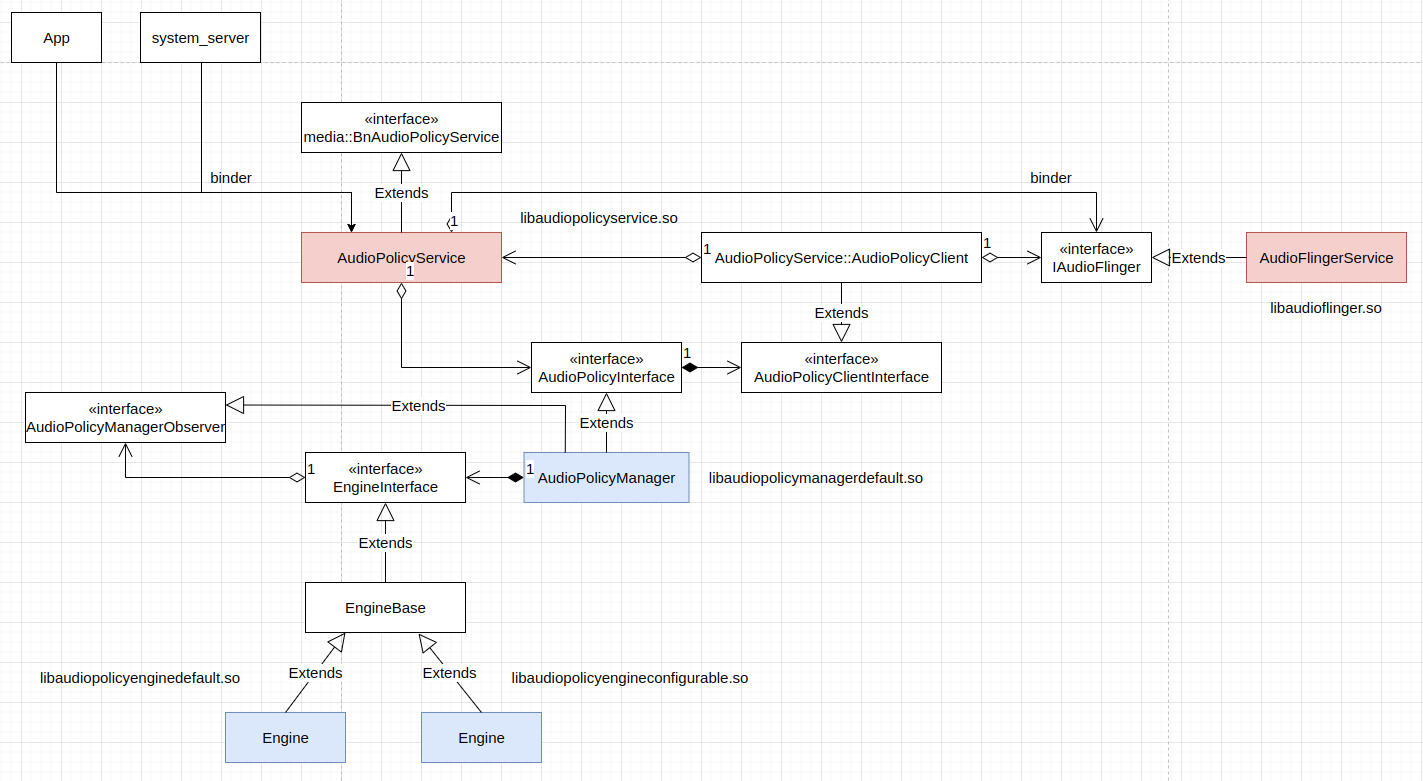
AudioPolicyService 类是 audio policy service 的 IPC 接口层,是服务端的代理,它直接接收客户端发过来的请求,同时也封装其它一些组件,协助完成一些具体操作。AudioPolicyService 类成员函数的具体实现主要分布在两个文件中,一是 frameworks/av/services/audiopolicy/service/AudioPolicyInterfaceImpl.cpp,如其文件名所指示的那样,主要是接口函数的实现;二是 frameworks/av/services/audiopolicy/service/AudioPolicyService.cpp,包含其它成员函数的实现。
AudioPolicyService 类封装的 AudioPolicyInterface,也就是 AudioPolicyManager 协助其完成主要的音频策略逻辑。AudioPolicyManager 的具体定制版实现可以被动态加载加载起来,具体定制版实现的动态链接库文件名需要是 libaudiopolicymanagercustom.so,android 系统提供了默认的实现,在定制版实现不存在,会采用这个默认实现。相关逻辑实现如下:
static AudioPolicyInterface* createAudioPolicyManager(AudioPolicyClientInterface *clientInterface)
{
    AudioPolicyManager *apm = new AudioPolicyManager(clientInterface);
    status_t status = apm->initialize();
    if (status != NO_ERROR) {
        delete apm;
        apm = nullptr;
    }
    return apm;
}

static void destroyAudioPolicyManager(AudioPolicyInterface *interface)
{
    delete interface;
}
// ----------------------------------------------------------------------------

AudioPolicyService::AudioPolicyService()
    : BnAudioPolicyService(),
      mAudioPolicyManager(NULL),
      mAudioPolicyClient(NULL),
      mPhoneState(AUDIO_MODE_INVALID),
      mCaptureStateNotifier(false),
      mCreateAudioPolicyManager(createAudioPolicyManager),
      mDestroyAudioPolicyManager(destroyAudioPolicyManager) {
}

void AudioPolicyService::loadAudioPolicyManager()
{
    mLibraryHandle = dlopen(kAudioPolicyManagerCustomPath, RTLD_NOW);
    if (mLibraryHandle != nullptr) {
        ALOGI("%s loading %s", __func__, kAudioPolicyManagerCustomPath);
        mCreateAudioPolicyManager = reinterpret_cast<CreateAudioPolicyManagerInstance>
                                            (dlsym(mLibraryHandle, "createAudioPolicyManager"));
        const char *lastError = dlerror();
        ALOGW_IF(mCreateAudioPolicyManager == nullptr, "%s createAudioPolicyManager is null %s",
                    __func__, lastError != nullptr ? lastError : "no error");

        mDestroyAudioPolicyManager = reinterpret_cast<DestroyAudioPolicyManagerInstance>(
                                        dlsym(mLibraryHandle, "destroyAudioPolicyManager"));
        lastError = dlerror();
        ALOGW_IF(mDestroyAudioPolicyManager == nullptr, "%s destroyAudioPolicyManager is null %s",
                    __func__, lastError != nullptr ? lastError : "no error");
        if (mCreateAudioPolicyManager == nullptr || mDestroyAudioPolicyManager == nullptr){
            unloadAudioPolicyManager();
            LOG_ALWAYS_FATAL("could not find audiopolicymanager interface methods");
        }
    }
}

void AudioPolicyService::onFirstRef()
{
    {
        Mutex::Autolock _l(mLock);

        // start audio commands thread
        mAudioCommandThread = new AudioCommandThread(String8("ApmAudio"), this);
        // start output activity command thread
        mOutputCommandThread = new AudioCommandThread(String8("ApmOutput"), this);

        mAudioPolicyClient = new AudioPolicyClient(this);

        loadAudioPolicyManager();
        mAudioPolicyManager = mCreateAudioPolicyManager(mAudioPolicyClient);
    }

    // load audio processing modules
    sp<AudioPolicyEffects> audioPolicyEffects = new AudioPolicyEffects();
    sp<UidPolicy> uidPolicy = new UidPolicy(this);
    sp<SensorPrivacyPolicy> sensorPrivacyPolicy = new SensorPrivacyPolicy(this);
    {
        Mutex::Autolock _l(mLock);
        mAudioPolicyEffects = audioPolicyEffects;
        mUidPolicy = uidPolicy;
        mSensorPrivacyPolicy = sensorPrivacyPolicy;
    }
    uidPolicy->registerSelf();
    sensorPrivacyPolicy->registerSelf();

    // Create spatializer if supported
    if (mAudioPolicyManager != nullptr) {
        Mutex::Autolock _l(mLock);
        const audio_attributes_t attr = attributes_initializer(AUDIO_USAGE_MEDIA);
        AudioDeviceTypeAddrVector devices;
        bool hasSpatializer = mAudioPolicyManager->canBeSpatialized(&attr, nullptr, devices);
        if (hasSpatializer) {
            mSpatializer = Spatializer::create(this);
        }
    }
    AudioSystem::audioPolicyReady();
}

void AudioPolicyService::unloadAudioPolicyManager()
{
    ALOGV("%s ", __func__);
    if (mLibraryHandle != nullptr) {
        dlclose(mLibraryHandle);
    }
    mLibraryHandle = nullptr;
    mCreateAudioPolicyManager = nullptr;
    mDestroyAudioPolicyManager = nullptr;
}
AudioPolicyManager 会从 audio_policy_configuration.xml 等文件中加载配置信息,它借助于 EngineInterface 维护 stream type 和设备之间的关系之类的信息,同样 EngineInterface 也是动态加载获得的:
status_t AudioPolicyManager::initialize() {
    {
        std::string path = "libaudiopolicyengine" + getConfig().getEngineLibraryNameSuffix() + ".so";
        ALOGD("%s: libaudiopolicyengine file path %s", __FUNCTION__, path.c_str());
        auto engLib = EngineLibrary::load(path);
        if (!engLib) {
            ALOGE("%s: Failed to load the engine library", __FUNCTION__);
            return NO_INIT;
        }
        mEngine = engLib->createEngine();
        if (mEngine == nullptr) {
            ALOGE("%s: Failed to instantiate the APM engine", __FUNCTION__);
            return NO_INIT;
        }
    }
    mEngine->setObserver(this);
    status_t status = mEngine->initCheck();
    if (status != NO_ERROR) {
        LOG_FATAL("Policy engine not initialized(err=%d)", status);
        return status;
    }

    mCommunnicationStrategy = mEngine->getProductStrategyForAttributes(
        mEngine->getAttributesForStreamType(AUDIO_STREAM_VOICE_CALL));

    // after parsing the config, mOutputDevicesAll and mInputDevicesAll contain all known devices;
    // open all output streams needed to access attached devices
    onNewAudioModulesAvailableInt(nullptr /*newDevices*/);

    // make sure default device is reachable
    if (mDefaultOutputDevice == 0 || !mAvailableOutputDevices.contains(mDefaultOutputDevice)) {
        ALOGE_IF(mDefaultOutputDevice != 0, "Default device %s is unreachable",
                 mDefaultOutputDevice->toString().c_str());
        status = NO_INIT;
    }
    // If microphones address is empty, set it according to device type
    for (size_t i = 0; i < mAvailableInputDevices.size(); i++) {
        if (mAvailableInputDevices[i]->address().empty()) {
            if (mAvailableInputDevices[i]->type() == AUDIO_DEVICE_IN_BUILTIN_MIC) {
                mAvailableInputDevices[i]->setAddress(AUDIO_BOTTOM_MICROPHONE_ADDRESS);
            } else if (mAvailableInputDevices[i]->type() == AUDIO_DEVICE_IN_BACK_MIC) {
                mAvailableInputDevices[i]->setAddress(AUDIO_BACK_MICROPHONE_ADDRESS);
            }
        }
    }

    ALOGW_IF(mPrimaryOutput == nullptr, "The policy configuration does not declare a primary output");

    // Silence ALOGV statements
    property_set("log.tag." LOG_TAG, "D");

    updateDevicesAndOutputs();
    return status;
}
android 提供了两个 EngineInterface 的实现,分别是位于 frameworks/av/services/audiopolicy/enginedefault 的 libaudiopolicyenginedefault.so 和位于 frameworks/av/services/audiopolicy/engineconfigurable 的 libaudiopolicyengineconfigurable.so,具体使用哪个由 audio_policy_configuration.xml 等配置文件中的 engine_library 配置项决定,默认使用 libaudiopolicyenginedefault.so。
libaudiopolicyenginedefault.so 等从配置文件 /vendor/etc/audio_policy_engine_configuration.xml 加载 audio policy engine 配置信息,其中主要包括产品策略,音量组等信息及其内容类型、usage 等信息。EngineInterface 的具体实现所需的设备信息从 AudioPolicyManager 获取。
我们回到设置音量的操作上来。在 audio policy service 中,这个操作请求首先来到 AudioPolicyService::setStreamVolumeIndex():
Status AudioPolicyService::setStreamVolumeIndex(media::AudioStreamType streamAidl,
                                                int32_t deviceAidl, int32_t indexAidl) {
    audio_stream_type_t stream = VALUE_OR_RETURN_BINDER_STATUS(
            aidl2legacy_AudioStreamType_audio_stream_type_t(streamAidl));
    int index = VALUE_OR_RETURN_BINDER_STATUS(convertIntegral<int>(indexAidl));
    audio_devices_t device = VALUE_OR_RETURN_BINDER_STATUS(
            aidl2legacy_int32_t_audio_devices_t(deviceAidl));

    if (mAudioPolicyManager == NULL) {
        return binderStatusFromStatusT(NO_INIT);
    }
    if (!settingsAllowed()) {
        return binderStatusFromStatusT(PERMISSION_DENIED);
    }
    if (uint32_t(stream) >= AUDIO_STREAM_PUBLIC_CNT) {
        return binderStatusFromStatusT(BAD_VALUE);
    }
    Mutex::Autolock _l(mLock);
    AutoCallerClear acc;
    return binderStatusFromStatusT(mAudioPolicyManager->setStreamVolumeIndex(stream,
                                                                             index,
                                                                             device));
}
在这里,首先转换传入的参数,随后操作被传给 AudioPolicyManager::setStreamVolumeIndex():
status_t AudioPolicyManager::setStreamVolumeIndex(audio_stream_type_t stream,
                                                  int index,
                                                  audio_devices_t device)
{
    auto attributes = mEngine->getAttributesForStreamType(stream);
    if (attributes == AUDIO_ATTRIBUTES_INITIALIZER) {
        ALOGW("%s: no group for stream %s, bailing out", __func__, toString(stream).c_str());
        return NO_ERROR;
    }
    ALOGD("%s: stream %s attributes=%s", __func__,
          toString(stream).c_str(), toString(attributes).c_str());
    return setVolumeIndexForAttributes(attributes, index, device);
}

status_t AudioPolicyManager::getStreamVolumeIndex(audio_stream_type_t stream,
                                                  int *index,
                                                  audio_devices_t device)
{
    // if device is AUDIO_DEVICE_OUT_DEFAULT_FOR_VOLUME, return volume for device selected for this
    // stream by the engine.
    DeviceTypeSet deviceTypes = {device};
    if (device == AUDIO_DEVICE_OUT_DEFAULT_FOR_VOLUME) {
        deviceTypes = mEngine->getOutputDevicesForStream(
                stream, true /*fromCache*/).types();
    }
    return getVolumeIndex(getVolumeCurves(stream), *index, deviceTypes);
}

status_t AudioPolicyManager::setVolumeIndexForAttributes(const audio_attributes_t &attributes,
                                                         int index,
                                                         audio_devices_t device)
{
    // Get Volume group matching the Audio Attributes
    auto group = mEngine->getVolumeGroupForAttributes(attributes);
    if (group == VOLUME_GROUP_NONE) {
        ALOGD("%s: no group matching with %s", __FUNCTION__, toString(attributes).c_str());
        return BAD_VALUE;
    }
    ALOGD("%s: group %d matching with %s", __FUNCTION__, group, toString(attributes).c_str());
    status_t status = NO_ERROR;
    IVolumeCurves &curves = getVolumeCurves(attributes);
    VolumeSource vs = toVolumeSource(group);
    product_strategy_t strategy = mEngine->getProductStrategyForAttributes(attributes);

    status = setVolumeCurveIndex(index, device, curves);
    if (status != NO_ERROR) {
        ALOGE("%s failed to set curve index for group %d device 0x%X", __func__, group, device);
        return status;
    }

    DeviceTypeSet curSrcDevices;
    auto curCurvAttrs = curves.getAttributes();
    if (!curCurvAttrs.empty() && curCurvAttrs.front() != defaultAttr) {
        auto attr = curCurvAttrs.front();
        curSrcDevices = mEngine->getOutputDevicesForAttributes(attr, nullptr, false).types();
    } else if (!curves.getStreamTypes().empty()) {
        auto stream = curves.getStreamTypes().front();
        curSrcDevices = mEngine->getOutputDevicesForStream(stream, false).types();
    } else {
        ALOGE("%s: Invalid src %d: no valid attributes nor stream",__func__, vs);
        return BAD_VALUE;
    }
    audio_devices_t curSrcDevice = Volume::getDeviceForVolume(curSrcDevices);
    resetDeviceTypes(curSrcDevices, curSrcDevice);

    // update volume on all outputs and streams matching the following:
    // - The requested stream (or a stream matching for volume control) is active on the output
    // - The device (or devices) selected by the engine for this stream includes
    // the requested device
    // - For non default requested device, currently selected device on the output is either the
    // requested device or one of the devices selected by the engine for this stream
    // - For default requested device (AUDIO_DEVICE_OUT_DEFAULT_FOR_VOLUME), apply volume only if
    // no specific device volume value exists for currently selected device.
    for (size_t i = 0; i < mOutputs.size(); i++) {
        sp<SwAudioOutputDescriptor> desc = mOutputs.valueAt(i);
        DeviceTypeSet curDevices = desc->devices().types();

        if (curDevices.erase(AUDIO_DEVICE_OUT_SPEAKER_SAFE)) {
            curDevices.insert(AUDIO_DEVICE_OUT_SPEAKER);
        }
        if (!(desc->isActive(vs) || isInCall())) {
            continue;
        }
        if (device != AUDIO_DEVICE_OUT_DEFAULT_FOR_VOLUME &&
                curDevices.find(device) == curDevices.end()) {
            continue;
        }
        bool applyVolume = false;
        if (device != AUDIO_DEVICE_OUT_DEFAULT_FOR_VOLUME) {
            curSrcDevices.insert(device);
            applyVolume = (curSrcDevices.find(
                    Volume::getDeviceForVolume(curDevices)) != curSrcDevices.end());
        } else {
            applyVolume = !curves.hasVolumeIndexForDevice(curSrcDevice);
        }
        if (!applyVolume) {
            continue; // next output
        }
        // Inter / intra volume group priority management: Loop on strategies arranged by priority
        // If a higher priority strategy is active, and the output is routed to a device with a
        // HW Gain management, do not change the volume
        if (desc->useHwGain()) {
            applyVolume = false;
            for (const auto &productStrategy : mEngine->getOrderedProductStrategies()) {
                auto activeClients = desc->clientsList(true /*activeOnly*/, productStrategy,
                                                       false /*preferredDevice*/);
                if (activeClients.empty()) {
                    continue;
                }
                bool isPreempted = false;
                bool isHigherPriority = productStrategy < strategy;
                for (const auto &client : activeClients) {
                    if (isHigherPriority && (client->volumeSource() != vs)) {
                        ALOGV("%s: Strategy=%d (\nrequester:\n"
                              " group %d, volumeGroup=%d attributes=%s)\n"
                              " higher priority source active:\n"
                              " volumeGroup=%d attributes=%s) \n"
                              " on output %zu, bailing out", __func__, productStrategy,
                              group, group, toString(attributes).c_str(),
                              client->volumeSource(), toString(client->attributes()).c_str(), i);
                        applyVolume = false;
                        isPreempted = true;
                        break;
                    }
                    // However, continue for loop to ensure no higher prio clients running on output
                    if (client->volumeSource() == vs) {
                        applyVolume = true;
                    }
                }
                if (isPreempted || applyVolume) {
                    break;
                }
            }
            if (!applyVolume) {
                continue; // next output
            }
        }
        //FIXME: workaround for truncated touch sounds
        // delayed volume change for system stream to be removed when the problem is
        // handled by system UI
        status_t volStatus = checkAndSetVolume(
                    curves, vs, index, desc, curDevices,
                    ((vs == toVolumeSource(AUDIO_STREAM_SYSTEM))?
                         TOUCH_SOUND_FIXED_DELAY_MS : 0));
        if (volStatus != NO_ERROR) {
            status = volStatus;
        }
    }
    mpClientInterface->onAudioVolumeGroupChanged(group, 0 /*flags*/);
    return status;
}

status_t AudioPolicyManager::setVolumeCurveIndex(int index,
                                                 audio_devices_t device,
                                                 IVolumeCurves &volumeCurves)
{
    // VOICE_CALL stream has minVolumeIndex > 0  but can be muted directly by an
    // app that has MODIFY_PHONE_STATE permission.
    bool hasVoice = hasVoiceStream(volumeCurves.getStreamTypes());
    if (((index < volumeCurves.getVolumeIndexMin()) && !(hasVoice && index == 0)) ||
            (index > volumeCurves.getVolumeIndexMax())) {
        ALOGD("%s: wrong index %d min=%d max=%d", __FUNCTION__, index,
              volumeCurves.getVolumeIndexMin(), volumeCurves.getVolumeIndexMax());
        return BAD_VALUE;
    }
    if (!audio_is_output_device(device)) {
        return BAD_VALUE;
    }

    // Force max volume if stream cannot be muted
    if (!volumeCurves.canBeMuted()) index = volumeCurves.getVolumeIndexMax();

    ALOGD("%s device %08x, index %d", __FUNCTION__ , device, index);
    volumeCurves.addCurrentVolumeIndex(device, index);
    return NO_ERROR;
}
 . . . . . .
status_t AudioPolicyManager::checkAndSetVolume(IVolumeCurves &curves,
                                               VolumeSource volumeSource,
                                               int index,
                                               const sp<AudioOutputDescriptor>& outputDesc,
                                               DeviceTypeSet deviceTypes,
                                               int delayMs,
                                               bool force)
{
    // do not change actual attributes volume if the attributes is muted
    if (outputDesc->isMuted(volumeSource)) {
        ALOGVV("%s: volume source %d muted count %d active=%d", __func__, volumeSource,
               outputDesc->getMuteCount(volumeSource), outputDesc->isActive(volumeSource));
        return NO_ERROR;
    }
    VolumeSource callVolSrc = toVolumeSource(AUDIO_STREAM_VOICE_CALL);
    VolumeSource btScoVolSrc = toVolumeSource(AUDIO_STREAM_BLUETOOTH_SCO);
    bool isVoiceVolSrc = callVolSrc == volumeSource;
    bool isBtScoVolSrc = btScoVolSrc == volumeSource;

    bool isScoRequested = isScoRequestedForComm();
    // do not change in call volume if bluetooth is connected and vice versa
    // if sco and call follow same curves, bypass forceUseForComm
    if ((callVolSrc != btScoVolSrc) &&
            ((isVoiceVolSrc && isScoRequested) ||
             (isBtScoVolSrc && !isScoRequested))) {
        ALOGV("%s cannot set volume group %d volume when is%srequested for comm", __func__,
             volumeSource, isScoRequested ? " " : "n ot ");
        // Do not return an error here as AudioService will always set both voice call
        // and bluetooth SCO volumes due to stream aliasing.
        return NO_ERROR;
    }
    if (deviceTypes.empty()) {
        deviceTypes = outputDesc->devices().types();
    }

    float volumeDb = computeVolume(curves, volumeSource, index, deviceTypes);
    if (outputDesc->isFixedVolume(deviceTypes) ||
            // Force VoIP volume to max for bluetooth SCO device except if muted
            (index != 0 && (isVoiceVolSrc || isBtScoVolSrc) &&
                    isSingleDeviceType(deviceTypes, audio_is_bluetooth_out_sco_device))) {
        volumeDb = 0.0f;
    }
    outputDesc->setVolume(
            volumeDb, volumeSource, curves.getStreamTypes(), deviceTypes, delayMs, force);

    if (outputDesc == mPrimaryOutput && (isVoiceVolSrc || isBtScoVolSrc)) {
        float voiceVolume;
        // Force voice volume to max or mute for Bluetooth SCO as other attenuations are managed by the headset
        if (isVoiceVolSrc) {
            voiceVolume = (float)index/(float)curves.getVolumeIndexMax();
        } else {
            voiceVolume = index == 0 ? 0.0 : 1.0;
        }
        if (voiceVolume != mLastVoiceVolume) {
            mpClientInterface->setVoiceVolume(voiceVolume, delayMs);
            mLastVoiceVolume = voiceVolume;
        }
    }
    return NO_ERROR;
}
AudioPolicyManager 根据音量的 index 值,计算 db 值,随后通过 AudioOutputDescriptor 设置音量。AudioOutputDescriptor 在 android 中有两个实现,分别是 SwAudioOutputDescriptor 和 HwAudioOutputDescriptor,音量设置的执行来到 SwAudioOutputDescriptor::setVolume():
bool SwAudioOutputDescriptor::setVolume(float volumeDb,
                                        VolumeSource vs, const StreamTypeVector &streamTypes,
                                        const DeviceTypeSet& deviceTypes,
                                        uint32_t delayMs,
                                        bool force)
{
    ALOGD("SwAudioOutputDescriptor::%s: volumeDb %f", __FUNCTION__, volumeDb);
    StreamTypeVector streams = streamTypes;
    if (!AudioOutputDescriptor::setVolume(volumeDb, vs, streamTypes, deviceTypes, delayMs, force)) {
        return false;
    }
    if (streams.empty()) {
        streams.push_back(AUDIO_STREAM_MUSIC);
    }
    for (const auto& devicePort : devices()) {
        // APM loops on all group, so filter on active group to set the port gain,
        // let the other groups set the stream volume as per legacy
        // TODO: Pass in the device address and check against it.
        if (isSingleDeviceType(deviceTypes, devicePort->type()) &&
                devicePort->hasGainController(true) && isActive(vs)) {
            ALOGV("%s: device %s has gain controller", __func__, devicePort->toString().c_str());
            // @todo: here we might be in trouble if the SwOutput has several active clients with
            // different Volume Source (or if we allow several curves within same volume group)
            //
            // @todo: default stream volume to max (0) when using HW Port gain?
            float volumeAmpl = Volume::DbToAmpl(0);
            for (const auto &stream : streams) {
                mClientInterface->setStreamVolume(stream, volumeAmpl, mIoHandle, delayMs);
            }

            AudioGains gains = devicePort->getGains();
            int gainMinValueInMb = gains[0]->getMinValueInMb();
            int gainMaxValueInMb = gains[0]->getMaxValueInMb();
            int gainStepValueInMb = gains[0]->getStepValueInMb();
            int gainValueMb = ((volumeDb * 100)/ gainStepValueInMb) * gainStepValueInMb;
            gainValueMb = std::max(gainMinValueInMb, std::min(gainValueMb, gainMaxValueInMb));

            audio_port_config config = {};
            devicePort->toAudioPortConfig(&config);
            config.config_mask = AUDIO_PORT_CONFIG_GAIN;
            config.gain.values[0] = gainValueMb;
            return mClientInterface->setAudioPortConfig(&config, 0) == NO_ERROR;
        }
    }
    // Force VOICE_CALL to track BLUETOOTH_SCO stream volume when bluetooth audio is enabled
    float volumeAmpl = Volume::DbToAmpl(getCurVolume(vs));
    if (hasStream(streams, AUDIO_STREAM_BLUETOOTH_SCO)) {
        mClientInterface->setStreamVolume(AUDIO_STREAM_VOICE_CALL, volumeAmpl, mIoHandle, delayMs);
    }
    for (const auto &stream : streams) {
        ALOGD("%s output %d for volumeSource %d, volume %f, delay %d stream=%s", __func__,
              mIoHandle, vs, volumeDb, delayMs, toString(stream).c_str());
        mClientInterface->setStreamVolume(stream, volumeAmpl, mIoHandle, delayMs);
    }
    return true;
}
SwAudioOutputDescriptor 又通过 AudioPolicyClientInterface 设置音量;AudioPolicyClientInterface 的实现为 AudioPolicyService::AudioPolicyClient,设置音量的动作经 AudioPolicyService::AudioPolicyClient 转回 AudioPolicyService,只是这次调用的是 AudioPolicyService::setStreamVolume();在 AudioPolicyService::setStreamVolume() 中, 会构造音频命令,并发送命令给音频命令线程;音频命令线程在其命令执行循环中,通过 AudioSystem::setStreamVolume() 设置音量:
                case SET_VOLUME: {
                    VolumeData *data = (VolumeData *)command->mParam.get();
                    ALOGD("AudioCommandThread() processing set volume stream %d, \
                            volume %f, output %d", data->mStream, data->mVolume, data->mIO);
                    mLock.unlock();
                    command->mStatus = AudioSystem::setStreamVolume(data->mStream,
                                                                    data->mVolume,
                                                                    data->mIO);
                    mLock.lock();
                    }break;
AudioSystem::setStreamVolume() 将请求 AudioFlinger 设置音量:
status_t AudioSystem::setStreamVolume(audio_stream_type_t stream, float value,
                                      audio_io_handle_t output) {
    if (uint32_t(stream) >= AUDIO_STREAM_CNT) return BAD_VALUE;
    const sp<IAudioFlinger>& af = AudioSystem::get_audio_flinger();
    if (af == 0) return PERMISSION_DENIED;
    af->setStreamVolume(stream, value, output);
    return NO_ERROR;
}
这样,调节音量的动作在 audio policy service 中流转的过程如下图:
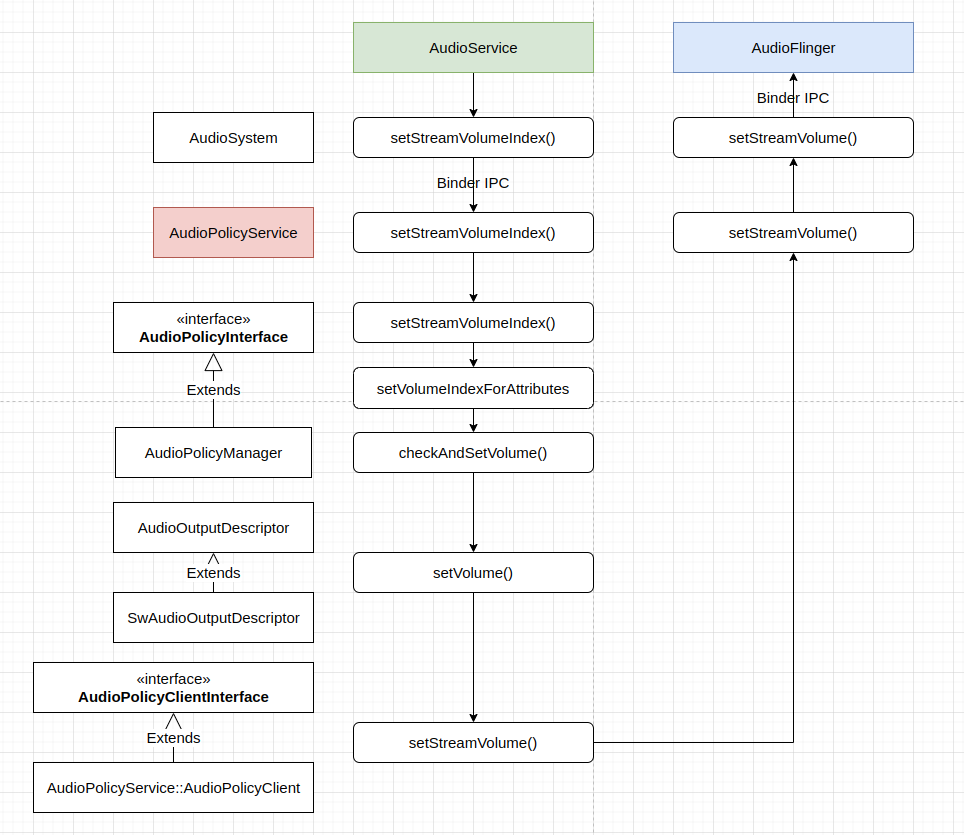
Audio policy service 接收 index 形式的音量值,将音量的 index 值转为db 值,又转为增益值,最后将音量增益设置给 audio flinger。
先来看一下 AudioFlinger 服务 IPC 接口层的实现结构:
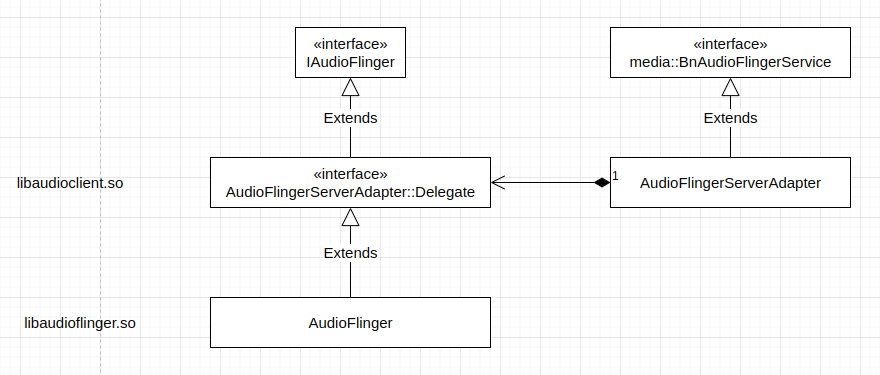
如上图所示,AudioFlinger 服务 IPC 接口层实现为 AudioFlingerServerAdapter,它的代码其实在动态链接库 libaudioclient.so 中,它接收请求,并在收到请求之后,将请求传给服务的真正实现者,也就是位于 frameworks/av/services/audioflinger/AudioFlinger.cpp 的 AudioFlinger。
接着上面的过程,AudioFlinger::setStreamVolume() 的实现如下:
status_t AudioFlinger::setStreamVolume(audio_stream_type_t stream, float value,
        audio_io_handle_t output)
{
    ALOGD("AudioFlinger::%s, stream %d, volume %f, output %d", __func__,
        static_cast<int>(stream), value, static_cast<int>(output));
    // check calling permissions
    if (!settingsAllowed()) {
        return PERMISSION_DENIED;
    }

    status_t status = checkStreamType(stream);
    if (status != NO_ERROR) {
        return status;
    }
    if (output == AUDIO_IO_HANDLE_NONE) {
        return BAD_VALUE;
    }
    LOG_ALWAYS_FATAL_IF(stream == AUDIO_STREAM_PATCH && value != 1.0f,
                        "AUDIO_STREAM_PATCH must have full scale volume");

    AutoMutex lock(mLock);
    VolumeInterface *volumeInterface = getVolumeInterface_l(output);
    if (volumeInterface == NULL) {
        return BAD_VALUE;
    }
    volumeInterface->setStreamVolume(stream, value);

    return NO_ERROR;
}
 . . . . . .
// checkPlaybackThread_l() must be called with AudioFlinger::mLock held
AudioFlinger::VolumeInterface *AudioFlinger::getVolumeInterface_l(audio_io_handle_t output) const
{
    VolumeInterface *volumeInterface = mPlaybackThreads.valueFor(output).get();
    if (volumeInterface == nullptr) {
        MmapThread *mmapThread = mMmapThreads.valueFor(output).get();
        if (mmapThread != nullptr) {
            if (mmapThread->isOutput()) {
                MmapPlaybackThread *mmapPlaybackThread =
                        static_cast<MmapPlaybackThread *>(mmapThread);
                volumeInterface = mmapPlaybackThread;
            }
        }
    }
    return volumeInterface;
}
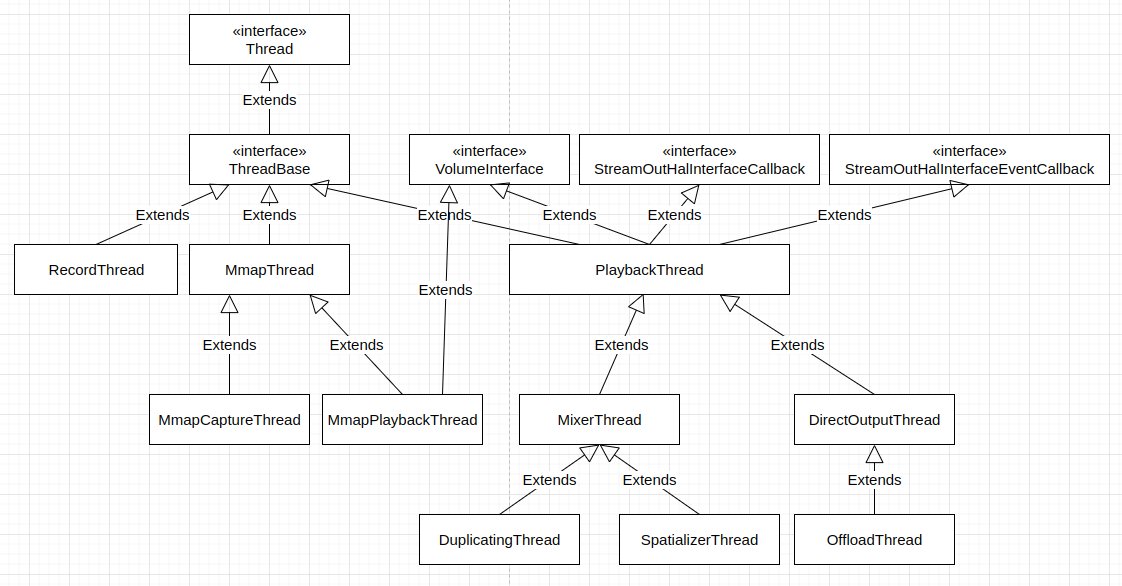
AudioFlinger 根据 audio_io_handle_t 获得 AudioFlinger::VolumeInterface,随后将 stream 的音量设置给它。AudioFlinger 中的这些 Thread 的结构如下:
frameworks/av/services/audioflinger/Threads.cpp 中 AudioFlinger::PlaybackThread 的 setStreamVolume() 的定义如下:
void AudioFlinger::PlaybackThread::setStreamVolume(audio_stream_type_t stream, float value)
{
    Mutex::Autolock _l(mLock);
    mStreamTypes[stream].volume = value;
    broadcast_l();
}
AudioFlinger::MmapPlaybackThread 的 setStreamVolume() 的定义如下:
void AudioFlinger::MmapPlaybackThread::setStreamVolume(audio_stream_type_t stream, float value)
{
    Mutex::Autolock _l(mLock);
    if (stream == mStreamType) {
        mStreamVolume = value;
        broadcast_l();
    }
}
即流的音量增益值被保存起来,后续在处理数据时,用来对音频数据做增益。
核心 Android 系统调节音量的过程到 Audio flinger 这一层大体如此。
参考文档:
Done.
最近因为项目需要,需要将Android手机系统自带的某个系统软件反编译并更改里面某个资源,并重新打包,签名生成新的自定义的apk,下面我来介绍一下我的实现过程。APK修改,分为以下几步:反编译解包,修改,重打包,修改签名等步骤。安卓apk修改准备工作1.系统配置好JavaJDK环境变量2.需要root权限的手机(针对系统自带apk,其他软件免root)3.Auto-Sign签名工具4.apktool工具安卓apk修改开始反编译本文拿Android系统里面的Settings.apk做demo,具体如何将apk获取出来在此就不过多介绍了,直接进入主题:按键win+R输入cmd,打开命令窗口,并将路
我已经开始学习Ruby,我已经阅读了一些教程,甚至还买了一本书(“ProgrammingRuby1.9-ThePragmaticProgrammers'Guide”),我遇到了一些以前从未见过的新东西使用我知道的任何其他语言(我是一名PHP网络开发人员)。block和过程。我想我明白它们是什么,但我不明白的是为什么它们如此伟大,以及我应该在何时何地使用它们。我到处都看到他们说block和过程是Ruby中的一个很棒的特性,但我不理解它们。这里有人能给像我这样的Ruby新手一些解释吗? 最佳答案 block有很多好处。电梯演讲:bloc
我是Ruby分析的新手,看起来像ruby-prof是一个受欢迎的选择。我刚刚安装了gem并调用了我的程序:ruby-prof./my-prog.rb但是,输出非常冗长,因为包含所有Ruby核心和标准库方法以及其他gem的分析数据。例如,前三行是:8.790.0110.0100.0000.0013343*String#%7.280.0780.0090.0000.0692068*Array#each4.930.0380.0060.0000.0321098*Array#map这对我来说不是什么有用的信息,因为我已经知道我的程序经常处理字符串和数组,并且大概已经对这些类进行了优化。我只关心我代
rails中View的解析过程是怎样的?我对View中erb标记中原始html与ruby代码的解析顺序部分感兴趣。我认为这是View代码被解析并最终发送给请求者的顺序:Controller调用ViewView代码从上到下解析当Rails在解析过程中遇到erb标记时:rails解析它并将结果附加到解析的html(这包括erb标签引用助手)一旦整个View被解析,整体结果将发送给请求者这似乎并非如此。看来View代码会扫描任何erb片段并首先解析那些片段(包括对助手的引用)。之后,rails然后从上到下解析所有View代码并将结果发送给请求者。以这个View为例:#_form.html
快速导航(持续更新中…)Cesium源码解析一(terrain文件的加载、解析与渲染全过程梳理)Cesium源码解析二(metadataAvailability的含义)Cesium源码解析三(metadata元数据拓展中行列号的分块规则解析)Cesium源码解析四(Quantized-Mesh(.terrain)格式文件在CesiumJS和UE中加载情况的对比)目录1.前言2.本篇的由来3.terrain文件的加载3.1更新环境3.2更新和执行渲染命令3.3数据优化3.4结束当前帧4.总结1.前言 目前市场上三维比较火的实现方案主要有两种,b/s的方案主要是Cesium,c/s的方案主要是u
点击->操作系统复习的文章集目录操作系统线程线程是什么进程与线程的关系用户态/内核态操作系统资源管理内核态用户态内核态/用户态切换程序运行类型分析计算密集型IO密集型结合进程,线程来理解程序运行类型分析协程基础上下文切换协程协程为什么叫协作式线程?协程的优缺点操作系统线程典型问题:简述进程和线程的区别以下内容带您一步步了解线程是什么比进程更小的独立运行的基本单位-线程(Threads)线程的提出主要是为了提高系统内程序并发执行的程度,从而进一步提升系统的吞吐量,充分发挥多核CPU的优越性而设计的引入进程是为了操作系统更加方便地管理程序,使得多个程序能并发管理和执行而线程则是为了减少程序在并发执
TCP是面向连接的协议,连接的建立和释放是每一次面向连接的通信中必不可少的过程。TCP连接的管理就是使连接的建立和释放都能正常地进行。三次握手TCP连接的建立—三次握手建立TCP连接①若主机A中运行了一个客户进程,当它需要主机B的服务时,就发起TCP连接请求,并在所发送的分段中用SYN=1表示连接请求,并产生一个随机发送序号x,如果连接成功,A将以x作为其发送序号的初始值:seq=x。主机B收到A的连接请求报文,就完成了第一次握手。客户端发送SYN=1表示连接请求客户端发送一个随机发送序号x,如果连接成功,A将以x作为其发送序号的初始值:seq=x②主机B如果同意建立连接,则向主机A发送确认报
“架设一个亿级高并发系统,是多数程序员、架构师的工作目标。许多的技术从业人员甚至有时会降薪去寻找这样的机会。但并不是所有人都有机会主导,甚至参与这样一个系统。今天我们用12306火车票购票这样一个业务场景来做DDD领域建模。”开篇要实现软件设计、软件开发在一个统一的思想、统一的节奏下进行,就应该有一个轻量级的框架对开发过程与代码编写做一定的约束。虽然DDD是一个软件开发的方法,而不是具体的技术或框架,但拥有一个轻量级的框架仍然是必要的,为了开发一个支持DDD的框架,首先需要理解DDD的基本概念和核心的组件。一.什么是领域驱动设计(DDD)首先要知道DDD是一种开发理念,核心是维护一个反应领域概
听说PostgreSQL的可以用Ruby写存储过程但我一直没能找到更多关于它的信息,教人们如何实际去做。有人可以为此推荐好的资源。谢谢 最佳答案 显然,您需要安装PL/Ruby。之后,你可以写:CREATEFUNCTIONruby_max(int4,int4)RETURNSint4AS'ifargs[0].to_i>args[1].to_ireturnargs[0]elsereturnargs[1]end'LANGUAGE'plruby';查看其GitHubrepository安装说明。
我是Ruby新手。我正在学习ruby中的抽象原则。据我了解,过程抽象是对用户隐藏实现细节,或者只是专注于要点而忽略细节。我关心的是如何实现它1)是不是一个简单的函数调用就这样#functiontosortarray#@paramsarray[Array]tobesortdefmy_sort(array)returnarrayifarray.sizearray[i+1]array[i],array[i+1]=array[i+1],array[i]swapped=trueendendendarrayend然后这样调用sorted_array=my_sort([12,34,123,43,
