Java BasePooledObjectFactory 对象池化技术
通常一个对象创建、销毁非常耗时的时候,我们不会频繁的创建和销毁它,而是考虑复用。复用对象的一种做法就是对象池,将创建好的对象放入池中维护起来,下次再用的时候直接拿池中已经创建好的对象继续用,这就是池化的思想。
Apache Commons Pool是一个对象池的框架,他提供了一整套用于实现对象池化的API。它提供了三种对象池:GenericKeyedObjectPool,SoftReferenceObjectPool和GenericObjectPool,其中GenericObjectPool是我们最常用的对象池,内部实现也最复杂。
GenericObjectPool 是一个通用对象池框架,我们可以借助它实现一个健壮的对象池,UML图如下所示:
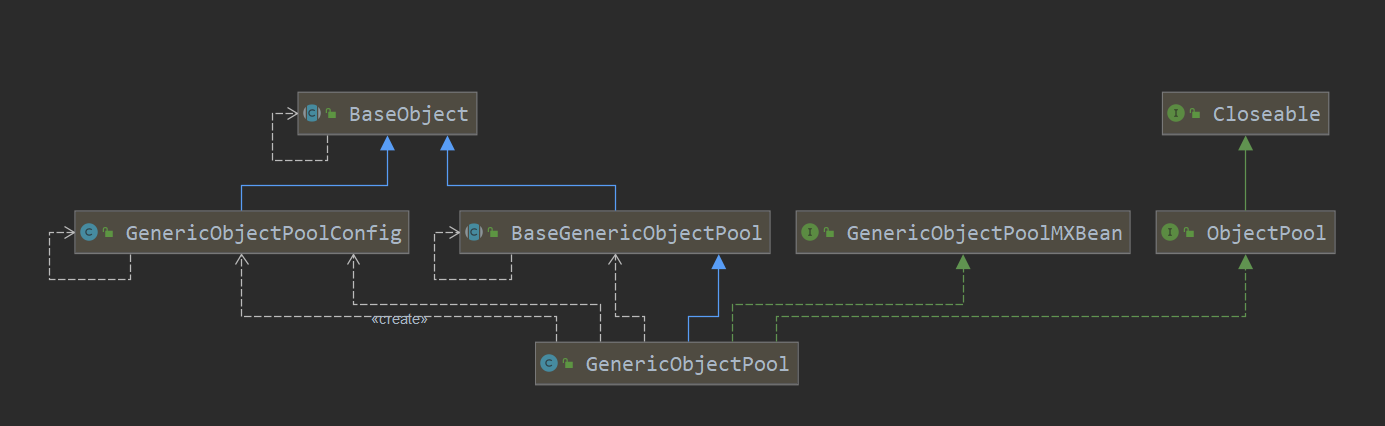
GenericObjectPool 实现了ObjectPool接口,而ObjectPool就是对象池的核心接口,它定义了一个对象池应该实现的行为。
public interface ObjectPool<T> extends Closeable {
    /**
     * 从池中借走到一个对象
     */
    T borrowObject() throws Exception, NoSuchElementException, IllegalStateException;
    /**
     * 把对象归还给对象池
     */
    void returnObject(T var1) throws Exception;
    /**
     * 验证对象的有效性
     */
    void invalidateObject(T var1) throws Exception;

    /**
     * 往池中添加一个对象
     */
    void addObject() throws Exception, IllegalStateException, UnsupportedOperationException;
    /**
     * 返回对象池中有多少对象是空闲的,也就是能够被借走的对象的数量。
     */
    int getNumIdle();
    /**
     * 返回对象池中有对象对象是活跃的,也就是已经被借走的,在使用中的对象的数量。
     */
    int getNumActive();
    /**
     * 清理对象池。注意是清理不是清空,该方法要求的是,清理所有空闲对象,释放相关资源。
     */
    void clear() throws Exception, UnsupportedOperationException;
    /**
     * 关闭对象池。这个方法可以达到清空的效果,清理所有对象以及相关资源。
     */
    void close();
}
Java BasePooledObjectFactory 对象池化技术
使用GenericObjectPool只需要创建一个对象工厂类,继承BasePooledObjectFactory并重写它的create()和destroyObject()。
如下文中的:SftpPool.java
public interface PooledObjectFactory<T> {
    /**
     * 创建一个可由池提供服务的实例,并将其封装在由池管理的PooledObject中。
     */
    PooledObject<T> makeObject() throws Exception;

    /**
     *  销毁池不再需要的实例
     */
    void destroyObject(PooledObject<T> var1) throws Exception;

    /**
     * 确保实例可以安全地由池返回
     */
    boolean validateObject(PooledObject<T> var1);

    /**
     * 重新初始化池返回的实例
     */
    void activateObject(PooledObject<T> var1) throws Exception;

    /**
     * 取消初始化要返回到空闲对象池的实例
     */
    void passivateObject(PooledObject<T> var1) throws Exception;
}
GenericObjectPoolConfig是封装GenericObject池配置的简单“结构”,此类不是线程安全的;它仅用于提供创建池时使用的属性。大多数情况,可以使用GenericObjectPoolConfig提供的默认参数就可以满足日常的需求。
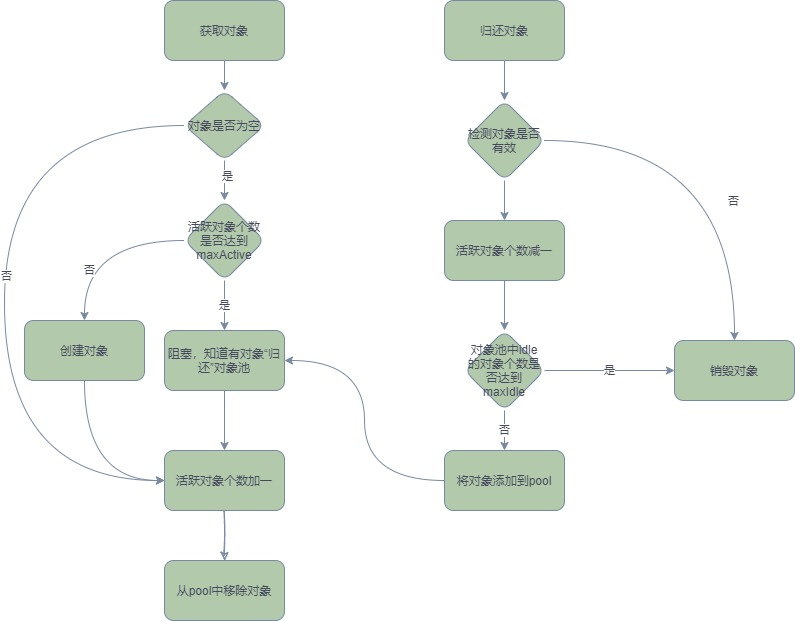
上面三步就是最简单的流程,由于取和还的流程步骤都在borrowObject和returnObject方法中固定的,所以我们只要重写Factory工厂类的makeObject()和validateObject以及destroyObject方法即可实现最简单的池的管理控制,通过构造方法传入该Factory工厂类对象则可以创建最简单的对象池管理类。这算是比较好的解耦设计模式,借和还的流程如下图所示:
<dependency>
    <groupId>org.apache.commons</groupId>
    <artifactId>commons-pool2</artifactId>
    <version>2.7.0</version>
</dependency>

<!-- https://mvnrepository.com/artifact/com.jcraft/jsch -->
<dependency>
    <groupId>com.jcraft</groupId>
    <artifactId>jsch</artifactId>
    <version>0.1.55</version>
</dependency>
<?xml version="1.0" encoding="UTF-8"?>
<project xmlns="http://maven.apache.org/POM/4.0.0"
         xmlns:xsi="http://www.w3.org/2001/XMLSchema-instance"
         xsi:schemaLocation="http://maven.apache.org/POM/4.0.0 http://maven.apache.org/xsd/maven-4.0.0.xsd">
    <parent>
        <artifactId>vipsoft-parent</artifactId>
        <groupId>com.vipsoft.boot</groupId>
        <version>1.0-SNAPSHOT</version>
    </parent>
    <modelVersion>4.0.0</modelVersion>

    <artifactId>vipsoft-sftp</artifactId>
    <version>1.0-SNAPSHOT</version>

    <dependencies>

        <dependency>
            <groupId>org.apache.commons</groupId>
            <artifactId>commons-pool2</artifactId>
            <version>2.7.0</version>
        </dependency>

        <!-- https://mvnrepository.com/artifact/com.jcraft/jsch -->
        <dependency>
            <groupId>com.jcraft</groupId>
            <artifactId>jsch</artifactId>
            <version>0.1.55</version>
        </dependency>

        <dependency>
            <groupId>org.eclipse.paho</groupId>
            <artifactId>org.eclipse.paho.client.mqttv3</artifactId>
            <version>1.2.5</version>
        </dependency>


        <dependency>
            <groupId>cn.hutool</groupId>
            <artifactId>hutool-all</artifactId>
            <version>5.3.6</version>
        </dependency>
        <dependency>
            <groupId>org.springframework.boot</groupId>
            <artifactId>spring-boot-starter-web</artifactId>
        </dependency>
        <dependency>
            <groupId>org.springframework.boot</groupId>
            <artifactId>spring-boot-starter-actuator</artifactId>
        </dependency>
        <dependency>
            <groupId>org.springframework.boot</groupId>
            <artifactId>spring-boot-starter-test</artifactId>
            <scope>test</scope>
            <exclusions>
                <exclusion>
                    <groupId>org.junit.vintage</groupId>
                    <artifactId>junit-vintage-engine</artifactId>
                </exclusion>
            </exclusions>
        </dependency>

    </dependencies>

    <build>
        <plugins>
            <plugin>
                <groupId>org.springframework.boot</groupId>
                <artifactId>spring-boot-maven-plugin</artifactId>
            </plugin>
        </plugins>
    </build>
</project>
application.yaml
server:
  port: 8088
  application:
    name: sftp Demo


sftp:
  host: 172.16.3.88 # 服务器ip
  port: 22 # ssh端口
  username: root # 用户名
  password: root # 密码
  # 连接池参数
  pool:
    max-total: 10
    max-idle: 10
    min-idle: 5
SftpPoolException.java
package com.vipsoft.sftp.exception;


/**
 * sftp连接池异常
 */
public class SftpPoolException extends RuntimeException {

    private static final long serialVersionUID = 1L;

    /**
     * Constructs a new runtime exception with {@code null} as its
     * detail message.  The cause is not initialized, and may subsequently be
     * initialized by a call to {@link #initCause}.
     */
    public SftpPoolException() {
    }

    /**
     * Constructs a new runtime exception with the specified detail message.
     * The cause is not initialized, and may subsequently be initialized by a
     * call to {@link #initCause}.
     *
     * @param message the detail message. The detail message is saved for
     *                later retrieval by the {@link #getMessage()} method.
     */
    public SftpPoolException(String message) {
        super(message);
    }

    /**
     * Constructs a new runtime exception with the specified detail message and
     * cause.  <p>Note that the detail message associated with
     * {@code cause} is <i>not</i> automatically incorporated in
     * this runtime exception's detail message.
     *
     * @param message the detail message (which is saved for later retrieval
     *                by the {@link #getMessage()} method).
     * @param cause   the cause (which is saved for later retrieval by the
     *                {@link #getCause()} method).  (A <tt>null</tt> value is
     *                permitted, and indicates that the cause is nonexistent or
     *                unknown.)
     * @since 1.4
     */
    public SftpPoolException(String message, Throwable cause) {
        super(message, cause);
    }

    /**
     * Constructs a new runtime exception with the specified cause and a
     * detail message of <tt>(cause==null ? null : cause.toString())</tt>
     * (which typically contains the class and detail message of
     * <tt>cause</tt>).  This constructor is useful for runtime exceptions
     * that are little more than wrappers for other throwables.
     *
     * @param cause the cause (which is saved for later retrieval by the
     *              {@link #getCause()} method).  (A <tt>null</tt> value is
     *              permitted, and indicates that the cause is nonexistent or
     *              unknown.)
     * @since 1.4
     */
    public SftpPoolException(Throwable cause) {
        super(cause);
    }

    /**
     * Constructs a new runtime exception with the specified detail
     * message, cause, suppression enabled or disabled, and writable
     * stack trace enabled or disabled.
     *
     * @param message            the detail message.
     * @param cause              the cause.  (A {@code null} value is permitted,
     *                           and indicates that the cause is nonexistent or unknown.)
     * @param enableSuppression  whether or not suppression is enabled
     *                           or disabled
     * @param writableStackTrace whether or not the stack trace should
     *                           be writable
     * @since 1.7
     */
    public SftpPoolException(String message, Throwable cause, boolean enableSuppression, boolean writableStackTrace) {
        super(message, cause, enableSuppression, writableStackTrace);
    }

}
SftpConfig.java
package com.vipsoft.sftp.config;

import com.vipsoft.sftp.pool.SftpFactory;
import com.vipsoft.sftp.pool.SftpPool;
import com.vipsoft.sftp.utils.SftpUtil;
import org.springframework.boot.context.properties.EnableConfigurationProperties;
import org.springframework.context.annotation.Bean;
import org.springframework.context.annotation.Configuration;

@Configuration
@EnableConfigurationProperties(SftpProperties.class)
public class SftpConfig {
    // 工厂
    @Bean
    public SftpFactory sftpFactory(SftpProperties properties) {
        return new SftpFactory(properties);
    }

    // 连接池
    @Bean
    public SftpPool sftpPool(SftpFactory sftpFactory) {
        return new SftpPool(sftpFactory);
    }

    // 辅助类
    @Bean
    public SftpUtil sftpUtil(SftpPool sftpPool) {
        return new SftpUtil(sftpPool);
    }
}
SftpProperties.java
package com.vipsoft.sftp.config;

import com.jcraft.jsch.ChannelSftp;
import org.apache.commons.pool2.impl.GenericObjectPoolConfig;
import org.springframework.boot.context.properties.ConfigurationProperties;

@ConfigurationProperties(prefix = "sftp")
public class SftpProperties {

    private String host;
    private int port = 22;
    private String username = "root";
    private String password = "root";
    private Pool pool = new Pool();

    public String getHost() {
        return host;
    }

    public void setHost(String host) {
        this.host = host;
    }

    public int getPort() {
        return port;
    }

    public void setPort(int port) {
        this.port = port;
    }

    public String getUsername() {
        return username;
    }

    public void setUsername(String username) {
        this.username = username;
    }

    public String getPassword() {
        return password;
    }

    public void setPassword(String password) {
        this.password = password;
    }

    public Pool getPool() {
        return pool;
    }

    public void setPool(Pool pool) {
        this.pool = pool;
    }

    public static class Pool extends GenericObjectPoolConfig<ChannelSftp> {

        private int maxTotal = DEFAULT_MAX_TOTAL;
        private int maxIdle = DEFAULT_MAX_IDLE;
        private int minIdle = DEFAULT_MIN_IDLE;

        public Pool() {
            super();
        }
        @Override
        public int getMaxTotal() {
            return maxTotal;
        }
        @Override
        public void setMaxTotal(int maxTotal) {
            this.maxTotal = maxTotal;
        }
        @Override
        public int getMaxIdle() {
            return maxIdle;
        }
        @Override
        public void setMaxIdle(int maxIdle) {
            this.maxIdle = maxIdle;
        }
        @Override
        public int getMinIdle() {
            return minIdle;
        }
        @Override
        public void setMinIdle(int minIdle) {
            this.minIdle = minIdle;
        }
    }
}
SftpFactory.java
package com.vipsoft.sftp.pool;

import com.jcraft.jsch.ChannelSftp;
import com.jcraft.jsch.JSch;
import com.jcraft.jsch.JSchException;
import com.jcraft.jsch.Session;
import com.vipsoft.sftp.config.SftpProperties;
import com.vipsoft.sftp.exception.SftpPoolException;
import org.apache.commons.pool2.BasePooledObjectFactory;
import org.apache.commons.pool2.PooledObject;
import org.apache.commons.pool2.impl.DefaultPooledObject;
import org.slf4j.Logger;
import org.slf4j.LoggerFactory;

import java.util.Properties;

public class SftpFactory extends BasePooledObjectFactory<ChannelSftp> {

    private  final Logger logger = LoggerFactory.getLogger(this.getClass());

    private SftpProperties properties;

    public SftpProperties getProperties() {
        return properties;
    }

    public void setProperties(SftpProperties properties) {
        this.properties = properties;
    }

    public SftpFactory(SftpProperties properties) {
        this.properties = properties;
    }

    @Override
    public ChannelSftp create() {
        try {
            JSch jsch = new JSch();
            Session sshSession = jsch.getSession(properties.getUsername(), properties.getHost(), properties.getPort());
            sshSession.setPassword(properties.getPassword());
            Properties sshConfig = new Properties();
            sshConfig.put("StrictHostKeyChecking", "no");
            sshSession.setConfig(sshConfig);
            sshSession.connect();
            ChannelSftp channel = (ChannelSftp) sshSession.openChannel("sftp");
            channel.connect();
            return channel;
        } catch (JSchException e) {
            throw new SftpPoolException("连接sfpt失败", e);
        }
    }

    @Override
    public PooledObject<ChannelSftp> wrap(ChannelSftp channelSftp) {
        return new DefaultPooledObject<>(channelSftp);
    }

    // 销毁对象
    @Override
    public void destroyObject(PooledObject<ChannelSftp> p) {
        ChannelSftp channelSftp = p.getObject();
        channelSftp.disconnect();
    }

}
SftpPool.java
package com.vipsoft.sftp.pool;

import com.jcraft.jsch.ChannelSftp;
import org.apache.commons.pool2.impl.GenericObjectPool;

public class SftpPool<T> extends GenericObjectPool<ChannelSftp> {

    public SftpPool(SftpFactory factory) {
        super(factory,factory.getProperties().getPool());
    }

    /**
     * 获取一个sftp连接对象
     * @return sftp连接对象
     */
    @Override
    public ChannelSftp borrowObject() throws Exception {
        return super.borrowObject();
    }

    /**
     * 归还一个sftp连接对象
     * @param channelSftp sftp连接对象
     */
    @Override
    public void returnObject(ChannelSftp channelSftp) {
        if (channelSftp!=null) {
            super.returnObject(channelSftp);
        }
    }

}
ByteUtil.java
package com.vipsoft.sftp.utils;

import com.jcraft.jsch.ChannelSftp;
import com.jcraft.jsch.SftpException;
import com.vipsoft.sftp.exception.SftpPoolException;
import com.vipsoft.sftp.pool.SftpPool;

import java.io.InputStream;

public class SftpUtil {

    private SftpPool pool;

    public SftpUtil(SftpPool pool) {
        this.pool = pool;
    }

    /**
     * 下载文件
     *
     * @param dir  远程目录
     * @param name 远程文件名
     * @return 文件字节数组
     */
    public byte[] download(String dir, String name) {
        ChannelSftp sftp = null;
        try {
            sftp = pool.borrowObject();
            sftp.cd(dir);
            InputStream in = sftp.get(name);
            return ByteUtil.inputStreamToByteArray(in);
        } catch (Exception e) {
            throw new SftpPoolException("sftp下载文件出错", e);
        } finally {
            pool.returnObject(sftp);
        }
    }

    /**
     * 上传文件
     *
     * @param dir  远程目录
     * @param name 远程文件名
     * @param in   输入流
     */
    public void upload(String dir, String name, InputStream in) {
        ChannelSftp sftp = null;
        try {
            sftp = pool.borrowObject();
            mkdirs(sftp, dir);
            sftp.cd(dir);
            sftp.put(in, name);
        } catch (Exception e) {
            throw new SftpPoolException("sftp上传文件出错", e);
        } finally {
            pool.returnObject(sftp);
        }
    }

    /**
     * 删除文件
     *
     * @param dir  远程目录
     * @param name 远程文件名
     */
    public void delete(String dir, String name) {
        ChannelSftp sftp = null;
        try {
            sftp = pool.borrowObject();
            sftp.cd(dir);
            sftp.rm(name);
        } catch (Exception e) {
            throw new SftpPoolException("sftp删除文件出错", e);
        } finally {
            pool.returnObject(sftp);
        }
    }

    /**
     * 递归创建多级目录
     *
     * @param dir 多级目录
     */
    private void mkdirs(ChannelSftp sftp, String dir) {
        String[] folders = dir.split("/");
        try {
            sftp.cd("/");
            for (String folder : folders) {
                if (folder.length() > 0) {
                    try {
                        sftp.cd(folder);
                    } catch (Exception e) {
                        sftp.mkdir(folder);
                        sftp.cd(folder);
                    }
                }
            }
        } catch (SftpException e) {
            throw new SftpPoolException("sftp创建目录出错", e);
        }
    }

}
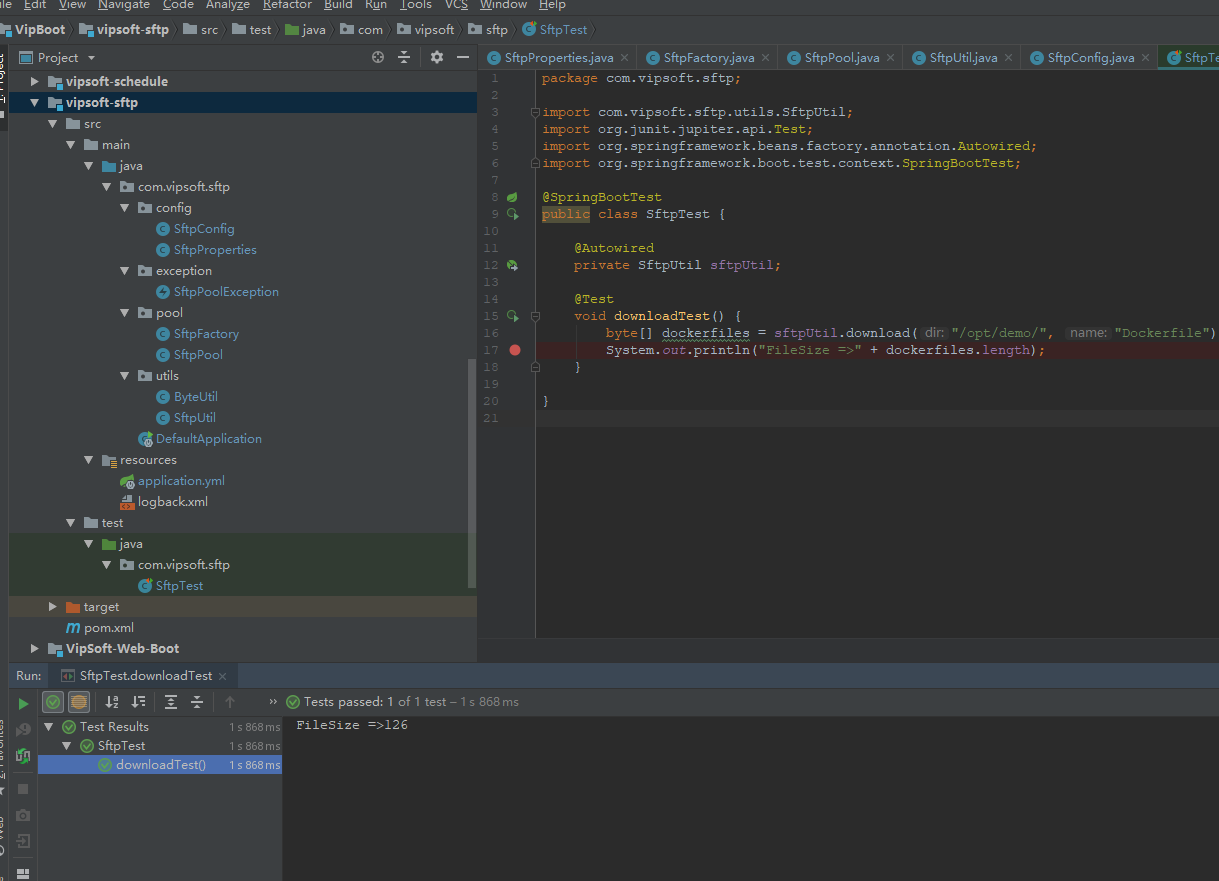
SftpTest.java
package com.vipsoft.sftp;

import com.vipsoft.sftp.utils.SftpUtil;
import org.junit.jupiter.api.Test;
import org.springframework.beans.factory.annotation.Autowired;
import org.springframework.boot.test.context.SpringBootTest;

@SpringBootTest
public class SftpTest {

    @Autowired
    private SftpUtil sftpUtil;

    @Test
    void downloadTest() {
        byte[] dockerfiles = sftpUtil.download("/opt/demo/", "Dockerfile");
        System.out.println("FileSize =>" + dockerfiles.length);
    }

}
总的来说,我对ruby还比较陌生,我正在为我正在创建的对象编写一些rspec测试用例。许多测试用例都非常基础,我只是想确保正确填充和返回值。我想知道是否有办法使用循环结构来执行此操作。不必为我要测试的每个方法都设置一个assertEquals。例如:describeitem,"TestingtheItem"doit"willhaveanullvaluetostart"doitem=Item.new#HereIcoulddotheitem.name.shouldbe_nil#thenIcoulddoitem.category.shouldbe_nilendend但我想要一些方法来使用
在控制台中反复尝试之后,我想到了这种方法,可以按发生日期对类似activerecord的(Mongoid)对象进行分组。我不确定这是完成此任务的最佳方法,但它确实有效。有没有人有更好的建议,或者这是一个很好的方法?#eventsisanarrayofactiverecord-likeobjectsthatincludeatimeattributeevents.map{|event|#converteventsarrayintoanarrayofhasheswiththedayofthemonthandtheevent{:number=>event.time.day,:event=>ev
我有一个表单,其中有很多字段取自数组(而不是模型或对象)。我如何验证这些字段的存在?solve_problem_pathdo|f|%>... 最佳答案 创建一个简单的类来包装请求参数并使用ActiveModel::Validations。#definedsomewhere,atthesimplest:require'ostruct'classSolvetrue#youcouldevencheckthesolutionwithavalidatorvalidatedoerrors.add(:base,"WRONG!!!")unlesss
好的,所以我的目标是轻松地将一些数据保存到磁盘以备后用。您如何简单地写入然后读取一个对象?所以如果我有一个简单的类classCattr_accessor:a,:bdefinitialize(a,b)@a,@b=a,bendend所以如果我从中非常快地制作一个objobj=C.new("foo","bar")#justgaveitsomerandomvalues然后我可以把它变成一个kindaidstring=obj.to_s#whichreturns""我终于可以将此字符串打印到文件或其他内容中。我的问题是,我该如何再次将这个id变回一个对象?我知道我可以自己挑选信息并制作一个接受该信
如果您尝试在Ruby中的nil对象上调用方法,则会出现NoMethodError异常并显示消息:"undefinedmethod‘...’fornil:NilClass"然而,有一个tryRails中的方法,如果它被发送到一个nil对象,它只返回nil:require'rubygems'require'active_support/all'nil.try(:nonexisting_method)#noNoMethodErrorexceptionanymore那么try如何在内部工作以防止该异常? 最佳答案 像Ruby中的所有其他对象
我在Rails工作并有以下类(class):classPlayer当我运行时bundleexecrailsconsole然后尝试:a=Player.new("me",5.0,"UCLA")我回来了:=>#我不知道为什么Player对象不会在这里初始化。关于可能导致此问题的操作/解释的任何建议?谢谢,马里奥格 最佳答案 havenoideawhythePlayerobjectwouldn'tbeinitializedhere它没有初始化很简单,因为你还没有初始化它!您已经覆盖了ActiveRecord::Base初始化方法,但您没有调
我有一个服务模型/表及其注册表。在表单中,我几乎拥有服务的所有字段,但我想在验证服务对象之前自动设置其中一些值。示例:--服务Controller#创建Action:defcreate@service=Service.new@service_form=ServiceFormObject.new(@service)@service_form.validate(params[:service_form_object])and@service_form.saverespond_with(@service_form,location:admin_services_path)end在验证@ser
我想让一个yaml对象引用另一个,如下所示:intro:"Hello,dearuser."registration:$introThanksforregistering!new_message:$introYouhaveanewmessage!上面的语法只是它如何工作的一个例子(这也是它在thiscpanmodule中的工作方式。)我正在使用标准的rubyyaml解析器。这可能吗? 最佳答案 一些yaml对象确实引用了其他对象:irb>require'yaml'#=>trueirb>str="hello"#=>"hello"ir
假设我有一个FireNinja我的数据库中的对象,使用单表继承存储。后来才知道他真的是WaterNinja.将他更改为不同的子类的最干净的方法是什么?更好的是,我很想创建一个新的WaterNinja对象并替换旧的FireNinja在数据库中,保留ID。编辑我知道如何创建新的WaterNinja来self现有FireNinja的对象,我也知道我可以删除旧的并保存新的。我想做的是改变现有项目的类别。我是通过创建一个新对象并执行一些ActiveRecord魔法来替换行,还是通过对对象本身做一些疯狂的事情,或者甚至通过删除它并使用相同的ID重新插入来做到这一点,这是问题的一部分。
根据ActiveRecord::Base的文档:==(comparison_object)Returnstrueifcomparison_objectisthesameexactobject,orcomparison_objectisofthesametypeandselfhasanIDanditisequaltocomparison_object.id.Notethatnewrecordsaredifferentfromanyotherrecordbydefinition,unlesstheotherrecordisthereceiveritself.Besides,ifyoufet
