我正在尝试将 2D 点重新投影到它们的原始 3D 坐标,假设我知道每个点的距离。关注OpenCV documentation ,我设法让它以零失真工作。然而,当存在扭曲时,结果是不正确的。
因此,我们的想法是反转以下内容:
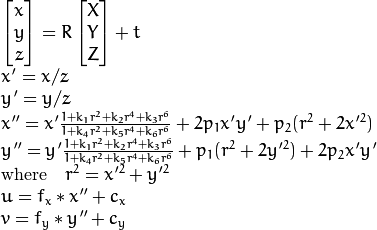
进入以下:

通过:
cv::undistortPoints 消除任何扭曲z 以反转归一化。f_x 和 f_y 才能返回标准化相机坐标(测试时凭经验找到)?在下面的代码中,在第 2 步中,如果我不减去——即使没有扭曲的结果也是关闭的#include <iostream>
#include <opencv2/calib3d/calib3d.hpp>
#include <opencv2/core/core.hpp>
#include <opencv2/imgproc/imgproc.hpp>
#include <vector>
std::vector<cv::Point2d> Project(const std::vector<cv::Point3d>& points,
const cv::Mat& intrinsic,
const cv::Mat& distortion) {
std::vector<cv::Point2d> result;
if (!points.empty()) {
cv::projectPoints(points, cv::Mat(3, 1, CV_64F, cvScalar(0.)),
cv::Mat(3, 1, CV_64F, cvScalar(0.)), intrinsic,
distortion, result);
}
return result;
}
std::vector<cv::Point3d> Unproject(const std::vector<cv::Point2d>& points,
const std::vector<double>& Z,
const cv::Mat& intrinsic,
const cv::Mat& distortion) {
double f_x = intrinsic.at<double>(0, 0);
double f_y = intrinsic.at<double>(1, 1);
double c_x = intrinsic.at<double>(0, 2);
double c_y = intrinsic.at<double>(1, 2);
// This was an error before:
// double c_x = intrinsic.at<double>(0, 3);
// double c_y = intrinsic.at<double>(1, 3);
// Step 1. Undistort
std::vector<cv::Point2d> points_undistorted;
assert(Z.size() == 1 || Z.size() == points.size());
if (!points.empty()) {
cv::undistortPoints(points, points_undistorted, intrinsic,
distortion, cv::noArray(), intrinsic);
}
// Step 2. Reproject
std::vector<cv::Point3d> result;
result.reserve(points.size());
for (size_t idx = 0; idx < points_undistorted.size(); ++idx) {
const double z = Z.size() == 1 ? Z[0] : Z[idx];
result.push_back(
cv::Point3d((points_undistorted[idx].x - c_x) / f_x * z,
(points_undistorted[idx].y - c_y) / f_y * z, z));
}
return result;
}
int main() {
const double f_x = 1000.0;
const double f_y = 1000.0;
const double c_x = 1000.0;
const double c_y = 1000.0;
const cv::Mat intrinsic =
(cv::Mat_<double>(3, 3) << f_x, 0.0, c_x, 0.0, f_y, c_y, 0.0, 0.0, 1.0);
const cv::Mat distortion =
// (cv::Mat_<double>(5, 1) << 0.0, 0.0, 0.0, 0.0); // This works!
(cv::Mat_<double>(5, 1) << -0.32, 1.24, 0.0013, 0.0013); // This doesn't!
// Single point test.
const cv::Point3d point_single(-10.0, 2.0, 12.0);
const cv::Point2d point_single_projected = Project({point_single}, intrinsic,
distortion)[0];
const cv::Point3d point_single_unprojected = Unproject({point_single_projected},
{point_single.z}, intrinsic, distortion)[0];
std::cout << "Expected Point: " << point_single.x;
std::cout << " " << point_single.y;
std::cout << " " << point_single.z << std::endl;
std::cout << "Computed Point: " << point_single_unprojected.x;
std::cout << " " << point_single_unprojected.y;
std::cout << " " << point_single_unprojected.z << std::endl;
}
import cv2
import numpy as np

def Project(points, intrinsic, distortion):
  result = []
  rvec = tvec = np.array([0.0, 0.0, 0.0])
  if len(points) > 0:
    result, _ = cv2.projectPoints(points, rvec, tvec,
                                  intrinsic, distortion)
  return np.squeeze(result, axis=1)

def Unproject(points, Z, intrinsic, distortion):
  f_x = intrinsic[0, 0]
  f_y = intrinsic[1, 1]
  c_x = intrinsic[0, 2]
  c_y = intrinsic[1, 2]
  # This was an error before
  # c_x = intrinsic[0, 3]
  # c_y = intrinsic[1, 3]

  # Step 1. Undistort.
  points_undistorted = np.array([])
  if len(points) > 0:
    points_undistorted = cv2.undistortPoints(np.expand_dims(points, axis=1), intrinsic, distortion, P=intrinsic)
  points_undistorted = np.squeeze(points_undistorted, axis=1)

  # Step 2. Reproject.
  result = []
  for idx in range(points_undistorted.shape[0]):
    z = Z[0] if len(Z) == 1 else Z[idx]
    x = (points_undistorted[idx, 0] - c_x) / f_x * z
    y = (points_undistorted[idx, 1] - c_y) / f_y * z
    result.append([x, y, z])
  return result

f_x = 1000.
f_y = 1000.
c_x = 1000.
c_y = 1000.

intrinsic = np.array([
  [f_x, 0.0, c_x],
  [0.0, f_y, c_y],
  [0.0, 0.0, 1.0]
])

distortion = np.array([0.0, 0.0, 0.0, 0.0])  # This works!
distortion = np.array([-0.32, 1.24, 0.0013, 0.0013])  # This doesn't!

point_single = np.array([[-10.0, 2.0, 12.0],])
point_single_projected = Project(point_single, intrinsic, distortion)
Z = np.array([point[2] for point in point_single])
point_single_unprojected = Unproject(point_single_projected,
                                     Z,
                                     intrinsic, distortion)
print "Expected point:", point_single[0]
print "Computed point:", point_single_unprojected[0]
零失真的结果(如前所述)是正确的:
Expected Point: -10 2 12
Computed Point: -10 2 12
但是当包含失真时,结果是关闭的:
Expected Point: -10 2 12
Computed Point: -4.26634 0.848872 12
这是一个相机到图像的投影——我假设 3D 点在相机坐标系中。
好的,我算出了 f_x 和 f_y 的减法——我愚蠢到把索引弄乱了。更新了代码以更正。另一个问题仍然成立。
为了增加可见性,添加Python代码,因为它有同样的错误。
最佳答案
我发现问题所在 -- 3D 点坐标很重要!我假设无论我选择什么 3D 坐标点,重建都会解决它。然而,我注意到一些奇怪的事情:当使用一系列 3D 点时,只有这些点的一个子集被正确重建。经过进一步调查,我发现只有在相机视野中的图像才能正确重建。视野是内在参数的函数(反之亦然)。
要使上述代码正常工作,请尝试按如下方式设置参数(内部参数来 self 的相机):
...
const double f_x = 2746.;
const double f_y = 2748.;
const double c_x = 991.;
const double c_y = 619.;
...
const cv::Point3d point_single(10.0, -2.0, 30.0);
...
此外,不要忘记在相机坐标中负 y 坐标是 UP :)
在我尝试使用访问内在函数时出现了一个错误
...
double f_x = intrinsic.at<double>(0, 0);
double f_y = intrinsic.at<double>(1, 1);
double c_x = intrinsic.at<double>(0, 3);
double c_y = intrinsic.at<double>(1, 3);
...
但是 intrinsic 是一个 3x3 矩阵。
故事的寓意 编写单元测试!!!
关于python - OpenCV unproject 2D 指向具有已知深度 `Z` 的 3D,我们在Stack Overflow上找到一个类似的问题: https://stackoverflow.com/questions/51272055/
关闭。这个问题是opinion-based.它目前不接受答案。想要改进这个问题?更新问题,以便editingthispost可以用事实和引用来回答它.关闭4年前。Improvethisquestion我想在固定时间创建一系列低音和高音调的哔哔声。例如:在150毫秒时发出高音调的蜂鸣声在151毫秒时发出低音调的蜂鸣声200毫秒时发出低音调的蜂鸣声250毫秒的高音调蜂鸣声有没有办法在Ruby或Python中做到这一点?我真的不在乎输出编码是什么(.wav、.mp3、.ogg等等),但我确实想创建一个输出文件。
这个问题在这里已经有了答案:关闭10年前。PossibleDuplicate:Pythonconditionalassignmentoperator对于这样一个简单的问题表示歉意,但是谷歌搜索||=并不是很有帮助;)Python中是否有与Ruby和Perl中的||=语句等效的语句?例如:foo="hey"foo||="what"#assignfooifit'sundefined#fooisstill"hey"bar||="yeah"#baris"yeah"另外,类似这样的东西的通用术语是什么?条件分配是我的第一个猜测,但Wikipediapage跟我想的不太一样。
什么是ruby的rack或python的Java的wsgi?还有一个路由库。 最佳答案 来自Python标准PEP333:Bycontrast,althoughJavahasjustasmanywebapplicationframeworksavailable,Java's"servlet"APImakesitpossibleforapplicationswrittenwithanyJavawebapplicationframeworktoruninanywebserverthatsupportstheservletAPI.ht
无论您是想搭建桌面端、WEB端或者移动端APP应用,HOOPSPlatform组件都可以为您提供弹性的3D集成架构,同时,由工业领域3D技术专家组成的HOOPS技术团队也能为您提供技术支持服务。如果您的客户期望有一种在多个平台(桌面/WEB/APP,而且某些客户端是“瘦”客户端)快速、方便地将数据接入到3D应用系统的解决方案,并且当访问数据时,在各个平台上的性能和用户体验保持一致,HOOPSPlatform将帮助您完成。利用HOOPSPlatform,您可以开发在任何环境下的3D基础应用架构。HOOPSPlatform可以帮您打造3D创新型产品,HOOPSSDK包含的技术有:快速且准确的CAD
华为OD机试题本篇题目:明明的随机数题目输入描述输出描述:示例1输入输出说明代码编写思路最近更新的博客华为od2023|什么是华为od,od薪资待遇,od机试题清单华为OD机试真题大全,用Python解华为机试题|机试宝典【华为OD机试】全流程解析+经验分享,题型分享,防作弊指南华为o
本教程将在Unity3D中混合Optitrack与数据手套的数据流,在人体运动的基础上,添加双手手指部分的运动。双手手背的角度仍由Optitrack提供,数据手套提供双手手指的角度。 01 客户端软件分别安装MotiveBody与MotionVenus并校准人体与数据手套。MotiveBodyMotionVenus数据手套使用、校准流程参照:https://gitee.com/foheart_1/foheart-h1-data-summary.git02 数据转发打开MotiveBody软件的Streaming,开始向Unity3D广播数据;MotionVenus中设置->选项选择Unit
Unity自动旋转动画1.开门需要门把手先动,门再动2.关门需要门先动,门把手再动3.中途播放过程中不可以再次进行操作觉得太复杂?查看我的文章开关门简易进阶版效果:如果这个门可以直接打开的话,就不需要放置"门把手"如果门把手还有钥匙需要旋转,那就可以把钥匙放在门把手的"门把手",理论上是可以无限套娃的可调整参数有:角度,反向,轴向,速度运行时点击Test进行测试自己写的代码比较垃圾,命名与结构比较拉,高手轻点喷,新手有类似的需求可以拿去做参考上代码usingSystem.Collections;usingSystem.Collections.Generic;usingUnityEngine;u
之前说过10之后的版本没有3dScan了,所以还是9.8的版本或者之前更早的版本。 3d物体扫描需要先下载扫描的APK进行扫面。首先要在手机上装一个扫描程序,扫描现实中的三维物体,然后上传高通官网,在下载成UnityPackage类型让Unity能够使用这个扫描程序可以从高通官网上进行下载,是一个安卓程序。点到Tools往下滑,找到VuforiaObjectScanner下载后解压数据线连接手机,将apk文件拷入手机安装然后刚才解压文件中的Media文件夹打开,两个PDF图打印第一张A4-ObjectScanningTarget.pdf,主要是用来辅助扫描的。好了,接下来就是扫描三维物体。将瓶
我想解析一个已经存在的.mid文件,改变它的乐器,例如从“acousticgrandpiano”到“violin”,然后将它保存回去或作为另一个.mid文件。根据我在文档中看到的内容,该乐器通过program_change或patch_change指令进行了更改,但我找不到任何在已经存在的MIDI文件中执行此操作的库.他们似乎都只支持从头开始创建的MIDI文件。 最佳答案 MIDIpackage会为您完成此操作,但具体方法取决于midi文件的原始内容。一个MIDI文件由一个或多个音轨组成,每个音轨是十六个channel中任何一个上的
本文主要介绍在使用Selenium进行自动化测试或者任务时,对于使用了iframe的页面,如何定位iframe中的元素文章目录场景描述解决方案具体代码场景描述当我们在使用Selenium进行自动化测试的时候,可能会遇到一些界面或者窗体是使用HTML的iframe标签进行承载的。对于iframe中的标签,如果直接查找是无法找到的,会抛出没有找到元素的异常。比如近在咫尺的例子就是,CSDN的登录窗体就是使用的iframe,大家可以尝试通过F12开发者模式查看到的tag_name,class_name,id或者xpath来定位中的页面元素,会抛出NoSuchElementException异常。解决
