目录
该步骤可自行处理,用excel也好,用python也罢,只要将待分析文本处理为csv或txt存储格式即可。注意:一条文本占一行
例如感想.txt:
我喜欢吃汉堡
小明喜欢吃螺蛳粉
螺蛳粉外卖好贵
以上句子来源于吃完一个汉堡还想再点碗螺蛳粉,但外卖好贵从而选择放弃的我
import re
import jieba as jb
def stopwordslist(filepath):
    stopwords = [line.strip() for line in open(filepath, 'r', encoding='utf-8').readlines()]
    return stopwords

# 对句子进行分词
def seg_sentence(sentence):
    sentence = re.sub(u'[0-9\.]+', u'', sentence)
    #jb.add_word('词汇')		# 这里是加入自定义的词来补充jieba词典
    sentence_seged = jb.cut(sentence.strip())
    stopwords = stopwordslist('自己搜来的停用词表.txt')  # 这里加载停用词的路径
    outstr = ''
    for word in sentence_seged:
        if word not in stopwords and word.__len__()>1:
            if word != '\t':
                outstr += word
                outstr += " "
    return outstr


inputs = open('感想.txt', 'r', encoding='utf-8')

outputs = open('感想分词.txt', 'w',encoding='utf-8')
for line in inputs:
    line_seg = seg_sentence(line)  # 这里的返回值是字符串
    outputs.write(line_seg + '\n')
outputs.close()
inputs.close()
该步骤生成感想分词.txt:
我 喜欢 吃 汉堡
小明 喜欢 吃 螺蛳粉
螺蛳粉 外卖 好贵
句子 来源于 吃完 一个 汉堡 再点碗 螺蛳粉 外卖 好贵 选择 放弃
假设主题个数设为4个(num_topics的参数)
import codecs
from gensim import corpora
from gensim.models import LdaModel
from gensim.corpora import Dictionary


train = []

fp = codecs.open('感想分词.txt','r',encoding='utf8')
for line in fp:
    if line != '':
        line = line.split()
        train.append([w for w in line])

dictionary = corpora.Dictionary(train)

corpus = [dictionary.doc2bow(text) for text in train]

lda = LdaModel(corpus=corpus, id2word=dictionary, num_topics=4, passes=100)
# num_topics:主题数目
# passes:训练伦次
# num_words:每个主题下输出的term的数目

for topic in lda.print_topics(num_words = 20):
    termNumber = topic[0]
    print(topic[0], ':', sep='')
    listOfTerms = topic[1].split('+')
    for term in listOfTerms:
        listItems = term.split('*')
print(' ', listItems[1], '(', listItems[0], ')', sep='')import pyLDAvis.gensim_models
'''插入之前的代码片段'''
import codecs
from gensim import corpora
from gensim.models import LdaModel
from gensim.corpora import Dictionary
train = []
fp = codecs.open('感想分词.txt','r',encoding='utf8')
for line in fp:
if line != '':
line = line.split()
train.append([w for w in line])
dictionary = corpora.Dictionary(train)
corpus = [dictionary.doc2bow(text) for text in train]
lda = LdaModel(corpus=corpus, id2word=dictionary, num_topics=4, passes=100)
# num_topics:主题数目
# passes:训练伦次
# num_words:每个主题下输出的term的数目
for topic in lda.print_topics(num_words = 20):
termNumber = topic[0]
print(topic[0], ':', sep='')
listOfTerms = topic[1].split('+')
for term in listOfTerms:
listItems = term.split('*')
print(' ', listItems[1], '(', listItems[0], ')', sep='')
d=pyLDAvis.gensim_models.prepare(lda, corpus, dictionary)
'''
lda: 计算好的话题模型
corpus: 文档词频矩阵
dictionary: 词语空间
'''
#pyLDAvis.show(d) #展示在浏览器
# pyLDAvis.displace(d) #展示在notebook的output cell中
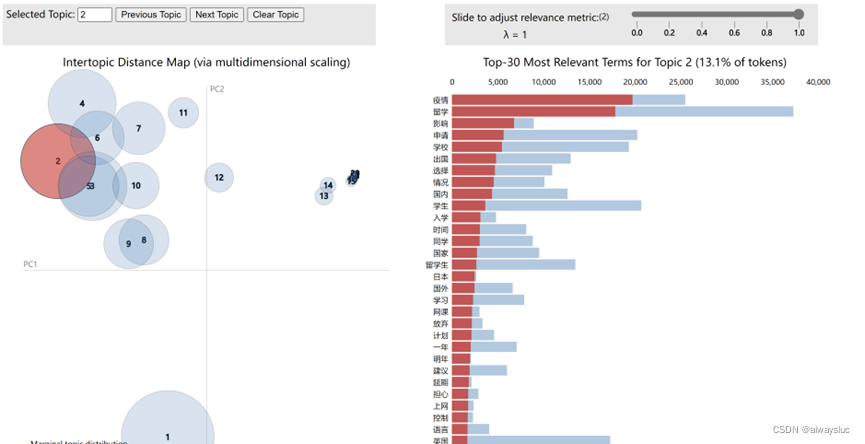
pyLDAvis.save_html(d, 'lda_pass4.html')这样就会生成看起来很炫酷的图啦(只是示例):
计算不同参数下结果的 Perlexity(困惑度)和 Coherence score(一致性评分),选择困惑度最低且一致性评分最高的参数值作为最终参数设定。
import gensim
from gensim import corpora, models
import matplotlib.pyplot as plt
import matplotlib
from nltk.tokenize import RegexpTokenizer
from nltk.stem.porter import PorterStemmer


 # 准备数据
PATH = "感想分词.txt"  #已经进行了分词的文档(如何分词前面的文章有介绍)


file_object2=open(PATH,encoding = 'utf-8',errors = 'ignore').read().split('\n')
data_set=[] #建立存储分词的列表
for i in range(len(file_object2)):
    result=[]
    seg_list = file_object2[i].split()  #读取没一行文本
    for w in seg_list :#读取每一行分词
        result.append(w)
    data_set.append(result)
print(data_set)  #输出所有分词列表


dictionary = corpora.Dictionary(data_set)  # 构建 document-term matrix
corpus = [dictionary.doc2bow(text) for text in data_set]
Lda = gensim.models.ldamodel.LdaModel  # 创建LDA对象

#计算困惑度
def perplexity(num_topics):
    ldamodel = Lda(corpus, num_topics=num_topics, id2word = dictionary, passes=50)  #passes为迭代次数,次数越多越精准
    print(ldamodel.print_topics(num_topics=num_topics, num_words=20))  #num_words为每个主题下的词语数量
    print(ldamodel.log_perplexity(corpus))
    return ldamodel.log_perplexity(corpus)

# 绘制困惑度折线图
x = range(1,20)  #主题范围数量
y = [perplexity(i) for i in x]
plt.plot(x, y)
plt.xlabel('主题数目')
plt.ylabel('困惑度大小')
plt.rcParams['font.sans-serif']=['SimHei']
matplotlib.rcParams['axes.unicode_minus']=False
plt.title('主题-困惑度变化情况')
plt.show()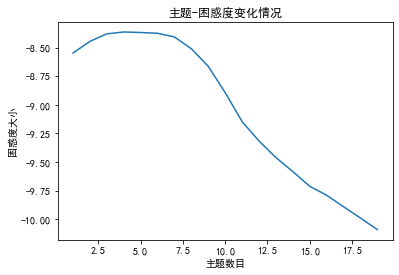
import gensim
from gensim import corpora, models
import matplotlib.pyplot as plt
import matplotlib
from nltk.tokenize import RegexpTokenizer
from nltk.stem.porter import PorterStemmer
import gensim
import gensim.corpora as corpora
from gensim.utils import simple_preprocess
from gensim.models import CoherenceModel


 # 准备数据
PATH = "感想分词.txt"  #已经进行了分词的文档(如何分词前面的文章有介绍)


file_object2=open(PATH,encoding = 'utf-8',errors = 'ignore').read().split('\n')
data_set=[] #建立存储分词的列表
for i in range(len(file_object2)):
    result=[]
    seg_list = file_object2[i].split()  #读取没一行文本
    for w in seg_list :#读取每一行分词
        result.append(w)
    data_set.append(result)
print(data_set)  #输出所有分词列表


dictionary = corpora.Dictionary(data_set)  # 构建 document-term matrix
corpus = [dictionary.doc2bow(text) for text in data_set]
Lda = gensim.models.ldamodel.LdaModel  # 创建LDA对象


def coherence(num_topics):
    ldamodel = Lda(corpus, num_topics=num_topics, id2word = dictionary, passes=50)  #passes为迭代次数,次数越多越精准
    coherence_model_lda = CoherenceModel(model=ldamodel, texts=data_set, dictionary=dictionary, coherence='c_v')
    coherence_lda = coherence_model_lda.get_coherence()
    print('\nCoherence Score: ', coherence_lda)
    return coherence_lda

# 绘制困惑度折线图
x = range(1,20)  #主题范围数量
y = [coherence(i) for i in x]
plt.plot(x,y)
plt.xlabel('主题数目')
plt.ylabel('coherence大小')
plt.rcParams['font.sans-serif']=['SimHei']
matplotlib.rcParams['axes.unicode_minus']=False
plt.title('主题-coherence变化情况')
plt.show()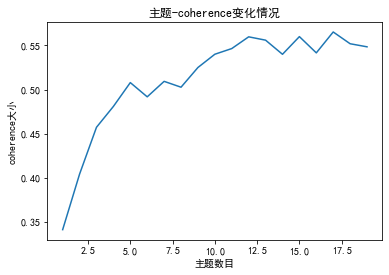
整个流程就大致是这样啦!有问题欢迎一起交流!!

我正在学习如何使用Nokogiri,根据这段代码我遇到了一些问题:require'rubygems'require'mechanize'post_agent=WWW::Mechanize.newpost_page=post_agent.get('http://www.vbulletin.org/forum/showthread.php?t=230708')puts"\nabsolutepathwithtbodygivesnil"putspost_page.parser.xpath('/html/body/div/div/div/div/div/table/tbody/tr/td/div
我有一个Ruby程序,它使用rubyzip压缩XML文件的目录树。gem。我的问题是文件开始变得很重,我想提高压缩级别,因为压缩时间不是问题。我在rubyzipdocumentation中找不到一种为创建的ZIP文件指定压缩级别的方法。有人知道如何更改此设置吗?是否有另一个允许指定压缩级别的Ruby库? 最佳答案 这是我通过查看rubyzip内部创建的代码。level=Zlib::BEST_COMPRESSIONZip::ZipOutputStream.open(zip_file)do|zip|Dir.glob("**/*")d
类classAprivatedeffooputs:fooendpublicdefbarputs:barendprivatedefzimputs:zimendprotecteddefdibputs:dibendendA的实例a=A.new测试a.foorescueputs:faila.barrescueputs:faila.zimrescueputs:faila.dibrescueputs:faila.gazrescueputs:fail测试输出failbarfailfailfail.发送测试[:foo,:bar,:zim,:dib,:gaz].each{|m|a.send(m)resc
很好奇,就使用rubyonrails自动化单元测试而言,你们正在做什么?您是否创建了一个脚本来在cron中运行rake作业并将结果邮寄给您?git中的预提交Hook?只是手动调用?我完全理解测试,但想知道在错误发生之前捕获错误的最佳实践是什么。让我们理所当然地认为测试本身是完美无缺的,并且可以正常工作。下一步是什么以确保他们在正确的时间将可能有害的结果传达给您? 最佳答案 不确定您到底想听什么,但是有几个级别的自动代码库控制:在处理某项功能时,您可以使用类似autotest的内容获得关于哪些有效,哪些无效的即时反馈。要确保您的提
假设我做了一个模块如下:m=Module.newdoclassCendend三个问题:除了对m的引用之外,还有什么方法可以访问C和m中的其他内容?我可以在创建匿名模块后为其命名吗(就像我输入“module...”一样)?如何在使用完匿名模块后将其删除,使其定义的常量不再存在? 最佳答案 三个答案:是的,使用ObjectSpace.此代码使c引用你的类(class)C不引用m:c=nilObjectSpace.each_object{|obj|c=objif(Class===objandobj.name=~/::C$/)}当然这取决于
我正在尝试使用ruby和Savon来使用网络服务。测试服务为http://www.webservicex.net/WS/WSDetails.aspx?WSID=9&CATID=2require'rubygems'require'savon'client=Savon::Client.new"http://www.webservicex.net/stockquote.asmx?WSDL"client.get_quotedo|soap|soap.body={:symbol=>"AAPL"}end返回SOAP异常。检查soap信封,在我看来soap请求没有正确的命名空间。任何人都可以建议我
关闭。这个问题是opinion-based.它目前不接受答案。想要改进这个问题?更新问题,以便editingthispost可以用事实和引用来回答它.关闭4年前。Improvethisquestion我想在固定时间创建一系列低音和高音调的哔哔声。例如:在150毫秒时发出高音调的蜂鸣声在151毫秒时发出低音调的蜂鸣声200毫秒时发出低音调的蜂鸣声250毫秒的高音调蜂鸣声有没有办法在Ruby或Python中做到这一点?我真的不在乎输出编码是什么(.wav、.mp3、.ogg等等),但我确实想创建一个输出文件。
我有一个模型:classItem项目有一个属性“商店”基于存储的值,我希望Item对象对特定方法具有不同的行为。Rails中是否有针对此的通用设计模式?如果方法中没有大的if-else语句,这是如何干净利落地完成的? 最佳答案 通常通过Single-TableInheritance. 关于ruby-on-rails-Rails-子类化模型的设计模式是什么?,我们在StackOverflow上找到一个类似的问题: https://stackoverflow.co
我在我的项目目录中完成了compasscreate.和compassinitrails。几个问题:我已将我的.sass文件放在public/stylesheets中。这是放置它们的正确位置吗?当我运行compasswatch时,它不会自动编译这些.sass文件。我必须手动指定文件:compasswatchpublic/stylesheets/myfile.sass等。如何让它自动运行?文件ie.css、print.css和screen.css已放在stylesheets/compiled。如何在编译后不让它们重新出现的情况下删除它们?我自己编译的.sass文件编译成compiled/t
我想将html转换为纯文本。不过,我不想只删除标签,我想智能地保留尽可能多的格式。为插入换行符标签,检测段落并格式化它们等。输入非常简单,通常是格式良好的html(不是整个文档,只是一堆内容,通常没有anchor或图像)。我可以将几个正则表达式放在一起,让我达到80%,但我认为可能有一些现有的解决方案更智能。 最佳答案 首先,不要尝试为此使用正则表达式。很有可能你会想出一个脆弱/脆弱的解决方案,它会随着HTML的变化而崩溃,或者很难管理和维护。您可以使用Nokogiri快速解析HTML并提取文本:require'nokogiri'h
