目录
商家一般会在 “双十一”,“双十二” 等节日进行大规模的促销,比如各种折扣券和现金券。然而,被低价、折扣、各种让利吸引的用户往往在这次消费之后就再也没有购买,主要为了“薅羊毛”,针对这些用户的促销并没有带来未来销量的提高,只是增加了相应的营销成本。因此店铺有迫切的需求,想知道哪些用户可能会成为重复购买其店铺商品的忠诚用户,以便对这些有潜力的用户进行精准营销,以降低促销成本,提高投资回报率。
这个赛题的目标就是给一堆数据(用户、店铺的历史行为),然后用训练好的模型预测新用户是否会在6个月内再次从同一店铺购买商品。所以这是一个典型的二分类问题。
常见的分类算法:朴素贝叶斯,决策树,支持向量机,KNN,逻辑回归等等;
集成学习:随机森林,GBDT(梯度提升决策树),Adaboot,XGBoost,LightGBM,CatBoost等等;
神经网络:MLP(多层神经网络),DL(深度学习)等。
本赛题的数据量不大,一把用不到深度学习,根据赛题特点,集成算法,尤其是XGBoost,LightGBM,CatBoost等算法效果会比较好。
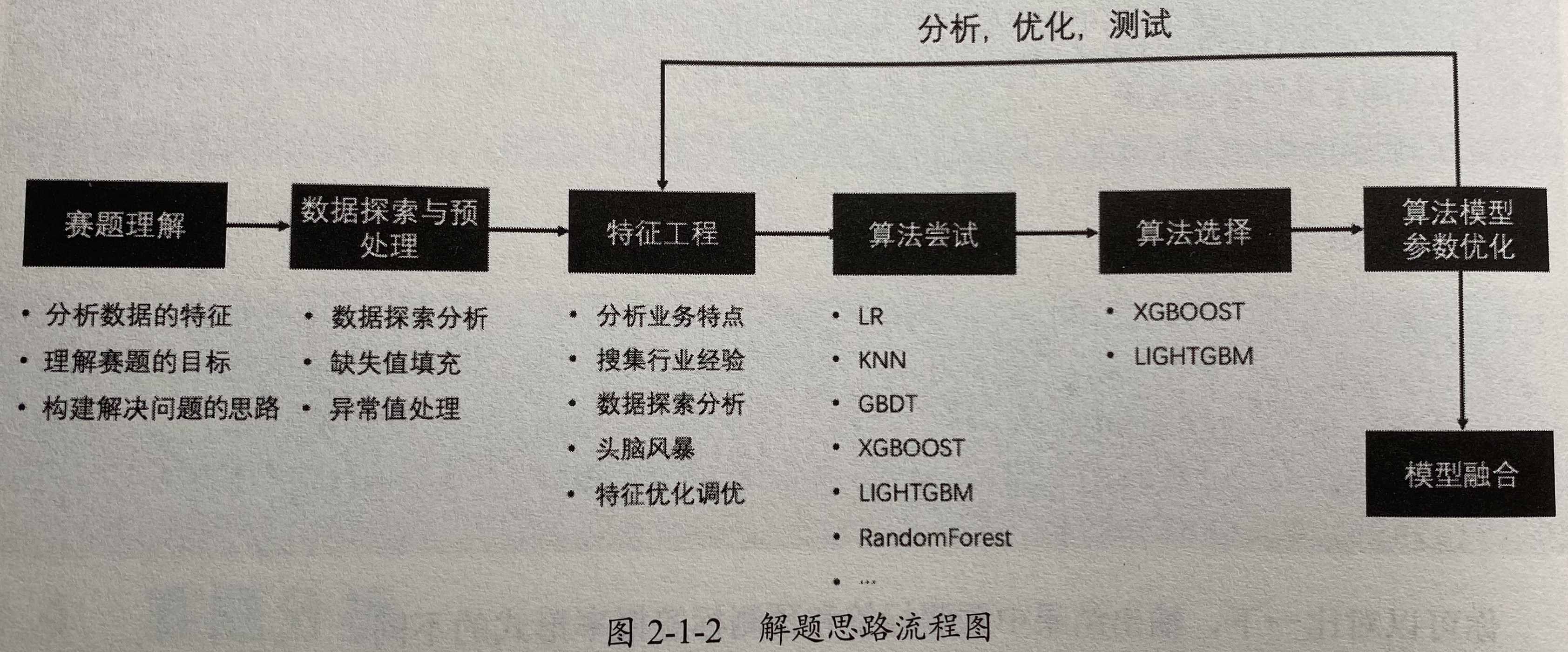
一个典型的机器学习实战算法基本包括 1) 数据处理,2) 特征选取、优化,和 3) 模型选取、验证、优化。 因为 “数据和特征决定了机器学习的上限,而模型和算法知识逼近这个上限而已。” 所以在解决一个机器学习问题时大部分时间都会花在数据处理和特征优化上。
大家最好在jupyter notebook上一段一段地跑下面的代码,加深理解。
机器学习的基本知识可以康康我的其他文章哦 好康的。
import pandas as pd
import numpy as np

import warnings
warnings.filterwarnings("ignore")
train_data = pd.read_csv('train_all.csv',nrows=10000)
test_data = pd.read_csv('test_all.csv',nrows=100)
train_data.head()
test_data.head()
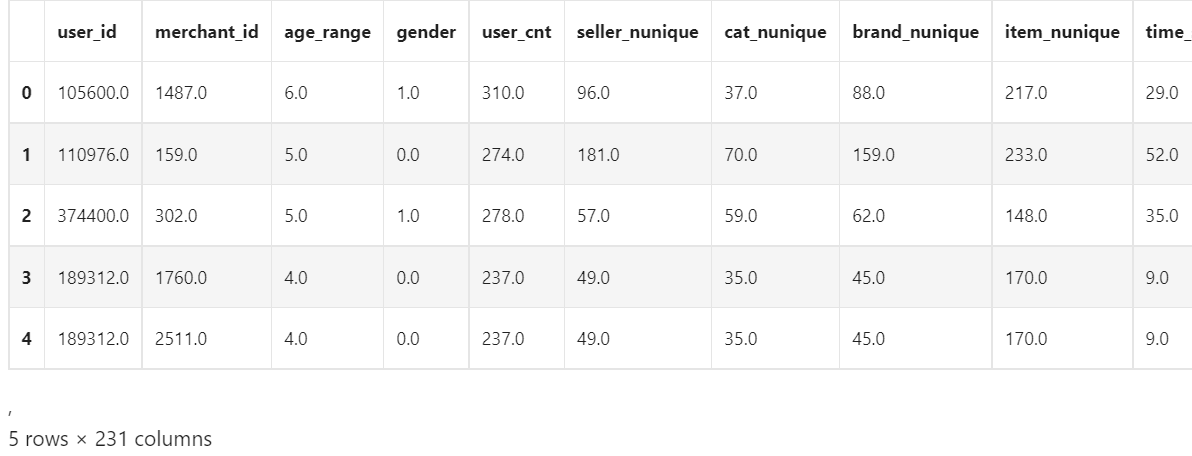
train_data.columns
features_columns = [col for col in train_data.columns if col not in ['user_id','label']]
train = train_data[features_columns].values
test = test_data[features_columns].values
target =train_data['label'].values
from sklearn.model_selection import train_test_split
from sklearn.ensemble import RandomForestClassifier

clf = RandomForestClassifier(n_estimators=100, max_depth=2, random_state=0, n_jobs=-1)
X_train, X_test, y_train, y_test = train_test_split(train, target, test_size=0.4, random_state=0)

print(X_train.shape, y_train.shape)
print(X_test.shape, y_test.shape)

clf = clf.fit(X_train, y_train)
clf.score(X_test, y_test)
from sklearn.model_selection import cross_val_score
from sklearn.ensemble import RandomForestClassifier

clf = RandomForestClassifier(n_estimators=100, max_depth=2, random_state=0, n_jobs=-1)
scores = cross_val_score(clf, train, target, cv=5)
print(scores)
print("Accuracy: %0.2f (+/- %0.2f)" % (scores.mean(), scores.std() * 2))
from sklearn import metrics
from sklearn.model_selection import cross_val_score
from sklearn.ensemble import RandomForestClassifier

clf = RandomForestClassifier(n_estimators=100, max_depth=2, random_state=0, n_jobs=-1)
scores = cross_val_score(clf, train, target, cv=5, scoring='f1_macro')
print(scores)
print("F1: %0.2f (+/- %0.2f)" % (scores.mean(), scores.std() * 2))
from sklearn.model_selection import ShuffleSplit
from sklearn.model_selection import cross_val_score
from sklearn.ensemble import RandomForestClassifier

clf = RandomForestClassifier(n_estimators=100, max_depth=2, random_state=0, n_jobs=-1)
cv = ShuffleSplit(n_splits=5, test_size=0.3, random_state=0)
cross_val_score(clf, train, target, cv=cv)
from sklearn.model_selection import train_test_split
from sklearn.model_selection import GridSearchCV
from sklearn.metrics import classification_report
from sklearn.ensemble import RandomForestClassifier


# Split the dataset in two equal parts
X_train, X_test, y_train, y_test = train_test_split(train, target, test_size=0.5, random_state=0)

# model
clf = RandomForestClassifier(n_jobs=-1)

# Set the parameters by cross-validation

tuned_parameters = {
                    'n_estimators': [50, 100, 200]
#                     ,'criterion': ['gini', 'entropy']
#                     ,'max_depth': [2, 5]
#                     ,'max_features': ['log2', 'sqrt', 'int']
#                     ,'bootstrap': [True, False]
#                     ,'warm_start': [True, False]
                    }

scores = ['precision']

for score in scores:
    print("# Tuning hyper-parameters for %s" % score)
    print()

    clf = GridSearchCV(clf, tuned_parameters, cv=5,
                       scoring='%s_macro' % score)
    clf.fit(X_train, y_train)

    print("Best parameters set found on development set:")
    print()
    print(clf.best_params_)
    print()
    print("Grid scores on development set:")
    print()
    means = clf.cv_results_['mean_test_score']
    stds = clf.cv_results_['std_test_score']
    for mean, std, params in zip(means, stds, clf.cv_results_['params']):
        print("%0.3f (+/-%0.03f) for %r"
              % (mean, std * 2, params))
    print()

    print("Detailed classification report:")
    print()
    print("The model is trained on the full development set.")
    print("The scores are computed on the full evaluation set.")
    print()
    y_true, y_pred = y_test, clf.predict(X_test)
    print(classification_report(y_true, y_pred))
    print()
import itertools
import numpy as np
import matplotlib.pyplot as plt

from sklearn.model_selection import train_test_split
from sklearn.metrics import confusion_matrix
from sklearn.ensemble import RandomForestClassifier

# label name
class_names = ['no-repeat', 'repeat']

# Split the data into a training set and a test set
X_train, X_test, y_train, y_test = train_test_split(train, target, random_state=0)

# Run classifier, using a model that is too regularized (C too low) to see
# the impact on the results
clf = RandomForestClassifier(n_jobs=-1)
y_pred = clf.fit(X_train, y_train).predict(X_test)


def plot_confusion_matrix(cm, classes,
                          normalize=False,
                          title='Confusion matrix',
                          cmap=plt.cm.Blues):
    """
    This function prints and plots the confusion matrix.
    Normalization can be applied by setting `normalize=True`.
    """
    if normalize:
        cm = cm.astype('float') / cm.sum(axis=1)[:, np.newaxis]
        print("Normalized confusion matrix")
    else:
        print('Confusion matrix, without normalization')

    print(cm)

    plt.imshow(cm, interpolation='nearest', cmap=cmap)
    plt.title(title)
    plt.colorbar()
    tick_marks = np.arange(len(classes))
    plt.xticks(tick_marks, classes, rotation=45)
    plt.yticks(tick_marks, classes)

    fmt = '.2f' if normalize else 'd'
    thresh = cm.max() / 2.
    for i, j in itertools.product(range(cm.shape[0]), range(cm.shape[1])):
        plt.text(j, i, format(cm[i, j], fmt),
                 horizontalalignment="center",
                 color="white" if cm[i, j] > thresh else "black")

    plt.ylabel('True label')
    plt.xlabel('Predicted label')
    plt.tight_layout()


# Compute confusion matrix
cnf_matrix = confusion_matrix(y_test, y_pred)
np.set_printoptions(precision=2)

# Plot non-normalized confusion matrix
plt.figure()
plot_confusion_matrix(cnf_matrix, classes=class_names,
                      title='Confusion matrix, without normalization')

# Plot normalized confusion matrix
plt.figure()
plot_confusion_matrix(cnf_matrix, classes=class_names, normalize=True,
                      title='Normalized confusion matrix')

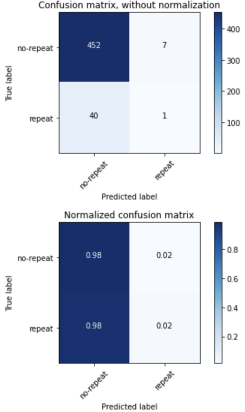
plt.show()
from sklearn.metrics import classification_report
from sklearn.ensemble import RandomForestClassifier

# label name
class_names = ['no-repeat', 'repeat']

# Split the data into a training set and a test set
X_train, X_test, y_train, y_test = train_test_split(train, target, random_state=0)

# Run classifier, using a model that is too regularized (C too low) to see
# the impact on the results
clf = RandomForestClassifier(n_jobs=-1)
y_pred = clf.fit(X_train, y_train).predict(X_test)

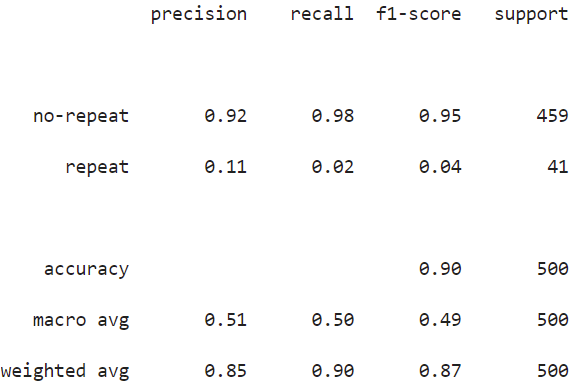
print(classification_report(y_test, y_pred, target_names=class_names))
from sklearn.linear_model import LinearRegression
from sklearn.linear_model import LogisticRegression
from sklearn.preprocessing import StandardScaler

stdScaler = StandardScaler()
X = stdScaler.fit_transform(train)

# Split the data into a training set and a test set
X_train, X_test, y_train, y_test = train_test_split(X, target, random_state=0)

clf = LogisticRegression(random_state=0, solver='lbfgs', multi_class='multinomial').fit(X_train, y_train)
clf.score(X_test, y_test)
from sklearn.neighbors import KNeighborsClassifier
from sklearn.preprocessing import StandardScaler

stdScaler = StandardScaler()
X = stdScaler.fit_transform(train)

# Split the data into a training set and a test set
X_train, X_test, y_train, y_test = train_test_split(X, target, random_state=0)

clf = KNeighborsClassifier(n_neighbors=3).fit(X_train, y_train)
clf.score(X_test, y_test)
from sklearn import tree

# Split the data into a training set and a test set
X_train, X_test, y_train, y_test = train_test_split(train, target, random_state=0)

clf = tree.DecisionTreeClassifier()
clf = clf.fit(X_train, y_train)
clf.score(X_test, y_test)
from sklearn.ensemble import BaggingClassifier
from sklearn.neighbors import KNeighborsClassifier

# Split the data into a training set and a test set
X_train, X_test, y_train, y_test = train_test_split(train, target, random_state=0)
clf = BaggingClassifier(KNeighborsClassifier(), max_samples=0.5, max_features=0.5)

clf = clf.fit(X_train, y_train)
clf.score(X_test, y_test)
from sklearn.ensemble import RandomForestClassifier

# Split the data into a training set and a test set
X_train, X_test, y_train, y_test = train_test_split(train, target, random_state=0)
clf = clf = RandomForestClassifier(n_estimators=10, max_depth=3, min_samples_split=12, random_state=0)

clf = clf.fit(X_train, y_train)
clf.score(X_test, y_test)
from sklearn.ensemble import ExtraTreesClassifier

# Split the data into a training set and a test set
X_train, X_test, y_train, y_test = train_test_split(train, target, random_state=0)
clf = ExtraTreesClassifier(n_estimators=10, max_depth=None, min_samples_split=2, random_state=0)

clf = clf.fit(X_train, y_train)
clf.score(X_test, y_test)
clf.n_features_
clf.feature_importances_[:10]
from sklearn.ensemble import AdaBoostClassifier

# Split the data into a training set and a test set
X_train, X_test, y_train, y_test = train_test_split(train, target, random_state=0)
clf = AdaBoostClassifier(n_estimators=10)

clf = clf.fit(X_train, y_train)
clf.score(X_test, y_test)
from sklearn.ensemble import GradientBoostingClassifier

# Split the data into a training set and a test set
X_train, X_test, y_train, y_test = train_test_split(train, target, random_state=0)
clf = GradientBoostingClassifier(n_estimators=10, learning_rate=1.0, max_depth=1, random_state=0)

clf = clf.fit(X_train, y_train)
clf.score(X_test, y_test)
from sklearn import datasets
from sklearn.model_selection import cross_val_score
from sklearn.linear_model import LogisticRegression
from sklearn.naive_bayes import GaussianNB
from sklearn.ensemble import RandomForestClassifier
from sklearn.ensemble import VotingClassifier
from sklearn.preprocessing import StandardScaler

stdScaler = StandardScaler()
X = stdScaler.fit_transform(train)
y = target


clf1 = LogisticRegression(solver='lbfgs', multi_class='multinomial', random_state=1)
clf2 = RandomForestClassifier(n_estimators=50, random_state=1)
clf3 = GaussianNB()

eclf = VotingClassifier(estimators=[('lr', clf1), ('rf', clf2), ('gnb', clf3)], voting='hard')

for clf, label in zip([clf1, clf2, clf3, eclf], ['Logistic Regression', 'Random Forest', 'naive Bayes', 'Ensemble']):
    scores = cross_val_score(clf, X, y, cv=5, scoring='accuracy')
    print("Accuracy: %0.2f (+/- %0.2f) [%s]" % (scores.mean(), scores.std(), label))
import lightgbm

X_train, X_test, y_train, y_test = train_test_split(train, target, test_size=0.4, random_state=0)
X_test, X_valid, y_test, y_valid = train_test_split(X_test, y_test, test_size=0.5, random_state=0)

clf = lightgbm

train_matrix = clf.Dataset(X_train, label=y_train)
test_matrix = clf.Dataset(X_test, label=y_test)
params = {
          'boosting_type': 'gbdt',
          #'boosting_type': 'dart',
          'objective': 'multiclass',
          'metric': 'multi_logloss',
          'min_child_weight': 1.5,
          'num_leaves': 2**5,
          'lambda_l2': 10,
          'subsample': 0.7,
          'colsample_bytree': 0.7,
          'colsample_bylevel': 0.7,
          'learning_rate': 0.03,
          'tree_method': 'exact',
          'seed': 2017,
          "num_class": 2,
          'silent': True,
          }
num_round = 10000
early_stopping_rounds = 100
model = clf.train(params,
                  train_matrix,
                  num_round,
                  valid_sets=test_matrix,
                  early_stopping_rounds=early_stopping_rounds)
pre= model.predict(X_valid,num_iteration=model.best_iteration)
print('score : ', np.mean((pre[:,1]>0.5)==y_valid))
import xgboost

X_train, X_test, y_train, y_test = train_test_split(train, target, test_size=0.4, random_state=0)
X_test, X_valid, y_test, y_valid = train_test_split(X_test, y_test, test_size=0.5, random_state=0)

clf = xgboost

train_matrix = clf.DMatrix(X_train, label=y_train, missing=-1)
test_matrix = clf.DMatrix(X_test, label=y_test, missing=-1)
z = clf.DMatrix(X_valid, label=y_valid, missing=-1)
params = {'booster': 'gbtree',
          'objective': 'multi:softprob',
          'eval_metric': 'mlogloss',
          'gamma': 1,
          'min_child_weight': 1.5,
          'max_depth': 5,
          'lambda': 100,
          'subsample': 0.7,
          'colsample_bytree': 0.7,
          'colsample_bylevel': 0.7,
          'eta': 0.03,
          'tree_method': 'exact',
          'seed': 2017,
          "num_class": 2
          }

num_round = 10000
early_stopping_rounds = 100
watchlist = [(train_matrix, 'train'),
             (test_matrix, 'eval')
             ]

model = clf.train(params,
                  train_matrix,
                  num_boost_round=num_round,
                  evals=watchlist,
                  early_stopping_rounds=early_stopping_rounds
                  )
pre = model.predict(z,ntree_limit=model.best_ntree_limit)
print('score : ', np.mean((pre[:,1]>0.3)==y_valid))
"""
    导入相关包
"""
import pandas as pd
import numpy as np
import lightgbm as lgb
from sklearn.metrics import f1_score
from sklearn.model_selection import train_test_split
from sklearn.model_selection import KFold
from sklearn.model_selection import StratifiedKFold

class SBBTree():
    """
        SBBTree
        Stacking,Bootstap,Bagging
    """
    def __init__(
                    self,
                    params,
                    stacking_num,
                    bagging_num,
                    bagging_test_size,
                    num_boost_round,
                    early_stopping_rounds
                ):
        """
            Initializes the SBBTree.
            Args:
              params : lgb params.
              stacking_num : k_flod stacking.
              bagging_num : bootstrap num.
              bagging_test_size : bootstrap sample rate.
              num_boost_round : boost num.
              early_stopping_rounds : early_stopping_rounds.
        """
        self.params = params
        self.stacking_num = stacking_num
        self.bagging_num = bagging_num
        self.bagging_test_size = bagging_test_size
        self.num_boost_round = num_boost_round
        self.early_stopping_rounds = early_stopping_rounds

        self.model = lgb
        self.stacking_model = []
        self.bagging_model = []

    def fit(self, X, y):
        """ fit model. """
        if self.stacking_num > 1:
            layer_train = np.zeros((X.shape[0], 2))
            self.SK = StratifiedKFold(n_splits=self.stacking_num, shuffle=True, random_state=1)
            for k,(train_index, test_index) in enumerate(self.SK.split(X, y)):
                X_train = X[train_index]
                y_train = y[train_index]
                X_test = X[test_index]
                y_test = y[test_index]

                lgb_train = lgb.Dataset(X_train, y_train)
                lgb_eval = lgb.Dataset(X_test, y_test, reference=lgb_train)

                gbm = lgb.train(self.params,
                            lgb_train,
                            num_boost_round=self.num_boost_round,
                            valid_sets=lgb_eval,
                            early_stopping_rounds=self.early_stopping_rounds)

                self.stacking_model.append(gbm)

                pred_y = gbm.predict(X_test, num_iteration=gbm.best_iteration)
                layer_train[test_index, 1] = pred_y

            X = np.hstack((X, layer_train[:,1].reshape((-1,1))))
        else:
            pass
        for bn in range(self.bagging_num):
            X_train, X_test, y_train, y_test = train_test_split(X, y, test_size=self.bagging_test_size, random_state=bn)

            lgb_train = lgb.Dataset(X_train, y_train)
            lgb_eval = lgb.Dataset(X_test, y_test, reference=lgb_train)

            gbm = lgb.train(self.params,
                        lgb_train,
                        num_boost_round=10000,
                        valid_sets=lgb_eval,
                        early_stopping_rounds=200)

            self.bagging_model.append(gbm)

    def predict(self, X_pred):
        """ predict test data. """
        if self.stacking_num > 1:
            test_pred = np.zeros((X_pred.shape[0], self.stacking_num))
            for sn,gbm in enumerate(self.stacking_model):
                pred = gbm.predict(X_pred, num_iteration=gbm.best_iteration)
                test_pred[:, sn] = pred
            X_pred = np.hstack((X_pred, test_pred.mean(axis=1).reshape((-1,1))))
        else:
            pass
        for bn,gbm in enumerate(self.bagging_model):
            pred = gbm.predict(X_pred, num_iteration=gbm.best_iteration)
            if bn == 0:
                pred_out=pred
            else:
                pred_out+=pred
        return pred_out/self.bagging_num
"""
    TEST CODE
"""
from sklearn.datasets import make_classification
from sklearn.datasets import load_breast_cancer
from sklearn.datasets import make_gaussian_quantiles
from sklearn import metrics
from sklearn.metrics import f1_score
# X, y = make_classification(n_samples=1000, n_features=25, n_clusters_per_class=1, n_informative=15, random_state=1)
X, y = make_gaussian_quantiles(mean=None, cov=1.0, n_samples=1000, n_features=50, n_classes=2, shuffle=True, random_state=2)
# data = load_breast_cancer()
# X, y = data.data, data.target
X_train, X_test, y_train, y_test = train_test_split(X, y, test_size=0.33, random_state=1)
params = {
        'task': 'train',
        'boosting_type': 'gbdt',
        'objective': 'binary',
        'metric': 'auc',
        'num_leaves': 9,
        'learning_rate': 0.03,
        'feature_fraction_seed': 2,
        'feature_fraction': 0.9,
        'bagging_fraction': 0.8,
        'bagging_freq': 5,
        'min_data': 20,
        'min_hessian': 1,
        'verbose': -1,
        'silent': 0
        }
# test 1
model = SBBTree(params=params, stacking_num=2, bagging_num=1,  bagging_test_size=0.33, num_boost_round=10000, early_stopping_rounds=200)
model.fit(X,y)
X_pred = X[0].reshape((1,-1))
pred=model.predict(X_pred)
print('pred')
print(pred)
print('TEST 1 ok')


# test 1
model = SBBTree(params, stacking_num=1, bagging_num=1, bagging_test_size=0.33, num_boost_round=10000, early_stopping_rounds=200)
model.fit(X_train,y_train)
pred1=model.predict(X_test)

# test 2
model = SBBTree(params, stacking_num=1, bagging_num=3, bagging_test_size=0.33, num_boost_round=10000, early_stopping_rounds=200)
model.fit(X_train,y_train)
pred2=model.predict(X_test)

# test 3
model = SBBTree(params, stacking_num=5, bagging_num=1, bagging_test_size=0.33, num_boost_round=10000, early_stopping_rounds=200)
model.fit(X_train,y_train)
pred3=model.predict(X_test)

# test 4
model = SBBTree(params, stacking_num=5, bagging_num=3, bagging_test_size=0.33, num_boost_round=10000, early_stopping_rounds=200)
model.fit(X_train,y_train)
pred4=model.predict(X_test)

fpr, tpr, thresholds = metrics.roc_curve(y_test+1, pred1, pos_label=2)
print('auc: ',metrics.auc(fpr, tpr))

fpr, tpr, thresholds = metrics.roc_curve(y_test+1, pred2, pos_label=2)
print('auc: ',metrics.auc(fpr, tpr))

fpr, tpr, thresholds = metrics.roc_curve(y_test+1, pred3, pos_label=2)
print('auc: ',metrics.auc(fpr, tpr))

fpr, tpr, thresholds = metrics.roc_curve(y_test+1, pred4, pos_label=2)
print('auc: ',metrics.auc(fpr, tpr))


# auc:  0.7281621243885396
# auc:  0.7710471146419509
# auc:  0.7894369046305492
# auc:  0.8084519474787597
import pandas as pd
import numpy as np
import lightgbm as lgb
from sklearn.metrics import f1_score
from sklearn.model_selection import train_test_split
from sklearn.model_selection import KFold
from sklearn.model_selection import StratifiedKFold

train_data = pd.read_csv('train_all.csv',nrows=10000)
test_data = pd.read_csv('test_all.csv',nrows=100)

features_columns = [col for col in train_data.columns if col not in ['user_id','label']]
train = train_data[features_columns].values
test = test_data[features_columns].values
target =train_data['label'].values
params = {
        'task': 'train',
        'boosting_type': 'gbdt',
        'objective': 'binary',
        'metric': 'auc',
        'num_leaves': 9,
        'learning_rate': 0.03,
        'feature_fraction_seed': 2,
        'feature_fraction': 0.9,
        'bagging_fraction': 0.8,
        'bagging_freq': 5,
        'min_data': 20,
        'min_hessian': 1,
        'verbose': -1,
        'silent': 0
        }

model = SBBTree(params=params,
                stacking_num=5,
                bagging_num=3,
                bagging_test_size=0.33,
                num_boost_round=10000,
                early_stopping_rounds=200)
model.fit(train, target)
pred = model.predict(test)
df_out = pd.DataFrame()
df_out['user_id'] = test_data['user_id'].astype(int)
df_out['predict_prob'] = pred
df_out.head()
"""
    保留数据头,不保存index
"""
df_out.to_csv('df_out.csv',header=True,index=False)
print('save OK!')
以上内容和代码全部来自于《阿里云天池大赛赛题解析(机器学习篇)》这本好书,十分推荐大家去阅读原书!
如何在buildr项目中使用Ruby?我在很多不同的项目中使用过Ruby、JRuby、Java和Clojure。我目前正在使用我的标准Ruby开发一个模拟应用程序,我想尝试使用Clojure后端(我确实喜欢功能代码)以及JRubygui和测试套件。我还可以看到在未来的不同项目中使用Scala作为后端。我想我要为我的项目尝试一下buildr(http://buildr.apache.org/),但我注意到buildr似乎没有设置为在项目中使用JRuby代码本身!这看起来有点傻,因为该工具旨在统一通用的JVM语言并且是在ruby中构建的。除了将输出的jar包含在一个独特的、仅限ruby
在rails源中:https://github.com/rails/rails/blob/master/activesupport/lib/active_support/lazy_load_hooks.rb可以看到以下内容@load_hooks=Hash.new{|h,k|h[k]=[]}在IRB中,它只是初始化一个空哈希。和做有什么区别@load_hooks=Hash.new 最佳答案 查看rubydocumentationforHashnew→new_hashclicktotogglesourcenew(obj)→new_has
我的主要目标是能够完全理解我正在使用的库/gem。我尝试在Github上从头到尾阅读源代码,但这真的很难。我认为更有趣、更温和的踏脚石就是在使用时阅读每个库/gem方法的源代码。例如,我想知道RubyonRails中的redirect_to方法是如何工作的:如何查找redirect_to方法的源代码?我知道在pry中我可以执行类似show-methodmethod的操作,但我如何才能对Rails框架中的方法执行此操作?您对我如何更好地理解Gem及其API有什么建议吗?仅仅阅读源代码似乎真的很难,尤其是对于框架。谢谢! 最佳答案 Ru
我的假设是moduleAmoduleBendend和moduleA::Bend是一样的。我能够从thisblog找到解决方案,thisSOthread和andthisSOthread.为什么以及什么时候应该更喜欢紧凑语法A::B而不是另一个,因为它显然有一个缺点?我有一种直觉,它可能与性能有关,因为在更多命名空间中查找常量需要更多计算。但是我无法通过对普通类进行基准测试来验证这一点。 最佳答案 这两种写作方法经常被混淆。首先要说的是,据我所知,没有可衡量的性能差异。(在下面的书面示例中不断查找)最明显的区别,可能也是最著名的,是你的
几个月前,我读了一篇关于rubygem的博客文章,它可以通过阅读代码本身来确定编程语言。对于我的生活,我不记得博客或gem的名称。谷歌搜索“ruby编程语言猜测”及其变体也无济于事。有人碰巧知道相关gem的名称吗? 最佳答案 是这个吗:http://github.com/chrislo/sourceclassifier/tree/master 关于ruby-寻找通过阅读代码确定编程语言的rubygem?,我们在StackOverflow上找到一个类似的问题:
这似乎非常适得其反,因为太多的gem会在window上破裂。我一直在处理很多mysql和ruby-mysqlgem问题(gem本身发生段错误,一个名为UnixSocket的类显然在Windows机器上不能正常工作,等等)。我只是在浪费时间吗?我应该转向不同的脚本语言吗? 最佳答案 我在Windows上使用Ruby的经验很少,但是当我开始使用Ruby时,我是在Windows上,我的总体印象是它不是Windows原生系统。因此,在主要使用Windows多年之后,开始使用Ruby促使我切换回原来的系统Unix,这次是Linux。Rub
我目前正在使用以下方法获取页面的源代码:Net::HTTP.get(URI.parse(page.url))我还想获取HTTP状态,而无需发出第二个请求。有没有办法用另一种方法做到这一点?我一直在查看文档,但似乎找不到我要找的东西。 最佳答案 在我看来,除非您需要一些真正的低级访问或控制,否则最好使用Ruby的内置Open::URI模块:require'open-uri'io=open('http://www.example.org/')#=>#body=io.read[0,50]#=>"["200","OK"]io.base_ur
前言作为一名程序员,自己的本质工作就是做程序开发,那么程序开发的时候最直接的体现就是代码,检验一个程序员技术水平的一个核心环节就是开发时候的代码能力。众所周知,程序开发的水平提升是一个循序渐进的过程,每一位程序员都是从“菜鸟”变成“大神”的,所以程序员在程序开发过程中的代码能力也是根据平时开发中的业务实践来积累和提升的。提高代码能力核心要素程序员要想提高自身代码能力,尤其是新晋程序员的代码能力有很大的提升空间的时候,需要针对性的去提高自己的代码能力。提高代码能力其实有几个比较关键的点,只要把握住这些方面,就能很好的、快速的提高自己的一部分代码能力。1、多去阅读开源项目,如有机会可以亲自参与开源
嗨~大家好,这里是可莉!今天给大家带来的是7个C语言的经典基础代码~那一起往下看下去把【程序一】打印100到200之间的素数#includeintmain(){ inti; for(i=100;i 【程序二】输出乘法口诀表#includeintmain(){inti;for(i=1;i 【程序三】判断1000年---2000年之间的闰年#includeintmain(){intyear;for(year=1000;year 【程序四】给定两个整形变量的值,将两个值的内容进行交换。这里提供两种方法来进行交换,第一种为创建临时变量来进行交换,第二种是不创建临时变量而直接进行交换。1.创建临时变量来
目录前言滤波电路科普主要分类实际情况单位的概念常用评价参数函数型滤波器简单分析滤波电路构成低通滤波器RC低通滤波器RL低通滤波器高通滤波器RC高通滤波器RL高通滤波器部分摘自《LC滤波器设计与制作》,侵权删。前言最近需要学习放大电路和滤波电路,但是由于只在之前做音乐频谱分析仪的时候简单了解过一点点运放,所以也是相当从零开始学习了。滤波电路科普主要分类滤波器:主要是从不同频率的成分中提取出特定频率的信号。有源滤波器:由RC元件与运算放大器组成的滤波器。可滤除某一次或多次谐波,最普通易于采用的无源滤波器结构是将电感与电容串联,可对主要次谐波(3、5、7)构成低阻抗旁路。无源滤波器:无源滤波器,又称
