作者:明明如月学长
链接:https://juejin.cn/post/7118073840999071751
有些业务场景下需要将 Java Bean 转成 Map 再使用。
本以为很简单场景,但是坑很多。
import lombok.Data;

import java.util.Date;

@Data
public class MockObject extends  MockParent{

    private Integer aInteger;

    private Long aLong;

    private Double aDouble;

    private Date aDate;
}
父类
import lombok.Data;

@Data
public class MockParent {
    private Long parent;
}
将 Java Bean 转 Map 最常见的手段就是使用 JSON 框架,如 fastjson 、 gson、jackson 等。 但使用 JSON 将 Java Bean 转 Map 会导致部分数据类型丢失。 如使用 fastjson ,当属性为 Long 类型但数字小于 Integer 最大值时,反序列成 Map 之后,将变为 Integer 类型。
maven 依赖:
<!-- https://mvnrepository.com/artifact/com.alibaba/fastjson -->
<dependency>
    <groupId>com.alibaba</groupId>
    <artifactId>fastjson</artifactId>
    <version>2.0.8</version>
</dependency>
示例代码:
import com.alibaba.fastjson.JSON;
import com.alibaba.fastjson.TypeReference;

import java.util.Date;
import java.util.Map;

public class JsonDemo {

    public static void main(String[] args) {
        MockObject mockObject = new MockObject();
        mockObject.setAInteger(1);
        mockObject.setALong(2L);
        mockObject.setADate(new Date());
        mockObject.setADouble(3.4D);
        mockObject.setParent(3L);

       String json = JSON.toJSONString(mockObject);

        Map<String,Object> map =  JSON.parseObject(json, new TypeReference<Map<String,Object>>(){});

        System.out.println(map);
    }
}
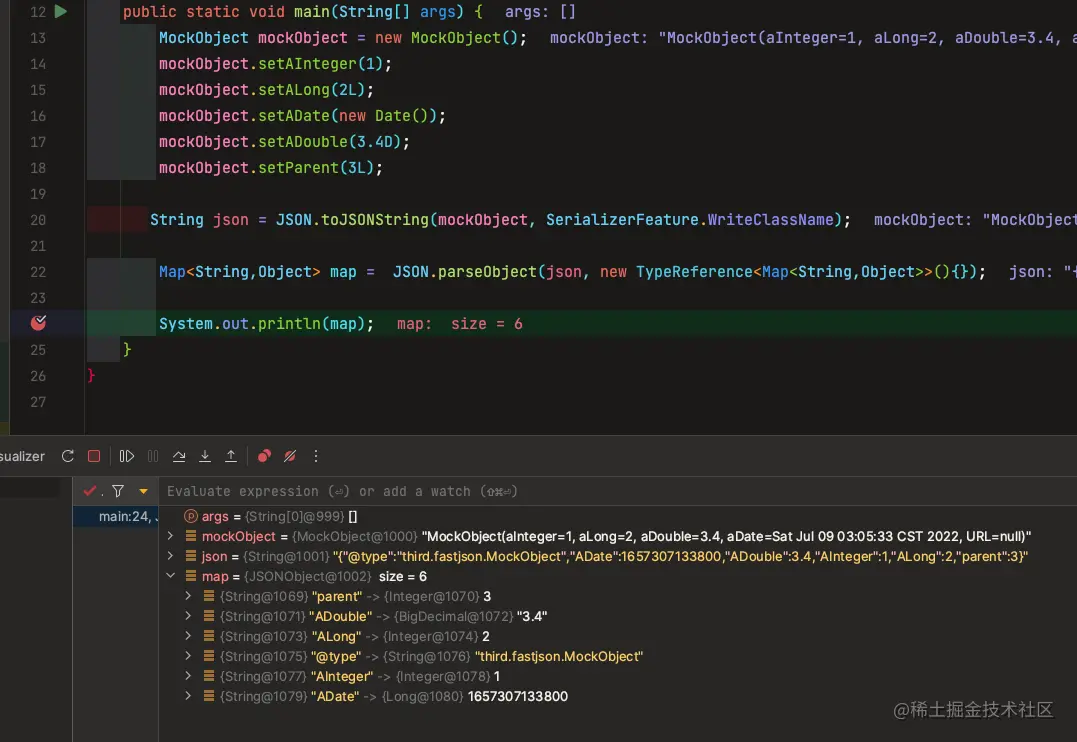
结果打印:
调试截图:
 通过 Java Visualizer 插件进行可视化查看:
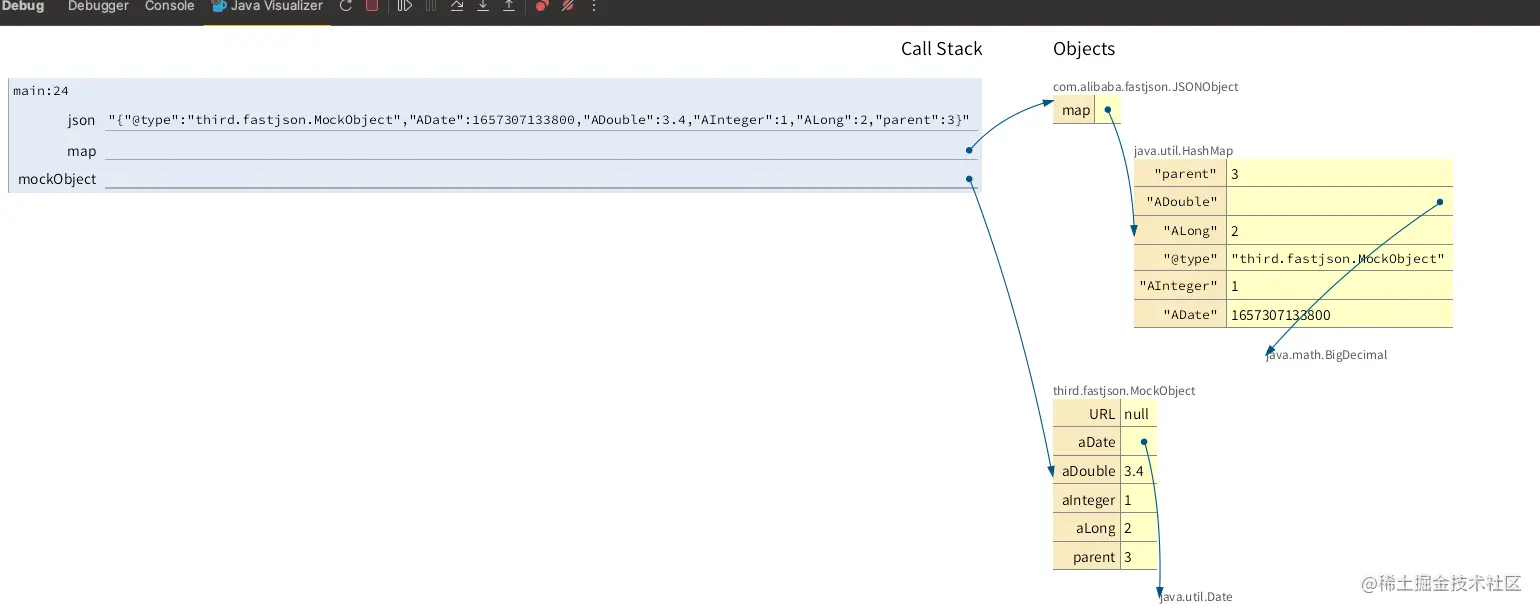
存在两个问题 (1) 通过 fastjson 将 Java Bean 转为 Map ,类型会发生转变。 如 Long 变成 Integer ,Date 变成 Long, Double 变成 Decimal 类型等。 (2)在某些场景下,Map 的 key 并非和属性名完全对应,像是通过 get set 方法“推断”出来的属性名。
maven 版本:
<!-- https://mvnrepository.com/artifact/commons-beanutils/commons-beanutils -->
<dependency>
    <groupId>commons-beanutils</groupId>
    <artifactId>commons-beanutils</artifactId>
    <version>1.9.4</version>
</dependency>
代码示例:
import org.apache.commons.beanutils.BeanMap;
import third.fastjson.MockObject;

import java.util.Date;

public class BeanUtilsDemo {
    public static void main(String[] args) {
        MockObject mockObject = new MockObject();
        mockObject.setAInteger(1);
        mockObject.setALong(2L);
        mockObject.setADate(new Date());
        mockObject.setADouble(3.4D);
        mockObject.setParent(3L);

        BeanMap beanMap = new BeanMap(mockObject);
        System.out.println(beanMap);
    }
}
调试截图:
 存在和 cglib 一样的问题,虽然类型没问题但是属性名还是不对。
原因分析:
/**
 * Constructs a new <code>BeanMap</code> that operates on the
 * specified bean.  If the given bean is <code>null</code>, then
 * this map will be empty.
 *
 * @param bean  the bean for this map to operate on
 */
public BeanMap(final Object bean) {
    this.bean = bean;
    initialise();
}
关键代码:
private void initialise() {
    if(getBean() == null) {
        return;
    }

    final Class<? extends Object>  beanClass = getBean().getClass();
    try {
        //BeanInfo beanInfo = Introspector.getBeanInfo( bean, null );
        final BeanInfo beanInfo = Introspector.getBeanInfo( beanClass );
        final PropertyDescriptor[] propertyDescriptors = beanInfo.getPropertyDescriptors();
        if ( propertyDescriptors != null ) {
            for (final PropertyDescriptor propertyDescriptor : propertyDescriptors) {
                if ( propertyDescriptor != null ) {
                    final String name = propertyDescriptor.getName();
                    final Method readMethod = propertyDescriptor.getReadMethod();
                    final Method writeMethod = propertyDescriptor.getWriteMethod();
                    final Class<? extends Object> aType = propertyDescriptor.getPropertyType();

                    if ( readMethod != null ) {
                        readMethods.put( name, readMethod );
                    }
                    if ( writeMethod != null ) {
                        writeMethods.put( name, writeMethod );
                    }
                    types.put( name, aType );
                }
            }
        }
    }
    catch ( final IntrospectionException e ) {
        logWarn(  e );
    }
}
调试一下就会发现,问题出在 BeanInfo 里面 PropertyDescriptor 的 name 不正确。
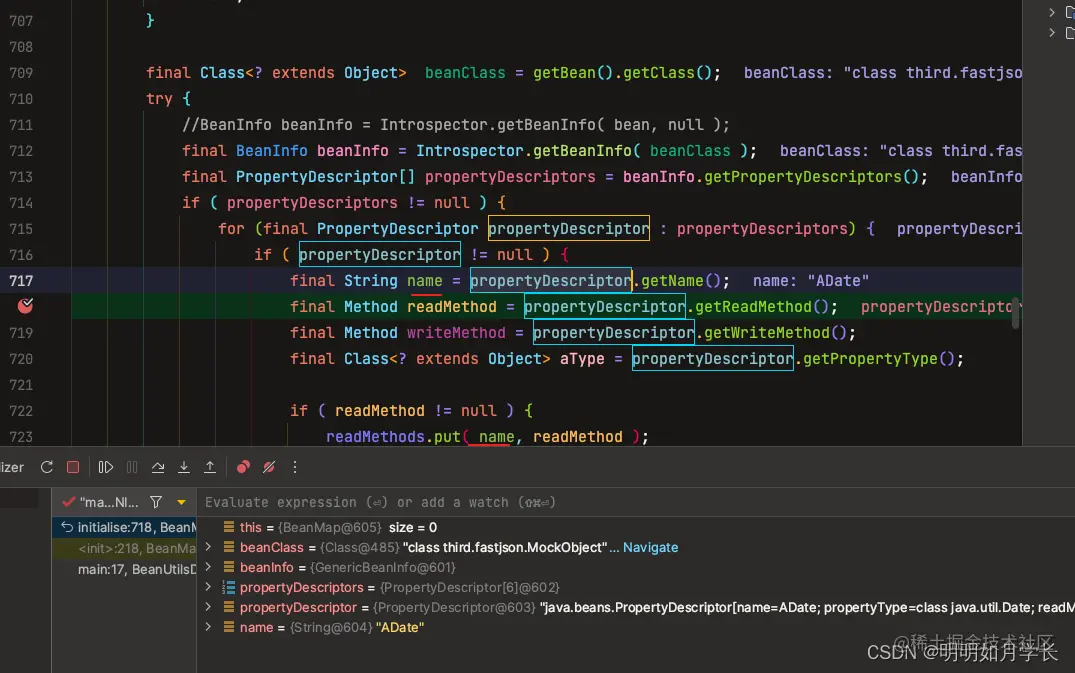
经过分析会发现 java.beans.Introspector#getTargetPropertyInfo 方法是字段解析的关键
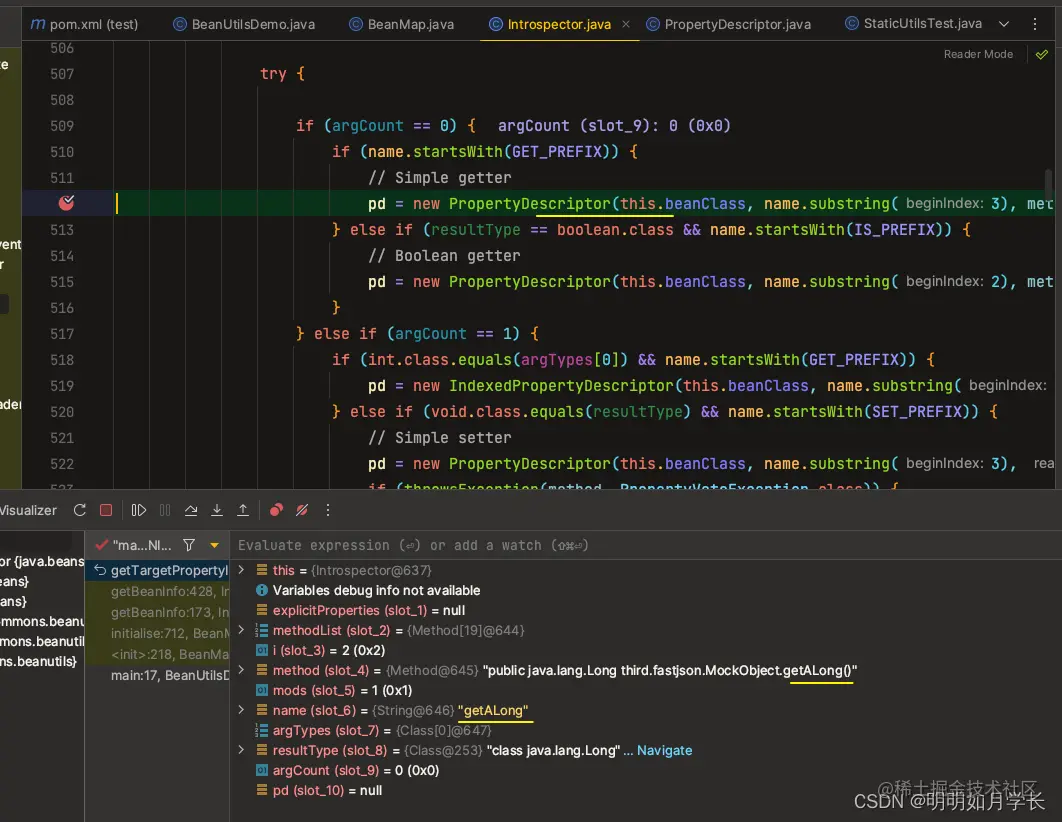 对于无参的以 get 开头的方法名从 index =3 处截取,如 getALong 截取后为 ALong, 如 getADouble 截取后为 ADouble。
然后去构造 PropertyDescriptor:
/**
 * Creates <code>PropertyDescriptor</code> for the specified bean
 * with the specified name and methods to read/write the property value.
 *
 * @param bean   the type of the target bean
 * @param base   the base name of the property (the rest of the method name)
 * @param read   the method used for reading the property value
 * @param write  the method used for writing the property value
 * @exception IntrospectionException if an exception occurs during introspection
 *
 * @since 1.7
 */
PropertyDescriptor(Class<?> bean, String base, Method read, Method write) throws IntrospectionException {
    if (bean == null) {
        throw new IntrospectionException("Target Bean class is null");
    }
    setClass0(bean);
    setName(Introspector.decapitalize(base));
    setReadMethod(read);
    setWriteMethod(write);
    this.baseName = base;
}
底层使用 java.beans.Introspector#decapitalize 进行解析:
/**
 * Utility method to take a string and convert it to normal Java variable
 * name capitalization.  This normally means converting the first
 * character from upper case to lower case, but in the (unusual) special
 * case when there is more than one character and both the first and
 * second characters are upper case, we leave it alone.
 * <p>
 * Thus "FooBah" becomes "fooBah" and "X" becomes "x", but "URL" stays
 * as "URL".
 *
 * @param  name The string to be decapitalized.
 * @return  The decapitalized version of the string.
 */
public static String decapitalize(String name) {
    if (name == null || name.length() == 0) {
        return name;
    }
    if (name.length() > 1 && Character.isUpperCase(name.charAt(1)) &&
                    Character.isUpperCase(name.charAt(0))){
        return name;
    }
    char chars[] = name.toCharArray();
    chars[0] = Character.toLowerCase(chars[0]);
    return new String(chars);
}
从代码中我们可以看出 (1) 当 name 的长度 > 1,且第一个字符和第二个字符都大写时,直接返回参数作为PropertyDescriptor name。 (2) 否则将 name 转为首字母小写
这种处理本意是为了不让属性为类似 URL 这种缩略词转为 uRL ,结果“误伤”了我们这种场景。
cglib 依赖
<!-- https://mvnrepository.com/artifact/cglib/cglib -->
<dependency>
        <groupId>cglib</groupId>
        <artifactId>cglib-nodep</artifactId>
        <version>3.2.12</version>
</dependency>
代码示例:
import net.sf.cglib.beans.BeanMap;
import third.fastjson.MockObject;

import java.util.Date;

public class BeanMapDemo {

    public static void main(String[] args) {

        MockObject mockObject = new MockObject();
        mockObject.setAInteger(1);
        mockObject.setALong(2L);
        mockObject.setADate(new Date());
        mockObject.setADouble(3.4D);
        mockObject.setParent(3L);

        BeanMap beanMapp = BeanMap.create(mockObject);

        System.out.println(beanMapp);
    }
}
结果展示: 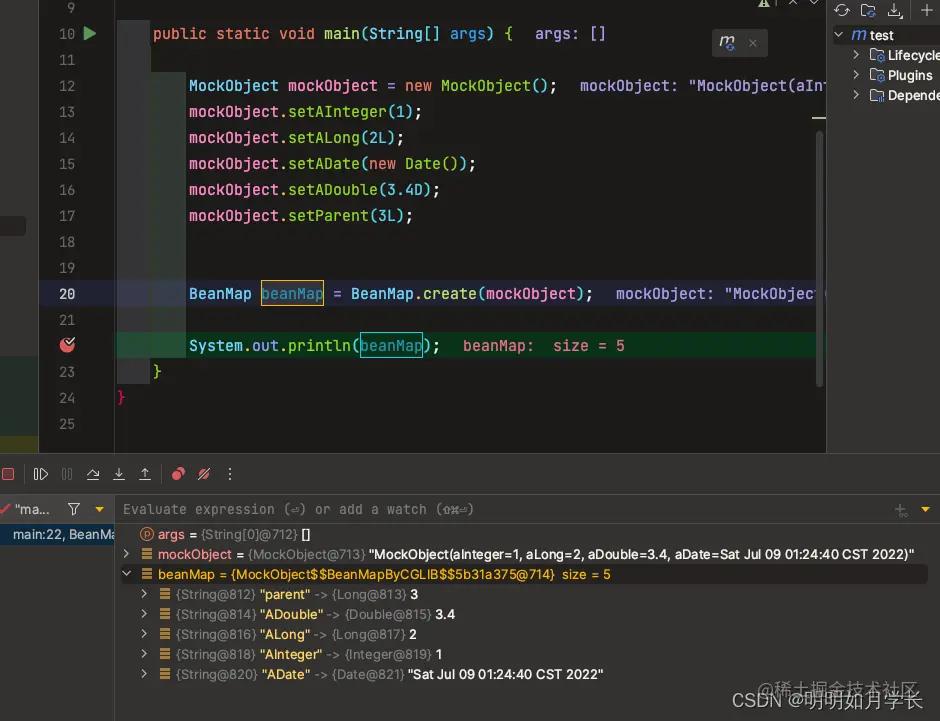 我们发现类型对了,但是属性名依然不对。
关键代码: net.sf.cglib.core.ReflectUtils#getBeanGetters 底层也会用到 java.beans.Introspector#decapitalize 所以属性名存在一样的问题就不足为奇了。
解决方案有很多,本文提供一个基于 dubbo的解决方案。
maven 依赖:
<!-- https://mvnrepository.com/artifact/org.apache.dubbo/dubbo -->
<dependency>
    <groupId>org.apache.dubbo</groupId>
    <artifactId>dubbo</artifactId>
    <version>3.0.9</version>
</dependency>
示例代码:
import org.apache.dubbo.common.utils.PojoUtils;
import third.fastjson.MockObject;

import java.util.Date;

public class DubboPojoDemo {
    public static void main(String[] args) {
        MockObject mockObject = new MockObject();
        mockObject.setAInteger(1);
        mockObject.setALong(2L);
        mockObject.setADate(new Date());
        mockObject.setADouble(3.4D);
        mockObject.setParent(3L);

        Object generalize = PojoUtils.generalize(mockObject);

        System.out.println(generalize);
    }
}
调试效果:
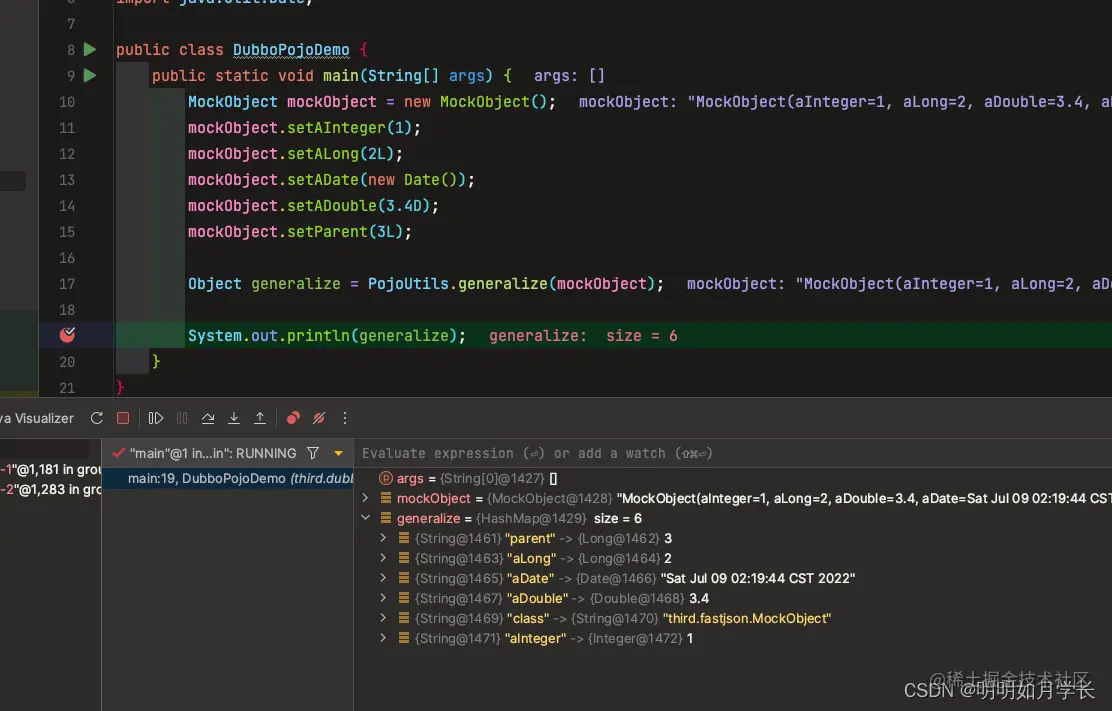 Java Visualizer 效果:
核心代码: org.apache.dubbo.common.utils.PojoUtils#generalize(java.lang.Object)
public static Object generalize(Object pojo) {
     eturn generalize(pojo, new IdentityHashMap());
}
关键代码:
// pojo 待转换的对象
// history 缓存 Map,提高性能
private static Object generalize(Object pojo, Map<Object, Object> history) {
    if (pojo == null) {
        return null;
    }

     // 枚举直接返回枚举名
    if (pojo instanceof Enum<?>) {
        return ((Enum<?>) pojo).name();
    }

    // 枚举数组,返回枚举名数组
    if (pojo.getClass().isArray() && Enum.class.isAssignableFrom(pojo.getClass().getComponentType())) {
        int len = Array.getLength(pojo);
        String[] values = new String[len];
        for (int i = 0; i < len; i++) {
            values[i] = ((Enum<?>) Array.get(pojo, i)).name();
        }
        return values;
    }

    // 基本类型返回 pojo 自身
    if (ReflectUtils.isPrimitives(pojo.getClass())) {
        return pojo;
    }

    // Class 返回 name
    if (pojo instanceof Class) {
        return ((Class) pojo).getName();
    }

    Object o = history.get(pojo);
    if (o != null) {
        return o;
    }
    history.put(pojo, pojo);

// 数组类型,递归
    if (pojo.getClass().isArray()) {
        int len = Array.getLength(pojo);
        Object[] dest = new Object[len];
        history.put(pojo, dest);
        for (int i = 0; i < len; i++) {
            Object obj = Array.get(pojo, i);
            dest[i] = generalize(obj, history);
        }
        return dest;
    }
// 集合类型递归
    if (pojo instanceof Collection<?>) {
        Collection<Object> src = (Collection<Object>) pojo;
        int len = src.size();
        Collection<Object> dest = (pojo instanceof List<?>) ? new ArrayList<Object>(len) : new HashSet<Object>(len);
        history.put(pojo, dest);
        for (Object obj : src) {
            dest.add(generalize(obj, history));
        }
        return dest;
    }
    // Map 类型,直接 对 key 和 value 处理
    if (pojo instanceof Map<?, ?>) {
        Map<Object, Object> src = (Map<Object, Object>) pojo;
        Map<Object, Object> dest = createMap(src);
        history.put(pojo, dest);
        for (Map.Entry<Object, Object> obj : src.entrySet()) {
            dest.put(generalize(obj.getKey(), history), generalize(obj.getValue(), history));
        }
        return dest;
    }
    Map<String, Object> map = new HashMap<String, Object>();
    history.put(pojo, map);

    // 开启生成 class 则写入 pojo 的class
    if (GENERIC_WITH_CLZ) {
        map.put("class", pojo.getClass().getName());
    }

  // 处理 get 方法
    for (Method method : pojo.getClass().getMethods()) {
        if (ReflectUtils.isBeanPropertyReadMethod(method)) {
            ReflectUtils.makeAccessible(method);
            try {
                map.put(ReflectUtils.getPropertyNameFromBeanReadMethod(method), generalize(method.invoke(pojo), history));
            } catch (Exception e) {
                throw new RuntimeException(e.getMessage(), e);
            }
        }
    }
    // 处理公有属性
    for (Field field : pojo.getClass().getFields()) {
        if (ReflectUtils.isPublicInstanceField(field)) {
            try {
                Object fieldValue = field.get(pojo);
                // 对象已经解析过,直接从缓存里读提高性能
                if (history.containsKey(pojo)) {
                    Object pojoGeneralizedValue = history.get(pojo);
                    // 已经解析过该属性则跳过(如公有属性,且有 get 方法的情况)
                    if (pojoGeneralizedValue instanceof Map
                        && ((Map) pojoGeneralizedValue).containsKey(field.getName())) {
                        continue;
                    }
                }
                if (fieldValue != null) {
                    map.put(field.getName(), generalize(fieldValue, history));
                }
            } catch (Exception e) {
                throw new RuntimeException(e.getMessage(), e);
            }
        }
    }
    return map;
}
关键截图 
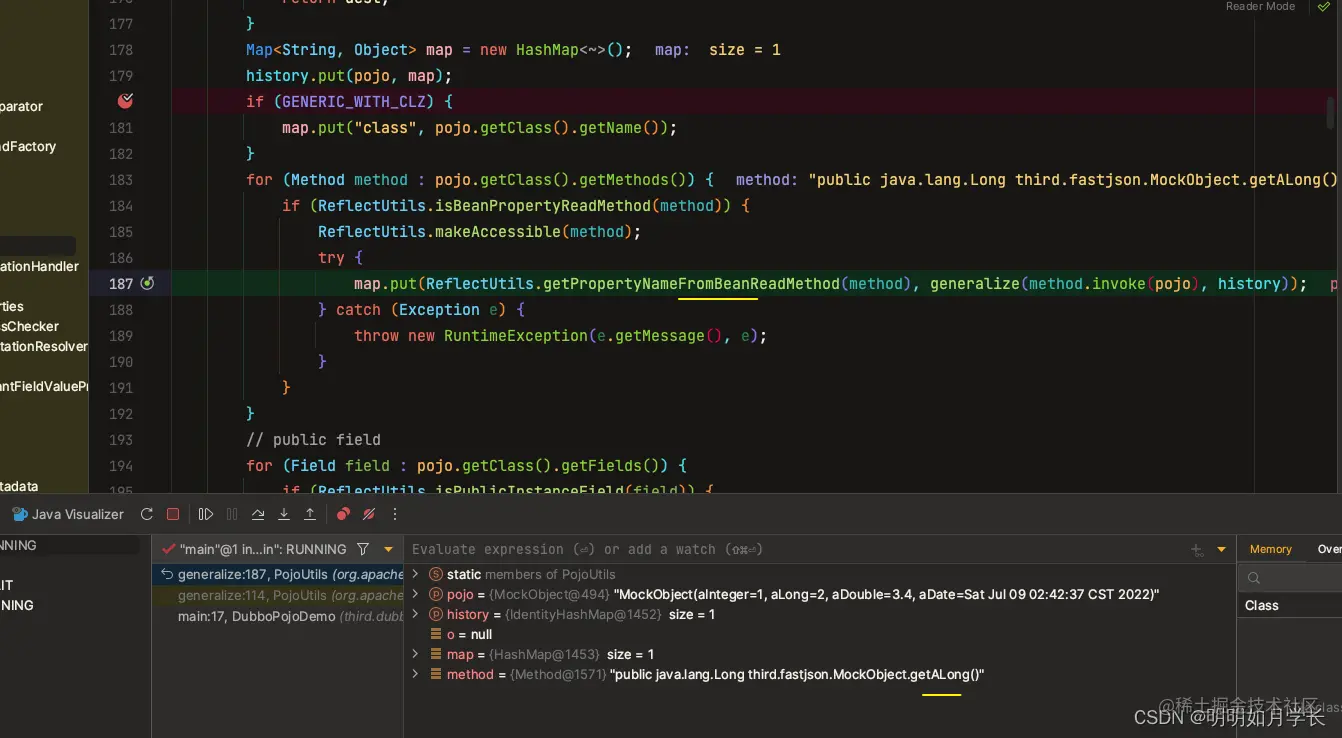
org.apache.dubbo.common.utils.ReflectUtils#getPropertyNameFromBeanReadMethod
public static String getPropertyNameFromBeanReadMethod(Method method) {
    if (isBeanPropertyReadMethod(method)) {
        // get 方法,则从 index =3 的字符小写 + 后面的字符串
        if (method.getName().startsWith("get")) {
            return method.getName().substring(3, 4).toLowerCase()
                    + method.getName().substring(4);
        }
        // is 开头方法, index =2 的字符小写 + 后面的字符串
        if (method.getName().startsWith("is")) {
            return method.getName().substring(2, 3).toLowerCase()
                    + method.getName().substring(3);
        }
    }
    return null;
}
因此, getALong 方法对应的属性名被解析为 aLong。
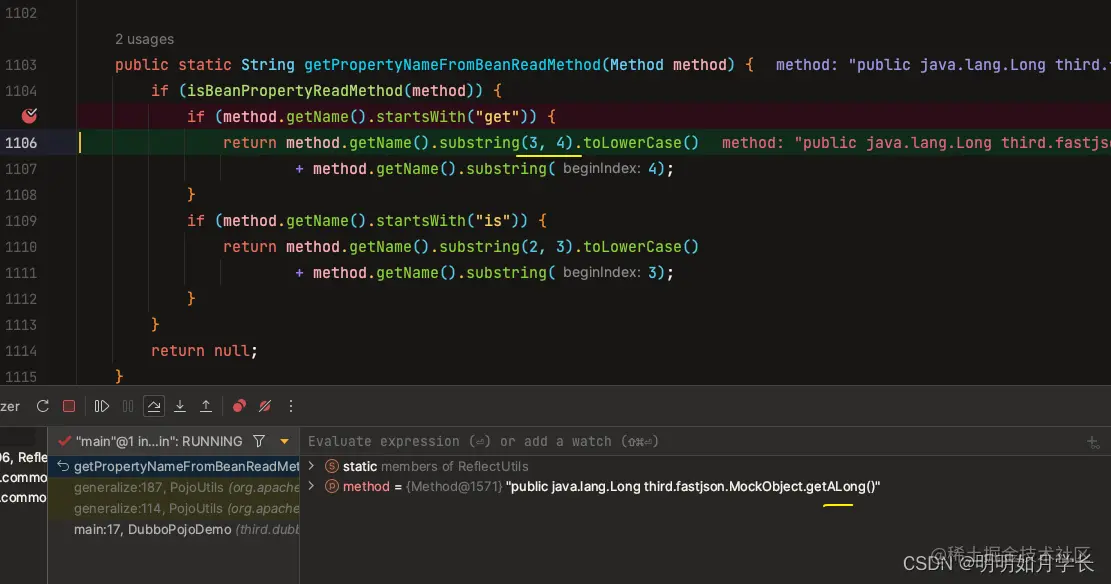 同时,这么处理也会存在问题。如当属性名叫 URL 时,转为 Map 后 key 就会被解析成 uRL。
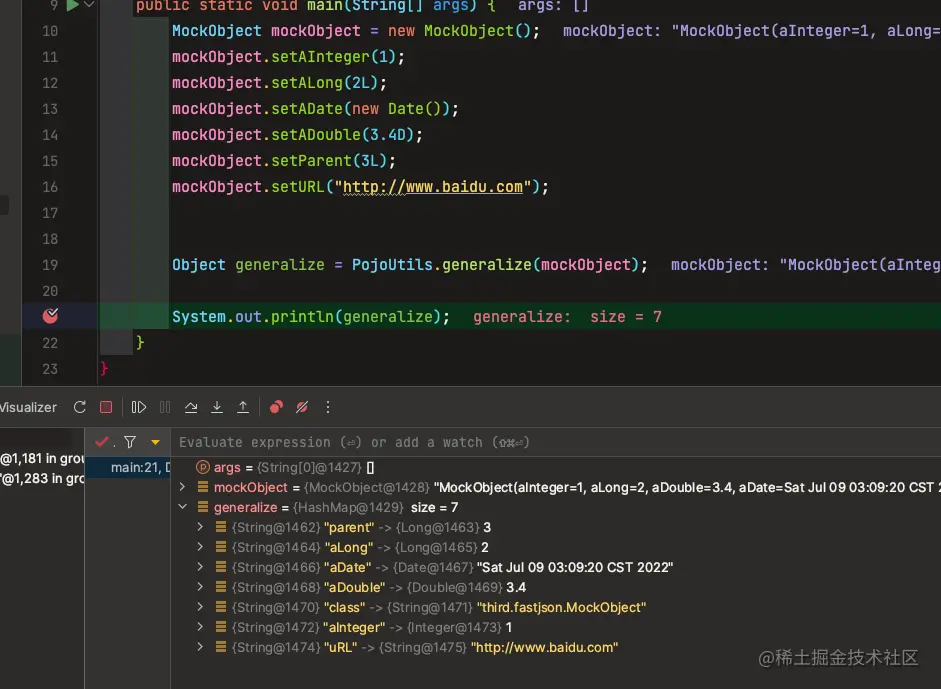
从这里看出,当属性名比较特殊时也很容易出问题,但 dubbo 这个工具类更符合我们的预期。 更多细节,大家可以根据 DEMO 自行调试学习。
如果想严格和属性保持一致,可以使用反射获取属性名和属性值,加缓存机制提升解析的效率。
Java Bean 转 Map 的坑很多,最常见的就是类型丢失和属性名解析错误的问题。 大家在使用 JSON 框架和 Java Bean 转 Map 的框架时要特别小心。 平时使用某些框架时,多写一些 DEMO 进行验证,多读源码,多调试,少趟坑。
近期热文推荐:
1.1,000+ 道 Java面试题及答案整理(2022最新版)
4.别再写满屏的爆爆爆炸类了,试试装饰器模式,这才是优雅的方式!!
觉得不错,别忘了随手点赞+转发哦!
作为新的阿里云用户,您可以50免费试用多种优惠,价值高达1,700美元(或8,500美元)。这将让您了解和体验阿里云平台上提供的一系列产品和服务。如果您以个人身份注册免费试用,您将获得价值1,700美元的优惠。但是,如果您是注册公司,您可以选择企业免费试用,提交基本信息通过企业实名注册验证,即可开始价值$8,500的免费试用!本教程介绍了如何设置您的帐户并使用您的免费试用版。关于免费试用在我们开始此试用之前,您还必须遵守以下条款和条件才能访问您的免费试用:只有在一年内创建的账户才有资格获得阿里云免费试用。通过此免费试用优惠,用户可以免费试用免费试用活动页面上列出的每种产品一次。如果您有多个帐
我需要从json记录中获取一些值并像下面这样提取curr_json_doc['title']['genre'].map{|s|s['name']}.join(',')但对于某些记录,curr_json_doc['title']['genre']可以为空。所以我想对map和join()使用try函数。我试过如下curr_json_doc['title']['genre'].try(:map,{|s|s['name']}).try(:join,(','))但是没用。 最佳答案 你没有正确传递block。block被传递给参数括号外的方法
Enumerable#each和Enumerable#map的区别在于返回的是接收者还是映射后的结果。回到接收者是微不足道的,你通常不需要在each之后继续一个方法链,比如each{...}.another_method(我可能没见过这样的案例。即使你想回到接收者那里,你也可以通过tap来实现)。所以我认为所有或者大部分使用Enumerable#each的情况都可以用Enumerable#map代替。我错了吗?如果我是对的,each的目的是什么?map是否比each慢?编辑:我知道当您对返回值不感兴趣时使用each是一种常见的做法。我对这种做法是否存在不感兴趣,但感兴趣的是,除了从
map遍历数组是否比each更快?两者有速度差异吗?mapresult=arr.map{|a|a+2}每个result=[]arr.eachdo|a|result.push(a+2)end 最佳答案 我认为是的。我试过这个测试require"benchmark"n=10000arr=Array.new(10000,1)Benchmark.bmdo|x|#Mapx.reportdon.timesdoresult=arr.map{|a|a+2}endend#Eachx.reportdon.timesdoresult=[]arr.each
我想念Ruby中的Hash方法来仅转换/映射散列值。h={1=>[9,2,3,4],2=>[6],3=>[5,7,1]}h.map_values{|v|v.size}#=>{1=>4,2=>1,3=>3}你如何在Ruby中归档它?更新:我正在寻找map_values()的实现。#moreexamplesh.map_values{|v|v.reduce(0,:+)}#=>{1=>18,2=>6,3=>13}h.map_values(&:min)#=>{1=>2,2=>6,3=>1} 最佳答案 Ruby2.4引入了方法Hash#tran
假设我有一个函数defodd_or_evennifn%2==0return:evenelsereturn:oddendend我有一个简单的可枚举数组simple=[1,2,3,4,5]然后我用我的函数在map中运行它,使用一个do-endblock:simple.mapdo|n|odd_or_even(n)end#=>[:odd,:even,:odd,:even,:odd]如果不首先定义函数,我怎么能做到这一点?例如,#doesnotworksimple.mapdo|n|ifn%2==0return:evenelsereturn:oddendend#Desiredresult:#=>[
我想获取一个数组并将其作为订单列表。目前我正在尝试以这种方式进行:r=["a","b","c"]r.each_with_index{|w,index|puts"#{index+1}.#{w}"}.map.to_a#1.a#2.b#3.c#=>["a","b","c"]输出应该是["1.a","2.b","3.c"]。如何让正确的输出成为r数组的新值? 最佳答案 a.to_enum.with_index(1).map{|element,index|"#{index}.#{element}"}或a.map.with_index(1){|
我看到有关未找到文件min.map的错误消息:GETjQuery'sjquery-1.10.2.min.mapistriggeringa404(NotFound)截图这是从哪里来的? 最佳答案 如果ChromeDevTools报告.map文件的404(可能是jquery-1.10.2.min.map、jquery.min.map或jquery-2.0.3.min.map,但任何事情都可能发生)首先要知道的是,这仅在使用DevTools时才会请求。您的用户不会遇到此404。现在您可以修复此问题或禁用sourcemap功能。修复:获取文
在Ruby中,Enumerable模块混合到集合类中,并依赖于提供each方法的类,该方法产生集合中的每个项目。好吧,如果我想在我自己的类中使用Enumerable,我将只实现each[1]:classColorsincludeEnumerabledefeachyield"red"yield"green"yield"blue"endend>c=Colors.new>c.map{|i|i.reverse}#=>["der","neerg","eulb"]这按预期工作。但是,如果我用Enumerable重写现有类上的each方法,它不会破坏map等函数。为什么不呢?classArrayde
我想编写一些新的Array方法来改变调用对象,如下所示:a=[1,2,3,4]a.map!{|e|e+1}a=[2,3,4,5]...但我对如何执行此操作一无所知。我想我需要一个新的大脑。所以,我想要这样的东西:classArraydefstuff!#changethecallingobjectinsomewayendendmap!只是一个例子,我想写一个全新的,而不使用任何预先存在的!方法。谢谢! 最佳答案 编辑-更新答案以反射(reflect)对您问题的更改。classArraydefstuff!self[0]="a"enden
