cd /data/app/elk/elk-6.8.5
tar zxvf logstash-6.8.5.tar.gz
# 数据输入部分
input {
    # 读取nginx访问日志
    file {
		#path:监听文件的路径,绝对路径
        path => "/data/app/nginx/logs/access.log" #为Nginx的access.log路径
		# 格式:json
        codec => "json"
		#start_position:监听文件的起始位置,beginning:从文件的头开始读取
        start_position => "beginning"
		#type:自定义类型
        type => "nginx-access-log"
    }
    # 读取nginx异常日志
    file {
        path => "/data/app/nginx/logs/error.log" #为Nginx的error.log路径
        # 格式:plain,输入的是字符串,输出把全部内容放到message字段
        codec => "plain"
        start_position => "beginning"
        type => "nginx-error-log"
    }

	#filebeats方式
	beats {
		port => 5044
        type => "beats_log"
	}

	#自定义端口,一个项目可对应一个自定义tcp端口接收数据
	tcp {
		mode => "server"
		host => "192.168.X.X" #IP地址
		port => 21022
		codec => json
		type => "application-log" #application一般为项目名称
	}
}

# 数据处理部分
filter{
	if[type] == "application-log"{
		mutate {
			rename => {"host" => "hostname"}
		}
	}
}

# 数据输出部分
output {
    # beat监控信息
	if [type] == "beats_log"{
		elasticsearch {
            hosts => ["192.168.X.X:9200"]
			manage_template => false
			index => "%{[@metadata][beat]}-%{[@metadata][version]}-%{+YYYY.MM.dd}"
            user => "elastic"
            password => "elastic2021"
        }
	}
    # nginx访问日志
    if[type] == "nginx-access-log" {
        elasticsearch {
            hosts => ["192.168.X.X:9200"]
            index => "nginx-access-log-%{+YYYY.MM.dd}"
			# elasticsearch的用户名、密码
            user => "elastic"
            password => "elastic2021"
        }
    }
    # nginx异常日志
    if[type] == "nginx-error-log"{
        elasticsearch{
            hosts => ["192.168.X.X:9200"]
            index => "nginx-error-log-%{+YYYY.MM.dd}"
            user => "elastic"
            password => "elastic2021"
        }
    }
	# 应用系统日志
	if[type] == "application-log"{
		elasticsearch {
			hosts => ["192.168.X.X:9200"]
			index => "application-log-%{+YYYY.MM.dd}"
			user => "elastic"
			password => "elastic2021"
		}
	}

}cd /data/app/elk/elk-6.8.5/logstash-6.8.5
nohup ./bin/logstash -f config/logstash.conf &
ps -ef | grep logstash
<!-- logstash 6.2 -->
<dependency>
   <groupId>net.logstash.logback</groupId>
   <artifactId>logstash-logback-encoder</artifactId>
   <version>6.2</version>
</dependency>
<?xml version="1.0" encoding="UTF-8" ?>
<configuration debug="false">
	<!-- 为logstash输出的JSON格式的Appender -->
	<appender name="logstash_dev"
			  class="net.logstash.logback.appender.LogstashTcpSocketAppender">
		<destination>192.168.X.X:21021</destination>
		<!-- 日志输出编码 -->
		<encoder
				class="net.logstash.logback.encoder.LoggingEventCompositeJsonEncoder">
			<providers>
				<timestamp>
					<timeZone>UTC</timeZone>
				</timestamp>
				<pattern>
					<pattern>
						{
						"severity": "%level",
						"service": "${APP_NAME:-}",
						"trace": "%X{X-B3-TraceId:-}",
						"span": "%X{X-B3-SpanId:-}",
						"parent": "%X{X-B3-ParentSpanId:-}",
						"exportable": "%X{X-Span-Export:-}",
						"pid": "${PID:-}",
						"thread": "%thread",
						"class": "%logger",
						"rest": "%message"
						}
					</pattern>
				</pattern>
			</providers>
		</encoder>
	</appender>


	<!-- 开发环境 -->
    <springProfile name="develop">
        <!--设置根日志级别-->
        <root level="INFO">
            <appender-ref ref="logstash_dev"/>
        </root>
    </springProfile>


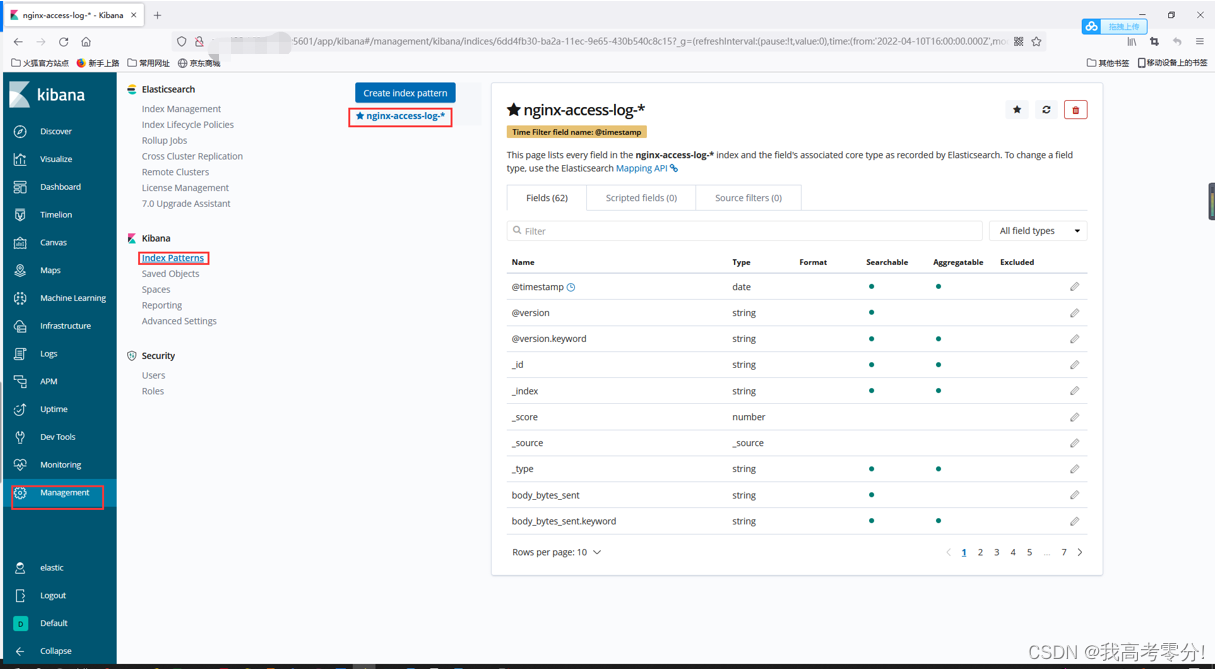
</configuration>浏览器访问192.168.X.X:5601


我想为Heroku构建一个Rails3应用程序。他们使用Postgres作为他们的数据库,所以我通过MacPorts安装了postgres9.0。现在我需要一个postgresgem并且共识是出于性能原因你想要pggem。但是我对我得到的错误感到非常困惑当我尝试在rvm下通过geminstall安装pg时。我已经非常明确地指定了所有postgres目录的位置可以找到但仍然无法完成安装:$envARCHFLAGS='-archx86_64'geminstallpg--\--with-pg-config=/opt/local/var/db/postgresql90/defaultdb/po
我打算为ruby脚本创建一个安装程序,但我希望能够确保机器安装了RVM。有没有一种方法可以完全离线安装RVM并且不引人注目(通过不引人注目,就像创建一个可以做所有事情的脚本而不是要求用户向他们的bash_profile或bashrc添加一些东西)我不是要脚本本身,只是一个关于如何走这条路的快速指针(如果可能的话)。我们还研究了这个很有帮助的问题:RVM-isthereawayforsimpleofflineinstall?但有点误导,因为答案只向我们展示了如何离线在RVM中安装ruby。我们需要能够离线安装RVM本身,并查看脚本https://raw.github.com/wayn
我有一个奇怪的问题:我在rvm上安装了rubyonrails。一切正常,我可以创建项目。但是在我输入“railsnew”时重新启动后,我有“程序'rails'当前未安装。”。SystemUbuntu12.04ruby-v"1.9.3p194"gemlistactionmailer(3.2.5)actionpack(3.2.5)activemodel(3.2.5)activerecord(3.2.5)activeresource(3.2.5)activesupport(3.2.5)arel(3.0.2)builder(3.0.0)bundler(1.1.4)coffee-rails(
我刚刚为fedora安装了emacs。我想用emacs编写ruby。为ruby提供代码提示、代码完成类型功能所需的工具、扩展是什么? 最佳答案 ruby-mode已经包含在Emacs23之后的版本中。不过,它也可以通过ELPA获得。您可能感兴趣的其他一些事情是集成RVM、feature-mode(Cucumber)、rspec-mode、ruby-electric、inf-ruby、rinari(用于Rails)等。这是我当前用于Ruby开发的Emacs配置:https://github.com/citizen428/emacs
我正在尝试在我的centos服务器上安装therubyracer,但遇到了麻烦。$geminstalltherubyracerBuildingnativeextensions.Thiscouldtakeawhile...ERROR:Errorinstallingtherubyracer:ERROR:Failedtobuildgemnativeextension./usr/local/rvm/rubies/ruby-1.9.3-p125/bin/rubyextconf.rbcheckingformain()in-lpthread...yescheckingforv8.h...no***e
我的最终目标是安装当前版本的RubyonRails。我在OSXMountainLion上运行。到目前为止,这是我的过程:已安装的RVM$\curl-Lhttps://get.rvm.io|bash-sstable检查已知(我假设已批准)安装$rvmlistknown我看到当前的稳定版本可用[ruby-]2.0.0[-p247]输入命令安装$rvminstall2.0.0-p247注意:我也试过这些安装命令$rvminstallruby-2.0.0-p247$rvminstallruby=2.0.0-p247我很快就无处可去了。结果:$rvminstall2.0.0-p247Search
我实际上是在尝试使用RVM在我的OSX10.7.5上更新ruby,并在输入以下命令后:rvminstallruby我得到了以下回复:Searchingforbinaryrubies,thismighttakesometime.Checkingrequirementsforosx.Installingrequirementsforosx.Updatingsystem.......Errorrunning'requirements_osx_brew_update_systemruby-2.0.0-p247',pleaseread/Users/username/.rvm/log/138121
由于fast-stemmer的问题,我很难安装我想要的任何rubygem。我把我得到的错误放在下面。Buildingnativeextensions.Thiscouldtakeawhile...ERROR:Errorinstallingfast-stemmer:ERROR:Failedtobuildgemnativeextension./System/Library/Frameworks/Ruby.framework/Versions/2.0/usr/bin/rubyextconf.rbcreatingMakefilemake"DESTDIR="cleanmake"DESTDIR=
当我尝试安装Ruby时遇到此错误。我试过查看this和this但无济于事➜~brewinstallrubyWarning:YouareusingOSX10.12.Wedonotprovidesupportforthispre-releaseversion.Youmayencounterbuildfailuresorotherbreakages.Pleasecreatepull-requestsinsteadoffilingissues.==>Installingdependenciesforruby:readline,libyaml,makedepend==>Installingrub
当我执行>rvminstall1.9.2时一切顺利。然后我做>rvmuse1.9.2也很顺利。但是当涉及到ruby-v时..sam@sjones:~$rvminstall1.9.2/home/sam/.rvm/rubies/ruby-1.9.2-p136,thismaytakeawhiledependingonyourcpu(s)...ruby-1.9.2-p136-#fetchingruby-1.9.2-p136-#downloadingruby-1.9.2-p136,thismaytakeawhiledependingonyourconnection...%Total%Rece
