nter先直接上C#软件效果图
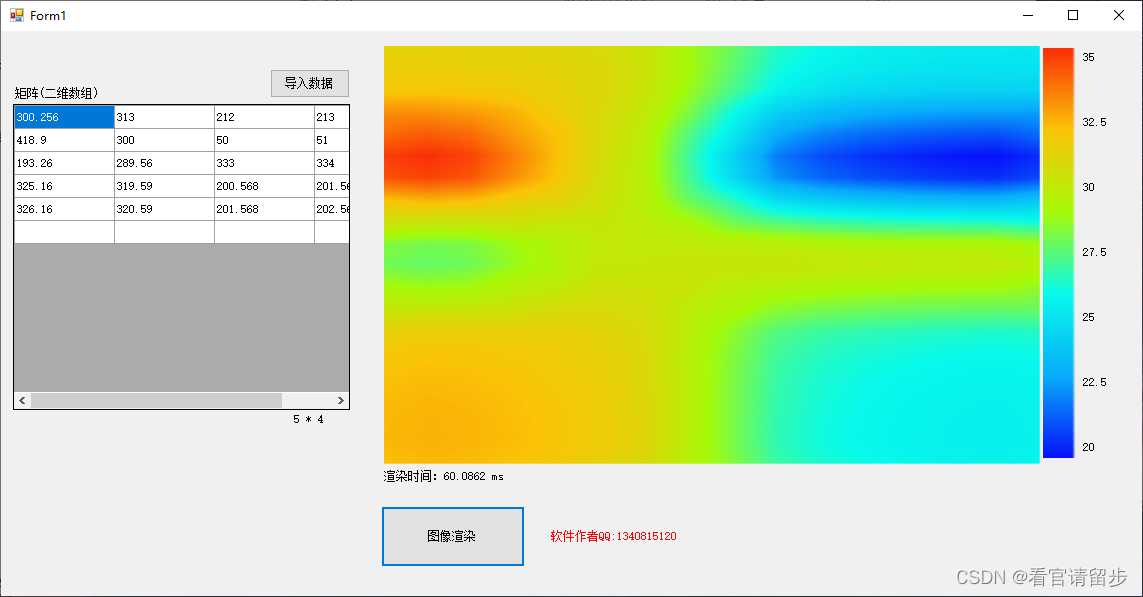
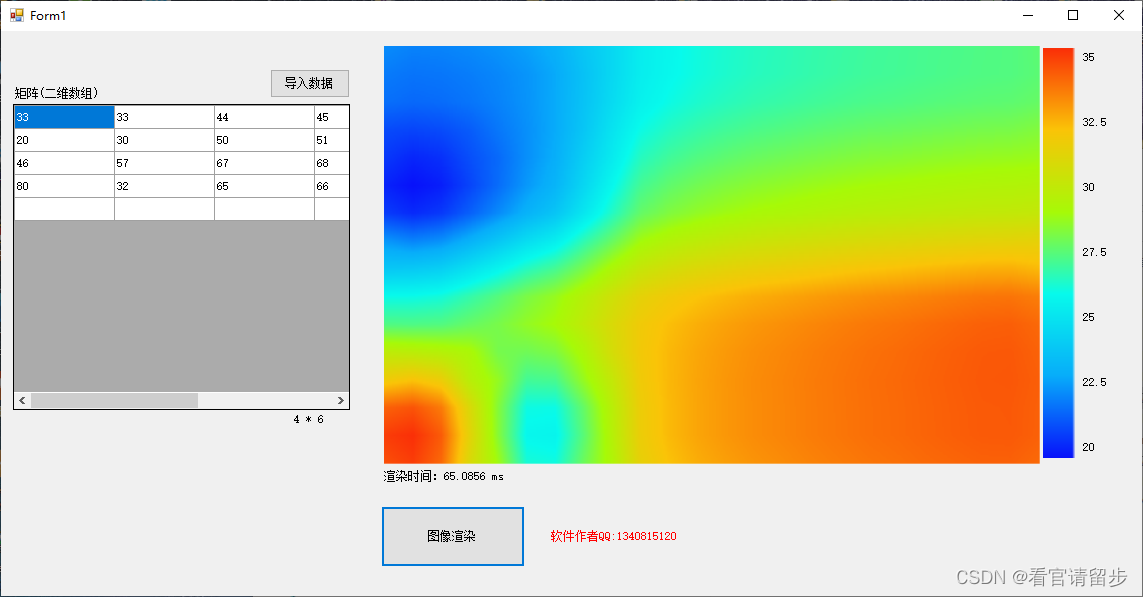
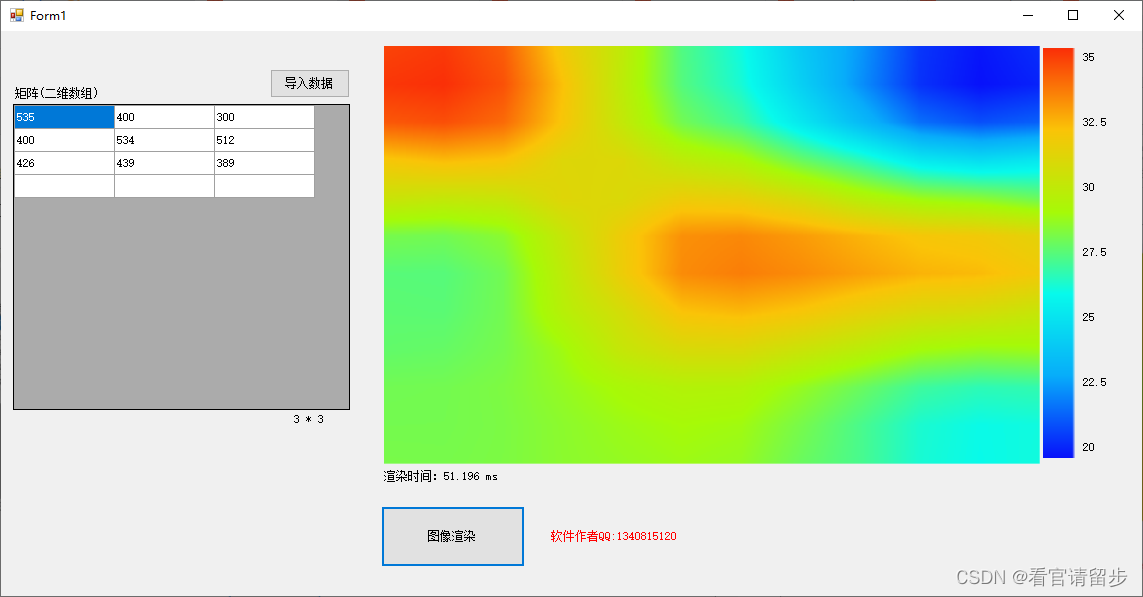
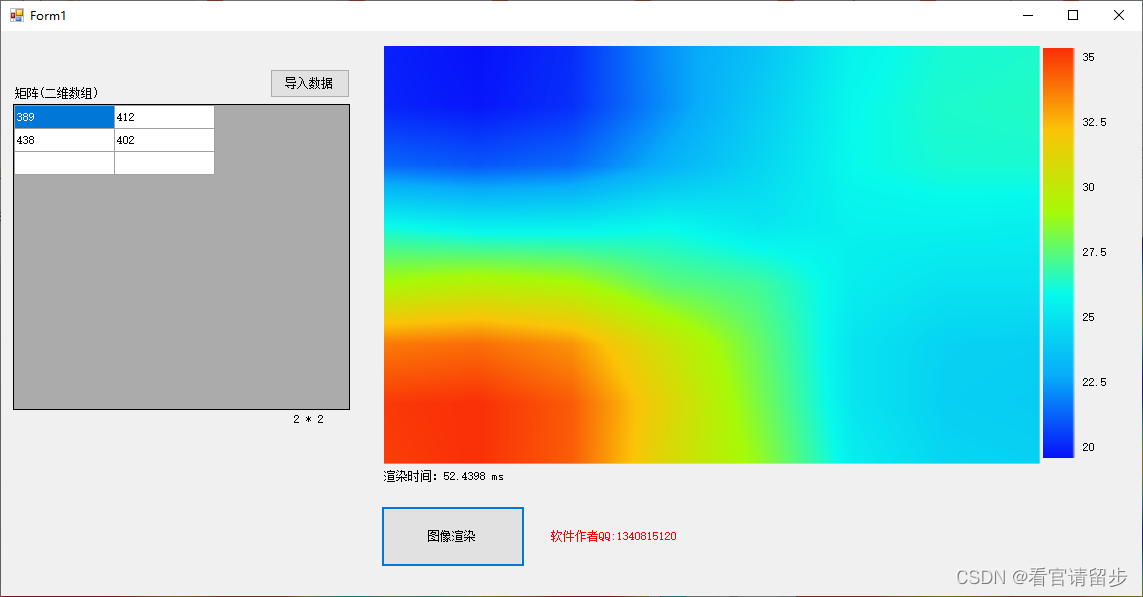
1、二维数据最小支持2*2,
2、渲染时间60ms左右,速度快,
3、纯粹的C#代码编写,不含第三方dll或者控件
4、支持ColorBar显示,强度值颜色坐标显示
5、整图保存为单个图片
6、渲染效果良好,颜色均匀分布,不存在等高线,交叉点
7、采样全新数据插值算法
CSDN软件0积分下载链接:https://download.csdn.net/download/wanghuannihao1992/86656759
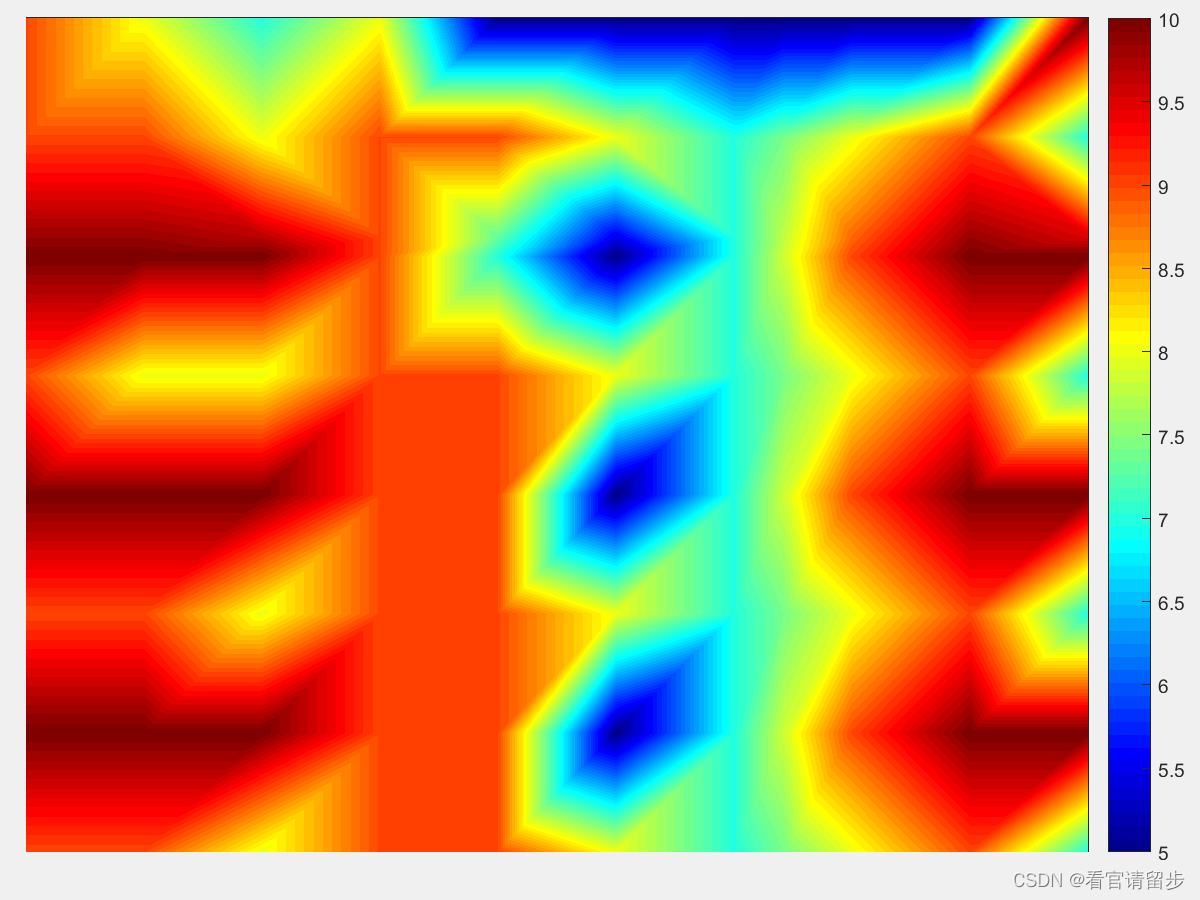
下面看几组其他软件做出来的效果(一般做简单的二维线性插值):
matlab效果
Labview效果
网格图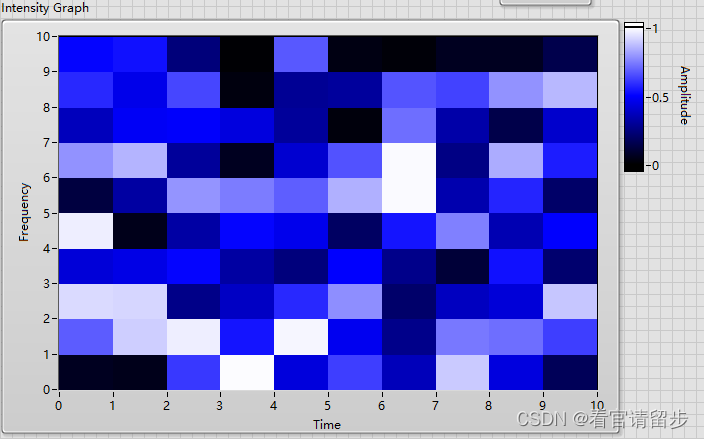
下面为Matlab官网关于二维线性插值的一些资料(可忽略,本人不是采样这个方法)
interp2
Two-dimensional data interpolation (table lookup)
Syntax
ZI = interp2(X,Y,Z,XI,YI)
ZI = interp2(Z,XI,YI)
ZI = interp2(Z,ntimes)
ZI = interp2(X,Y,Z,XI,YI,method)
ZI = interp2(…,method, extrapval)
Description
ZI = interp2(X,Y,Z,XI,YI) returns matrix ZI containing elements corresponding to the elements of XI and YI and determined by interpolation within the two-dimensional function specified by matrices X, Y, and Z. X and Y must be monotonic, and have the same format (“plaid”) as if they were produced by meshgrid. Matrices X and Y specify the points at which the data Z is given. Out of range values are returned as NaNs.
XI and YI can be matrices, in which case interp2 returns the values of Z corresponding to the points (XI(i,j),YI(i,j)). Alternatively, you can pass in the row and column vectors xi and yi, respectively. In this case, interp2 interprets these vectors as if you issued the command meshgrid(xi,yi).
ZI = interp2(Z,XI,YI) assumes that X = 1:n and Y = 1:m, where [m,n] = size(Z).
ZI = interp2(Z,ntimes) expands Z by interleaving interpolates between every element, working recursively for ntimes. interp2(Z) is the same as interp2(Z,1).
ZI = interp2(X,Y,Z,XI,YI,method) specifies an alternative interpolation method:
‘nearest’
Nearest neighbor interpolation
‘linear’
Bilinear interpolation (default)
‘spline’
Cubic spline interpolation
‘cubic’
Bicubuc interpolation
All interpolation methods require that X and Y be monotonic, and have the same format (“plaid”) as if they were produced by meshgrid. If you provide two monotonic vectors, interp2 changes them to a plaid internally. Variable spacing is handled by mapping the given values in X, Y, XI, and YI to an equally spaced domain before interpolating. For faster interpolation when X and Y are equally spaced and monotonic, use the methods ‘*linear’, ‘*cubic’, ‘*spline’, or ‘*nearest’.
ZI = interp2(…,method, extrapval) specifies a method and a scalar value for ZI outside of the domain created by X and Y. Thus, ZI equals extrapval for any value of YI or XI that is not spanned by Y or X respectively. A method must be specified to use extrapval. The default method is ‘linear’.
Remarks
The interp2 command interpolates between data points. It finds values of a two-dimensional function underlying the data at intermediate points.
Interpolation is the same operation as table lookup. Described in table lookup terms, the table is tab = [NaN,Y; X,Z] and interp2 looks up the elements of XI in X, YI in Y, and, based upon their location, returns values ZI interpolated within the elements of Z.
Examples
Example 1. Interpolate the peaks function over a finer grid.
[X,Y] = meshgrid(-3:.25:3);
Z = peaks(X,Y);
[XI,YI] = meshgrid(-3:.125:3);
ZI = interp2(X,Y,Z,XI,YI);
mesh(X,Y,Z), hold, mesh(XI,YI,ZI+15)
hold off
axis([-3 3 -3 3 -5 20])
Example 2. Given this set of employee data,
years = 1950:10:1990;
service = 10:10:30;
wage = [150.697 199.592 187.625
179.323 195.072 250.287
203.212 179.092 322.767
226.505 153.706 426.730
249.633 120.281 598.243];
it is possible to interpolate to find the wage earned in 1975 by an employee with 15 years’ service:
w = interp2(service,years,wage,15,1975)
w =
190.6287
我有多个ActiveRecord子类Item的实例数组,我需要根据最早的事件循环打印。在这种情况下,我需要打印付款和维护日期,如下所示:ItemAmaintenancerequiredin5daysItemBpaymentrequiredin6daysItemApaymentrequiredin7daysItemBmaintenancerequiredin8days我目前有两个查询,用于查找maintenance和payment项目(非排他性查询),并输出如下内容:paymentrequiredin...maintenancerequiredin...有什么方法可以改善上述(丑陋的)代
我的代码目前看起来像这样numbers=[1,2,3,4,5]defpop_threepop=[]3.times{pop有没有办法在一行中完成pop_three方法中的内容?我基本上想做类似numbers.slice(0,3)的事情,但要删除切片中的数组项。嗯...嗯,我想我刚刚意识到我可以试试slice! 最佳答案 是numbers.pop(3)或者numbers.shift(3)如果你想要另一边。 关于ruby-多次弹出/移动ruby数组,我们在StackOverflow上找到一
我需要读入一个包含数字列表的文件。此代码读取文件并将其放入二维数组中。现在我需要获取数组中所有数字的平均值,但我需要将数组的内容更改为int。有什么想法可以将to_i方法放在哪里吗?ClassTerraindefinitializefile_name@input=IO.readlines(file_name)#readinfile@size=@input[0].to_i@land=[@size]x=1whilex 最佳答案 只需将数组映射为整数:@land边注如果你想得到一条线的平均值,你可以这样做:values=@input[x]
我正在使用puppet为ruby程序提供一组常量。我需要提供一组主机名,我的程序将对其进行迭代。在我之前使用的bash脚本中,我只是将它作为一个puppet变量hosts=>"host1,host2"我将其提供给bash脚本作为HOSTS=显然这对ruby不太适用——我需要它的格式hosts=["host1","host2"]自从phosts和putsmy_array.inspect提供输出["host1","host2"]我希望使用其中之一。不幸的是,我终其一生都无法弄清楚如何让它发挥作用。我尝试了以下各项:我发现某处他们指出我需要在函数调用前放置“function_”……这
这个问题在这里已经有了答案:Checktoseeifanarrayisalreadysorted?(8个答案)关闭9年前。我只是想知道是否有办法检查数组是否在增加?这是我的解决方案,但我正在寻找更漂亮的方法:n=-1@arr.flatten.each{|e|returnfalseife
我有一个这样的哈希数组:[{:foo=>2,:date=>Sat,01Sep2014},{:foo2=>2,:date=>Sat,02Sep2014},{:foo3=>3,:date=>Sat,01Sep2014},{:foo4=>4,:date=>Sat,03Sep2014},{:foo5=>5,:date=>Sat,02Sep2014}]如果:date相同,我想合并哈希值。我对上面数组的期望是:[{:foo=>2,:foo3=>3,:date=>Sat,01Sep2014},{:foo2=>2,:foo5=>5:date=>Sat,02Sep2014},{:foo4=>4,:dat
我正在尝试在Ruby中制作一个cli应用程序,它接受一个给定的数组,然后将其显示为一个列表,我可以使用箭头键浏览它。我觉得我已经在Ruby中看到一个库已经这样做了,但我记不起它的名字了。我正在尝试对soundcloud2000中的代码进行逆向工程做类似的事情,但他的代码与SoundcloudAPI的使用紧密耦合。我知道cursesgem,我正在考虑更抽象的东西。广告有没有人见过可以做到这一点的库或一些概念证明的Ruby代码可以做到这一点? 最佳答案 我不知道这是否是您正在寻找的,但也许您可以使用我的想法。由于我没有关于您要完成的工作
我使用Ember作为我的前端和GrapeAPI来为我的API提供服务。前端发送类似:{"service"=>{"name"=>"Name","duration"=>"30","user"=>nil,"organization"=>"org","category"=>nil,"description"=>"description","disabled"=>true,"color"=>nil,"availabilities"=>[{"day"=>"Saturday","enabled"=>false,"timeSlots"=>[{"startAt"=>"09:00AM","endAt"=>
如何在ruby中调用C#dll? 最佳答案 我能想到几种可能性:为您的DLL编写(或找人编写)一个COM包装器,如果它还没有,则使用Ruby的WIN32OLE库来调用它;看看RubyCLR,其中一位作者是JohnLam,他继续在Microsoft从事IronRuby方面的工作。(估计不会再维护了,可能不支持.Net2.0以上的版本);正如其他地方已经提到的,看看使用IronRuby,如果这是您的技术选择。有一个主题是here.请注意,最后一篇文章实际上来自JohnLam(看起来像是2009年3月),他似乎很自在地断言RubyCL
我正在尝试在Ruby中复制Convert.ToBase64String()行为。这是我的C#代码:varsha1=newSHA1CryptoServiceProvider();varpasswordBytes=Encoding.UTF8.GetBytes("password");varpasswordHash=sha1.ComputeHash(passwordBytes);returnConvert.ToBase64String(passwordHash);//returns"W6ph5Mm5Pz8GgiULbPgzG37mj9g="当我在Ruby中尝试同样的事情时,我得到了相同sha
