ERR_INVALID_HTTP_RESPONSE
前段时间刚学完《Java网络编程》,最近着手学习《深入剖析Tomcat》,但是这里第一个案例就出现了问题。建议稍微有点网络基础的同学看。
书上源码多自己思考,根据已有知识排错。
请求头和请求体之间有一个空行。
响应头和响应体之火箭有一个空行
不细说了,参见net模块的笔记。
package chapter01.demo01;

import java.io.IOException;
import java.io.InputStream;
import java.io.OutputStream;
import java.net.*;
import java.util.Objects;

/**
 * @description HTTP服务器
 * 阻塞的监听指定的应用程序,如果发现接收到请求就解析成Request
 * 如果uri是关闭,就不再循环;否则将对应的uri资源封装成response返回
 *
 * @date:2022/11/3 15:52
 * @author: qyl
 */
public class HttpServer {
    // 指定资源路径
    public static final String WEB_ROOT = Objects.requireNonNull(HttpServer.class.getClassLoader().getResource("webroot")).getPath();
    private static final String SHUTDOWN_COMMAND = "/SHUTDOWN";
    private boolean shutdown = false;

    public static void main(String[] args) {
        HttpServer server = new HttpServer();
        server.await();
    }

    private void await() {
        int port = 8080;
        try (ServerSocket serverSocket = new ServerSocket(port, 1, InetAddress.getByName("127.0.0.1"))){

            while (!shutdown) {
                try (Socket socket = serverSocket.accept()) {
                    // 解析请求
                    InputStream input = socket.getInputStream();
                    Request request = new Request(input);
                    request.parse();
                    // 封装响应
                    OutputStream output = socket.getOutputStream();
                    Response response = new Response(output);
                    response.setRequest(request);
                    // 发送响应
                    response.sendStaticResource();
                    shutdown = request.getUri().endsWith(SHUTDOWN_COMMAND);
                } catch (IOException e) {
                    e.printStackTrace();
                }
            }
        } catch (IOException e) {
            e.printStackTrace();
            System.exit(1);
        }
    }
}

```java
package chapter01.demo01;

import java.io.*;
import java.net.URLConnection;

/**
 * @description
 * @date:2022/11/3 16:10
 * @author: qyl
 */
public class Response {
    private static final int BUFFER_SIZE = 1024;
    Request request;
    OutputStream output;

    public Response(OutputStream output){
        this.output = output;
    }

    public void setRequest(Request request){
        this.request = request;
    }

    public void sendStaticResource() throws IOException {
        byte[] bytes = new byte[BUFFER_SIZE];
        FileInputStream fis = null;
        try{
            String filename = request.getUri();
            File file = new File(HttpServer.WEB_ROOT,filename);
            if (file.exists()){
                String mimeType = URLConnection.getFileNameMap().getContentTypeFor(filename);

                fis = new FileInputStream(file);
                int ch ;
                while ((ch = fis.read(bytes,0,BUFFER_SIZE)) != -1 ){
                    output.write(bytes,0,ch);
                }
            }else {
                String errorMessage = "HTTP/1.1 404 File Not Found\r\n" +
                        "Content-Type: text/html\r\n" +
                        "Content-Length:23\r\n"+
                        "\r\n"+
                        "<h1>File Not Found</h1>";
                output.write(errorMessage.getBytes());
            }
        } catch (IOException e) {
            e.printStackTrace();
        }finally {
            if (fis != null){
                fis.close();
            }
        }
    }
}
package chapter01.demo01;

import java.io.IOException;
import java.io.InputStream;

/**
 * @description
 * @date:2022/11/3 16:01
 * @author: qyl
 */
public class Request {
    private InputStream input;
    private String uri;

    public Request(InputStream input) {
        this.input = input;
    }

    public void parse() {
        StringBuilder request = new StringBuilder(2048);
        int i;
        byte[] buffer = new byte[2048];
        try {
            i = input.read(buffer);
        } catch (IOException e) {
            e.printStackTrace();
            i = -1;
        }
        for (int j = 0; j < i; j++) {
            request.append((char)buffer[j]);
        }
        System.out.println(request.toString());
        uri = parseUri(request.toString());
    }

    private String parseUri(String requestString) {
        int index1,index2;
        index1 = requestString.indexOf(' ');
        if (index1 != -1){
            index2 = requestString.indexOf(' ' ,index1+1);
            if (index2 > index1){
                return requestString.substring(index1+1,index2);
            }
        }
        return null;
    }

    public String getUri() {
        return uri;
    }
}
之后启动HttpServer,并且打开浏览器输入http://localhost:8080/index.html出现了如下错误:

明确表示了响应无效,根据前置知识:请求成功解析并封装,那么我们查看Response类。
有两种可能
文件找不到,我们的错误响应写错了。即如下这代码:
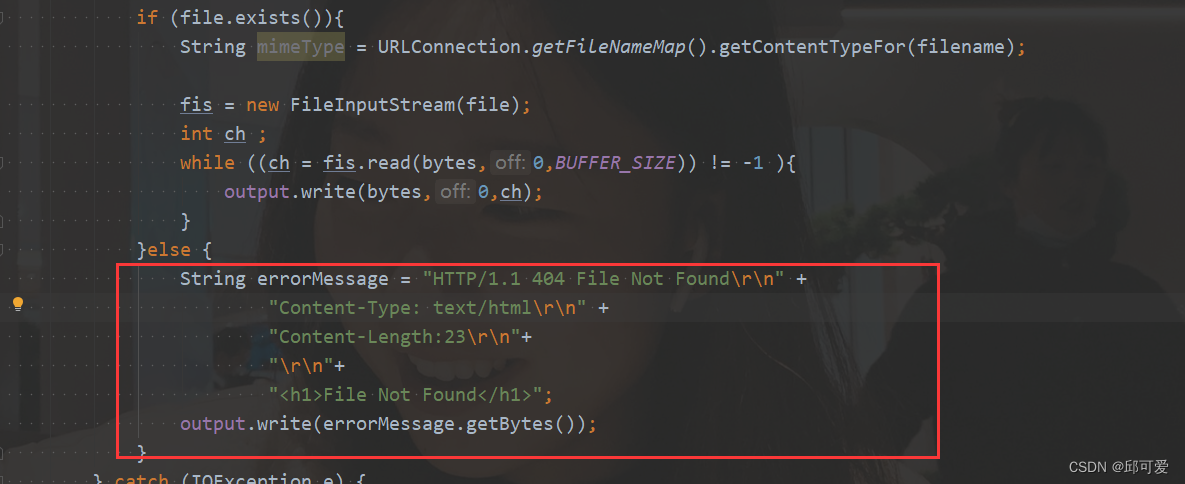
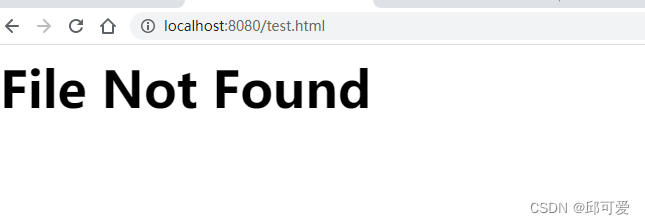
故进行如下测试,发现没有问题:
找到了文件,但是响应写错了。即如下代码
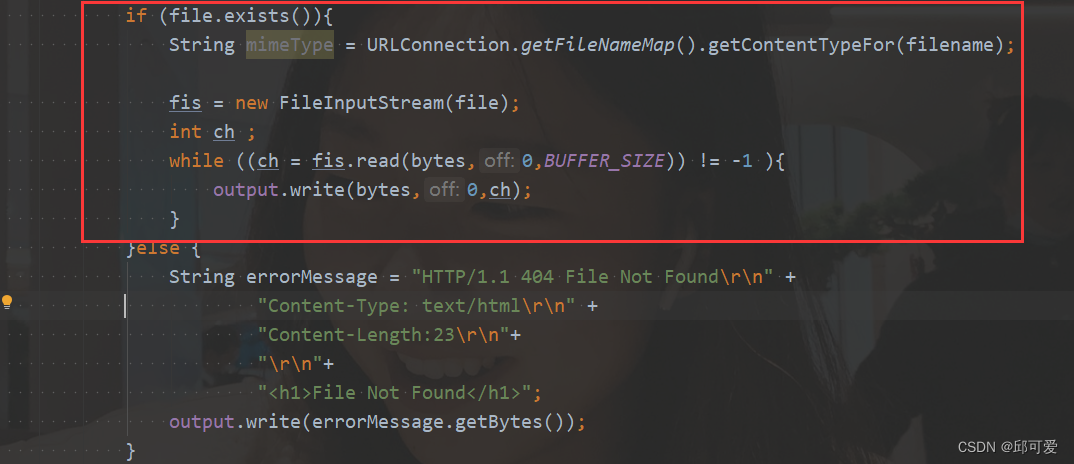
其实很明显就有问题,根据前置知识,这里只有响应体,没有响应头。
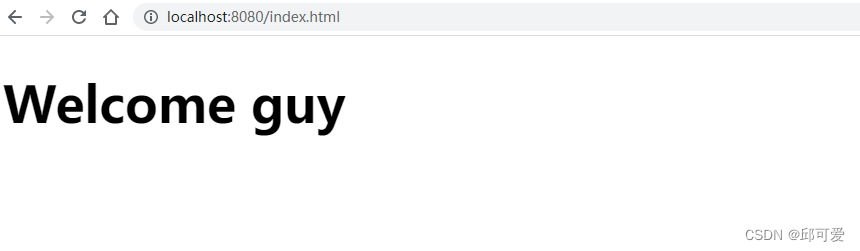
添加响应头内容,进行测试,成功解决。
package chapter01.demo01;

import java.io.*;
import java.net.URLConnection;

/**
 * @description
 * @date:2022/11/3 16:10
 * @author: qyl
 */
public class Response {
    private static final int BUFFER_SIZE = 1024;
    Request request;
    OutputStream output;

    public Response(OutputStream output){
        this.output = output;
    }

    public void setRequest(Request request){
        this.request = request;
    }

    public void sendStaticResource() throws IOException {
        byte[] bytes = new byte[BUFFER_SIZE];
        FileInputStream fis = null;
        try{
            String filename = request.getUri();
            File file = new File(HttpServer.WEB_ROOT,filename);
            if (file.exists()){
                String mimeType = URLConnection.getFileNameMap().getContentTypeFor(filename);
                String header = "HTTP/1.1 200 OK\r\n"
                        + "Server: OneFile 2.0\r\n"
                        + "Content-type: " + mimeType + ";\r\n\r\n";
                output.write(header.getBytes());
                fis = new FileInputStream(file);
                int ch ;
                while ((ch = fis.read(bytes,0,BUFFER_SIZE)) != -1 ){
                    output.write(bytes,0,ch);
                }
            }else {
                String errorMessage = "HTTP/1.1 404 File Not Found\r\n" +
                        "Content-Type: text/html\r\n" +
                        "Content-Length:23\r\n"+
                        "\r\n"+
                        "<h1>File Not Found</h1>";
                output.write(errorMessage.getBytes());
            }
        } catch (IOException e) {
            e.printStackTrace();
        }finally {
            if (fis != null){
                fis.close();
            }
        }
    }
}
是的,我知道最好使用webmock,但我想知道如何在RSpec中模拟此方法:defmethod_to_testurl=URI.parseurireq=Net::HTTP::Post.newurl.pathres=Net::HTTP.start(url.host,url.port)do|http|http.requestreq,foo:1endresend这是RSpec:let(:uri){'http://example.com'}specify'HTTPcall'dohttp=mock:httpNet::HTTP.stub!(:start).and_yieldhttphttp.shou
我目前正在使用以下方法获取页面的源代码:Net::HTTP.get(URI.parse(page.url))我还想获取HTTP状态,而无需发出第二个请求。有没有办法用另一种方法做到这一点?我一直在查看文档,但似乎找不到我要找的东西。 最佳答案 在我看来,除非您需要一些真正的低级访问或控制,否则最好使用Ruby的内置Open::URI模块:require'open-uri'io=open('http://www.example.org/')#=>#body=io.read[0,50]#=>"["200","OK"]io.base_ur
1.错误信息:Errorresponsefromdaemon:Gethttps://registry-1.docker.io/v2/:net/http:requestcanceledwhilewaitingforconnection(Client.Timeoutexceededwhileawaitingheaders)或者:Errorresponsefromdaemon:Gethttps://registry-1.docker.io/v2/:net/http:TLShandshaketimeout2.报错原因:docker使用的镜像网址默认为国外,下载容易超时,需要修改成国内镜像地址(首先阿里
目录1.漏洞简介2、AJP13协议介绍Tomcat主要有两大功能:3.Tomcat远程文件包含漏洞分析4.漏洞复现 5、漏洞分析6.RCE实现的原理1.漏洞简介2020年2月20日,公开CNVD的漏洞公告中发现ApacheTomcat文件包含漏洞(CVE-2020-1938)。ApacheTomcat是Apache开源组织开发的用于处理HTTP服务的项目。ApacheTomcat服务器中被发现存在文件包含漏洞,攻击者可利用该漏洞读取或包含Tomcat上所有webapp目录下的任意文件。该漏洞是一个单独的文件包含漏洞,依赖于Tomcat的AJP(定向包协议)。AJP自身存在一定缺陷,导致存在可控
Rails中有没有一种方法可以提取与路由关联的HTTP动词?例如,给定这样的路线:将“users”匹配到:“users#show”,通过:[:get,:post]我能实现这样的目标吗?users_path.respond_to?(:get)(显然#respond_to不是正确的方法)我最接近的是通过执行以下操作,但它似乎并不令人满意。Rails.application.routes.routes.named_routes["users"].constraints[:request_method]#=>/^GET$/对于上下文,我有一个设置cookie然后执行redirect_to:ba
我正在使用Heroku(heroku.com)来部署我的Rails应用程序,并且正在构建一个iPhone客户端来与之交互。我的目的是将手机的唯一设备标识符作为HTTPheader传递给应用程序以进行身份验证。当我在本地测试时,我的header通过得很好,但在Heroku上它似乎去掉了我的自定义header。我用ruby脚本验证:url=URI.parse('http://#{myapp}.heroku.com/')#url=URI.parse('http://localhost:3000/')req=Net::HTTP::Post.new(url.path)#boguspara
我试图在我的网站上实现使用Facebook登录功能,但在尝试从Facebook取回访问token时遇到障碍。这是我的代码:ifparams[:error_reason]=="user_denied"thenflash[:error]="TologinwithFacebook,youmustclick'Allow'toletthesiteaccessyourinformation"redirect_to:loginelsifparams[:code]thentoken_uri=URI.parse("https://graph.facebook.com/oauth/access_token
我是Ruby的新手。我试过查看在线文档,但没有找到任何有效的方法。我想在以下HTTP请求botget_response()和get()中包含一个用户代理。有人可以指出我正确的方向吗?#PreliminarycheckthatProggitisupcheck=Net::HTTP.get_response(URI.parse(proggit_url))ifcheck.code!="200"puts"ErrorcontactingProggit"returnend#Attempttogetthejsonresponse=Net::HTTP.get(URI.parse(proggit_url)
我正在尝试解析网页,但有时会收到404错误。这是我用来获取网页的代码:result=Net::HTTP::getURI.parse(URI.escape(url))如何测试result是否为404错误代码? 最佳答案 像这样重写你的代码:uri=URI.parse(url)result=Net::HTTP.start(uri.host,uri.port){|http|http.get(uri.path)}putsresult.codeputsresult.body这将打印状态码和正文。
我正在安装gitlabhq,并且在Gemfile中有对某些资源的“git://...”的引用。但是,我在公司防火墙后面,所以我必须使用http://。我可以手动编辑Gemfile,但我想知道是否有另一种方法告诉bundler使用http://作为git存储库? 最佳答案 您可以通过运行gitconfig--globalurl."https://".insteadOfgit://或通过将以下内容添加到~/.gitconfig:[url"https://"]insteadOf=git://
