昨天试着安装一下信息收集特别好用的工具oneforall,没想到却遇到了一个特别大的问题
cannot import name 'sre_parse' from 're'(C:\Python311\Lib\re\_init_.py)
上网查找,却没想到竟然你没有一个答案,要么没有正确答案,要么众说纷纭,索性自己排查错误
根据报错提示,说的是不能从re中导入sre_parse,而且还和re文件夹下的_init_.py有关
下面是我python目前安装re中_init_.py的源码
#
# Secret Labs' Regular Expression Engine
#
# re-compatible interface for the sre matching engine
#
# Copyright (c) 1998-2001 by Secret Labs AB.  All rights reserved.
#
# This version of the SRE library can be redistributed under CNRI's
# Python 1.6 license.  For any other use, please contact Secret Labs
# AB (info@pythonware.com).
#
# Portions of this engine have been developed in cooperation with
# CNRI.  Hewlett-Packard provided funding for 1.6 integration and
# other compatibility work.
#

r"""Support for regular expressions (RE).

This module provides regular expression matching operations similar to
those found in Perl.  It supports both 8-bit and Unicode strings; both
the pattern and the strings being processed can contain null bytes and
characters outside the US ASCII range.

Regular expressions can contain both special and ordinary characters.
Most ordinary characters, like "A", "a", or "0", are the simplest
regular expressions; they simply match themselves.  You can
concatenate ordinary characters, so last matches the string 'last'.

The special characters are:
    "."      Matches any character except a newline.
    "^"      Matches the start of the string.
    "$"      Matches the end of the string or just before the newline at
             the end of the string.
    "*"      Matches 0 or more (greedy) repetitions of the preceding RE.
             Greedy means that it will match as many repetitions as possible.
    "+"      Matches 1 or more (greedy) repetitions of the preceding RE.
    "?"      Matches 0 or 1 (greedy) of the preceding RE.
    *?,+?,?? Non-greedy versions of the previous three special characters.
    {m,n}    Matches from m to n repetitions of the preceding RE.
    {m,n}?   Non-greedy version of the above.
    "\\"     Either escapes special characters or signals a special sequence.
    []       Indicates a set of characters.
             A "^" as the first character indicates a complementing set.
    "|"      A|B, creates an RE that will match either A or B.
    (...)    Matches the RE inside the parentheses.
             The contents can be retrieved or matched later in the string.
    (?aiLmsux) The letters set the corresponding flags defined below.
    (?:...)  Non-grouping version of regular parentheses.
    (?P<name>...) The substring matched by the group is accessible by name.
    (?P=name)     Matches the text matched earlier by the group named name.
    (?#...)  A comment; ignored.
    (?=...)  Matches if ... matches next, but doesn't consume the string.
    (?!...)  Matches if ... doesn't match next.
    (?<=...) Matches if preceded by ... (must be fixed length).
    (?<!...) Matches if not preceded by ... (must be fixed length).
    (?(id/name)yes|no) Matches yes pattern if the group with id/name matched,
                       the (optional) no pattern otherwise.

The special sequences consist of "\\" and a character from the list
below.  If the ordinary character is not on the list, then the
resulting RE will match the second character.
    \number  Matches the contents of the group of the same number.
    \A       Matches only at the start of the string.
    \Z       Matches only at the end of the string.
    \b       Matches the empty string, but only at the start or end of a word.
    \B       Matches the empty string, but not at the start or end of a word.
    \d       Matches any decimal digit; equivalent to the set [0-9] in
             bytes patterns or string patterns with the ASCII flag.
             In string patterns without the ASCII flag, it will match the whole
             range of Unicode digits.
    \D       Matches any non-digit character; equivalent to [^\d].
    \s       Matches any whitespace character; equivalent to [ \t\n\r\f\v] in
             bytes patterns or string patterns with the ASCII flag.
             In string patterns without the ASCII flag, it will match the whole
             range of Unicode whitespace characters.
    \S       Matches any non-whitespace character; equivalent to [^\s].
    \w       Matches any alphanumeric character; equivalent to [a-zA-Z0-9_]
             in bytes patterns or string patterns with the ASCII flag.
             In string patterns without the ASCII flag, it will match the
             range of Unicode alphanumeric characters (letters plus digits
             plus underscore).
             With LOCALE, it will match the set [0-9_] plus characters defined
             as letters for the current locale.
    \W       Matches the complement of \w.
    \\       Matches a literal backslash.

This module exports the following functions:
    match     Match a regular expression pattern to the beginning of a string.
    fullmatch Match a regular expression pattern to all of a string.
    search    Search a string for the presence of a pattern.
    sub       Substitute occurrences of a pattern found in a string.
    subn      Same as sub, but also return the number of substitutions made.
    split     Split a string by the occurrences of a pattern.
    findall   Find all occurrences of a pattern in a string.
    finditer  Return an iterator yielding a Match object for each match.
    compile   Compile a pattern into a Pattern object.
    purge     Clear the regular expression cache.
    escape    Backslash all non-alphanumerics in a string.

Each function other than purge and escape can take an optional 'flags' argument
consisting of one or more of the following module constants, joined by "|".
A, L, and U are mutually exclusive.
    A  ASCII       For string patterns, make \w, \W, \b, \B, \d, \D
                   match the corresponding ASCII character categories
                   (rather than the whole Unicode categories, which is the
                   default).
                   For bytes patterns, this flag is the only available
                   behaviour and needn't be specified.
    I  IGNORECASE  Perform case-insensitive matching.
    L  LOCALE      Make \w, \W, \b, \B, dependent on the current locale.
    M  MULTILINE   "^" matches the beginning of lines (after a newline)
                   as well as the string.
                   "$" matches the end of lines (before a newline) as well
                   as the end of the string.
    S  DOTALL      "." matches any character at all, including the newline.
    X  VERBOSE     Ignore whitespace and comments for nicer looking RE's.
    U  UNICODE     For compatibility only. Ignored for string patterns (it
                   is the default), and forbidden for bytes patterns.

This module also defines an exception 'error'.

"""

import enum
from . import _compiler, _parser
import functools


# public symbols
__all__ = [
    "match", "fullmatch", "search", "sub", "subn", "split",
    "findall", "finditer", "compile", "purge", "template", "escape",
    "error", "Pattern", "Match", "A", "I", "L", "M", "S", "X", "U",
    "ASCII", "IGNORECASE", "LOCALE", "MULTILINE", "DOTALL", "VERBOSE",
    "UNICODE", "NOFLAG", "RegexFlag",
]

__version__ = "2.2.1"

@enum.global_enum
@enum._simple_enum(enum.IntFlag, boundary=enum.KEEP)
class RegexFlag:
    NOFLAG = 0
    ASCII = A = _compiler.SRE_FLAG_ASCII # assume ascii "locale"
    IGNORECASE = I = _compiler.SRE_FLAG_IGNORECASE # ignore case
    LOCALE = L = _compiler.SRE_FLAG_LOCALE # assume current 8-bit locale
    UNICODE = U = _compiler.SRE_FLAG_UNICODE # assume unicode "locale"
    MULTILINE = M = _compiler.SRE_FLAG_MULTILINE # make anchors look for newline
    DOTALL = S = _compiler.SRE_FLAG_DOTALL # make dot match newline
    VERBOSE = X = _compiler.SRE_FLAG_VERBOSE # ignore whitespace and comments
    # sre extensions (experimental, don't rely on these)
    TEMPLATE = T = _compiler.SRE_FLAG_TEMPLATE # unknown purpose, deprecated
    DEBUG = _compiler.SRE_FLAG_DEBUG # dump pattern after compilation
    __str__ = object.__str__
    _numeric_repr_ = hex

# sre exception
error = _compiler.error

# --------------------------------------------------------------------
# public interface

def match(pattern, string, flags=0):
    """Try to apply the pattern at the start of the string, returning
    a Match object, or None if no match was found."""
    return _compile(pattern, flags).match(string)

def fullmatch(pattern, string, flags=0):
    """Try to apply the pattern to all of the string, returning
    a Match object, or None if no match was found."""
    return _compile(pattern, flags).fullmatch(string)

def search(pattern, string, flags=0):
    """Scan through string looking for a match to the pattern, returning
    a Match object, or None if no match was found."""
    return _compile(pattern, flags).search(string)

def sub(pattern, repl, string, count=0, flags=0):
    """Return the string obtained by replacing the leftmost
    non-overlapping occurrences of the pattern in string by the
    replacement repl.  repl can be either a string or a callable;
    if a string, backslash escapes in it are processed.  If it is
    a callable, it's passed the Match object and must return
    a replacement string to be used."""
    return _compile(pattern, flags).sub(repl, string, count)

def subn(pattern, repl, string, count=0, flags=0):
    """Return a 2-tuple containing (new_string, number).
    new_string is the string obtained by replacing the leftmost
    non-overlapping occurrences of the pattern in the source
    string by the replacement repl.  number is the number of
    substitutions that were made. repl can be either a string or a
    callable; if a string, backslash escapes in it are processed.
    If it is a callable, it's passed the Match object and must
    return a replacement string to be used."""
    return _compile(pattern, flags).subn(repl, string, count)

def split(pattern, string, maxsplit=0, flags=0):
    """Split the source string by the occurrences of the pattern,
    returning a list containing the resulting substrings.  If
    capturing parentheses are used in pattern, then the text of all
    groups in the pattern are also returned as part of the resulting
    list.  If maxsplit is nonzero, at most maxsplit splits occur,
    and the remainder of the string is returned as the final element
    of the list."""
    return _compile(pattern, flags).split(string, maxsplit)

def findall(pattern, string, flags=0):
    """Return a list of all non-overlapping matches in the string.

    If one or more capturing groups are present in the pattern, return
    a list of groups; this will be a list of tuples if the pattern
    has more than one group.

    Empty matches are included in the result."""
    return _compile(pattern, flags).findall(string)

def finditer(pattern, string, flags=0):
    """Return an iterator over all non-overlapping matches in the
    string.  For each match, the iterator returns a Match object.

    Empty matches are included in the result."""
    return _compile(pattern, flags).finditer(string)

def compile(pattern, flags=0):
    "Compile a regular expression pattern, returning a Pattern object."
    return _compile(pattern, flags)

def purge():
    "Clear the regular expression caches"
    _cache.clear()
    _compile_repl.cache_clear()

def template(pattern, flags=0):
    "Compile a template pattern, returning a Pattern object, deprecated"
    import warnings
    warnings.warn("The re.template() function is deprecated "
                  "as it is an undocumented function "
                  "without an obvious purpose. "
                  "Use re.compile() instead.",
                  DeprecationWarning)
    with warnings.catch_warnings():
        warnings.simplefilter("ignore", DeprecationWarning)  # warn just once
        return _compile(pattern, flags|T)

# SPECIAL_CHARS
# closing ')', '}' and ']'
# '-' (a range in character set)
# '&', '~', (extended character set operations)
# '#' (comment) and WHITESPACE (ignored) in verbose mode
_special_chars_map = {i: '\\' + chr(i) for i in b'()[]{}?*+-|^$\\.&~# \t\n\r\v\f'}

def escape(pattern):
    """
    Escape special characters in a string.
    """
    if isinstance(pattern, str):
        return pattern.translate(_special_chars_map)
    else:
        pattern = str(pattern, 'latin1')
        return pattern.translate(_special_chars_map).encode('latin1')

Pattern = type(_compiler.compile('', 0))
Match = type(_compiler.compile('', 0).match(''))

# --------------------------------------------------------------------
# internals

_cache = {}  # ordered!

_MAXCACHE = 512
def _compile(pattern, flags):
    # internal: compile pattern
    if isinstance(flags, RegexFlag):
        flags = flags.value
    try:
        return _cache[type(pattern), pattern, flags]
    except KeyError:
        pass
    if isinstance(pattern, Pattern):
        if flags:
            raise ValueError(
                "cannot process flags argument with a compiled pattern")
        return pattern
    if not _compiler.isstring(pattern):
        raise TypeError("first argument must be string or compiled pattern")
    if flags & T:
        import warnings
        warnings.warn("The re.TEMPLATE/re.T flag is deprecated "
                  "as it is an undocumented flag "
                  "without an obvious purpose. "
                  "Don't use it.",
                  DeprecationWarning)
    p = _compiler.compile(pattern, flags)
    if not (flags & DEBUG):
        if len(_cache) >= _MAXCACHE:
            # Drop the oldest item
            try:
                del _cache[next(iter(_cache))]
            except (StopIteration, RuntimeError, KeyError):
                pass
        _cache[type(pattern), pattern, flags] = p
    return p

@functools.lru_cache(_MAXCACHE)
def _compile_repl(repl, pattern):
    # internal: compile replacement pattern
    return _parser.parse_template(repl, pattern)

def _expand(pattern, match, template):
    # internal: Match.expand implementation hook
    template = _parser.parse_template(template, pattern)
    return _parser.expand_template(template, match)

def _subx(pattern, template):
    # internal: Pattern.sub/subn implementation helper
    template = _compile_repl(template, pattern)
    if not template[0] and len(template[1]) == 1:
        # literal replacement
        return template[1][0]
    def filter(match, template=template):
        return _parser.expand_template(template, match)
    return filter

# register myself for pickling

import copyreg

def _pickle(p):
    return _compile, (p.pattern, p.flags)

copyreg.pickle(Pattern, _pickle, _compile)

# --------------------------------------------------------------------
# experimental stuff (see python-dev discussions for details)

class Scanner:
    def __init__(self, lexicon, flags=0):
        from ._constants import BRANCH, SUBPATTERN
        if isinstance(flags, RegexFlag):
            flags = flags.value
        self.lexicon = lexicon
        # combine phrases into a compound pattern
        p = []
        s = _parser.State()
        s.flags = flags
        for phrase, action in lexicon:
            gid = s.opengroup()
            p.append(_parser.SubPattern(s, [
                (SUBPATTERN, (gid, 0, 0, _parser.parse(phrase, flags))),
                ]))
            s.closegroup(gid, p[-1])
        p = _parser.SubPattern(s, [(BRANCH, (None, p))])
        self.scanner = _compiler.compile(p)
    def scan(self, string):
        result = []
        append = result.append
        match = self.scanner.scanner(string).match
        i = 0
        while True:
            m = match()
            if not m:
                break
            j = m.end()
            if i == j:
                break
            action = self.lexicon[m.lastindex-1][1]
            if callable(action):
                self.match = m
                action = action(self, m.group())
            if action is not None:
                append(action)
            i = j
        return result, string[i:]
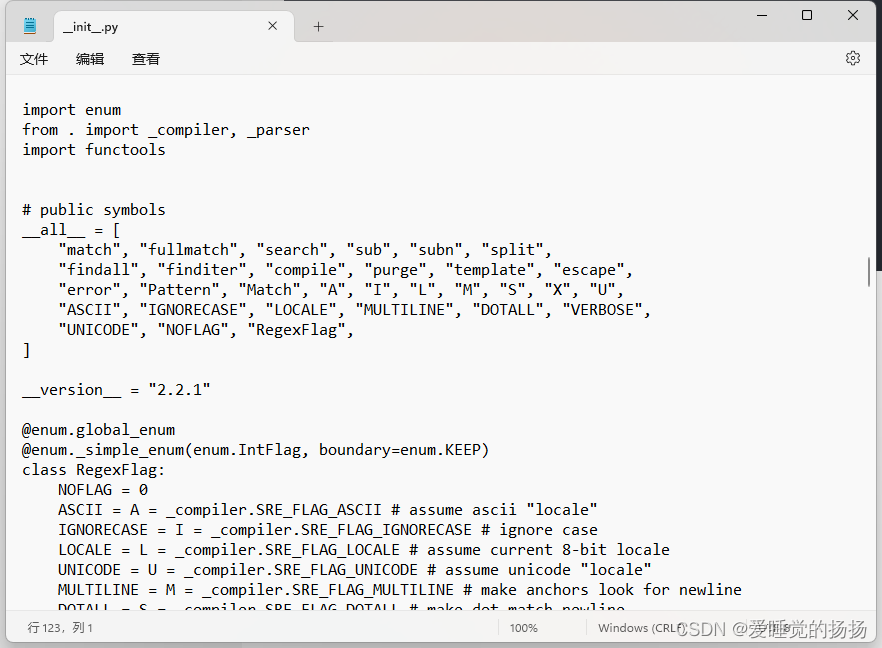
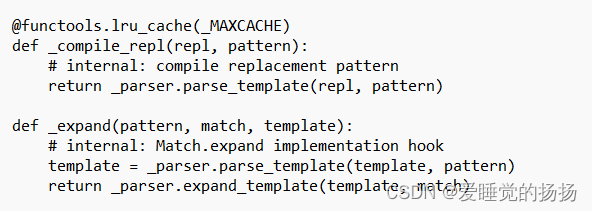
这里放出关键信息
同时根据报错提示我也在我的C:\Python311\Lib\site-packages\exrex.py查看
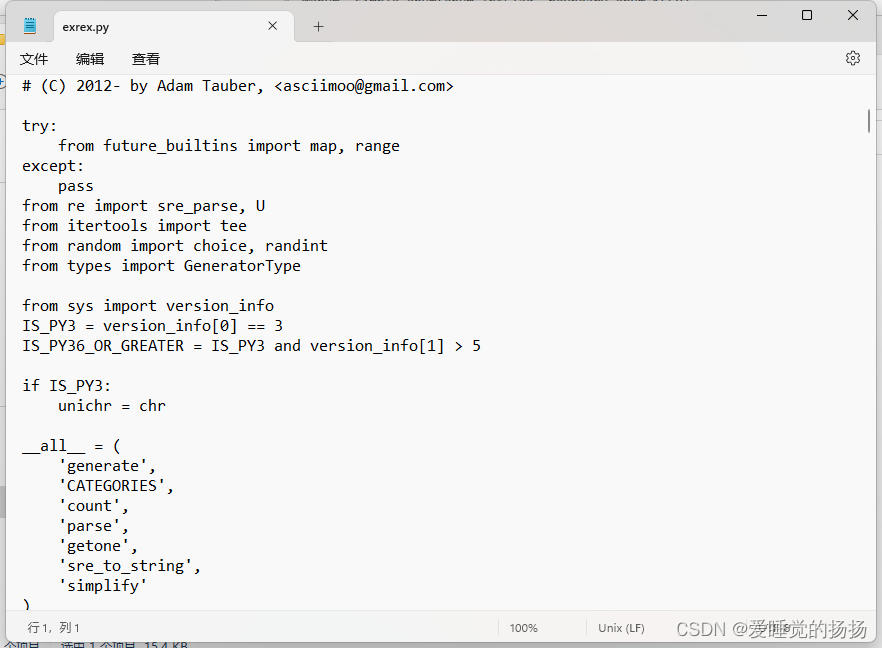
经过对比,我的C:\Python311\Lib\re_init_.py中根本没有sre_parse,只有_parser!!!
随后我在网上查找别人的re源码
#
# Secret Labs' Regular Expression Engine
#
# re-compatible interface for the sre matching engine
#
# Copyright (c) 1998-2001 by Secret Labs AB.  All rights reserved.
#
# This version of the SRE library can be redistributed under CNRI's
# Python 1.6 license.  For any other use, please contact Secret Labs
# AB (info@pythonware.com).
#
# Portions of this engine have been developed in cooperation with
# CNRI.  Hewlett-Packard provided funding for 1.6 integration and
# other compatibility work.
#

r"""Support for regular expressions (RE).
This module provides regular expression matching operations similar to
those found in Perl.  It supports both 8-bit and Unicode strings; both
the pattern and the strings being processed can contain null bytes and
characters outside the US ASCII range.
Regular expressions can contain both special and ordinary characters.
Most ordinary characters, like "A", "a", or "0", are the simplest
regular expressions; they simply match themselves.  You can
concatenate ordinary characters, so last matches the string 'last'.
The special characters are:
    "."      Matches any character except a newline.
    "^"      Matches the start of the string.
    "$"      Matches the end of the string or just before the newline at
             the end of the string.
    "*"      Matches 0 or more (greedy) repetitions of the preceding RE.
             Greedy means that it will match as many repetitions as possible.
    "+"      Matches 1 or more (greedy) repetitions of the preceding RE.
    "?"      Matches 0 or 1 (greedy) of the preceding RE.
    *?,+?,?? Non-greedy versions of the previous three special characters.
    {m,n}    Matches from m to n repetitions of the preceding RE.
    {m,n}?   Non-greedy version of the above.
    "\\"     Either escapes special characters or signals a special sequence.
    []       Indicates a set of characters.
             A "^" as the first character indicates a complementing set.
    "|"      A|B, creates an RE that will match either A or B.
    (...)    Matches the RE inside the parentheses.
             The contents can be retrieved or matched later in the string.
    (?iLmsux) Set the I, L, M, S, U, or X flag for the RE (see below).
    (?:...)  Non-grouping version of regular parentheses.
    (?P<name>...) The substring matched by the group is accessible by name.
    (?P=name)     Matches the text matched earlier by the group named name.
    (?#...)  A comment; ignored.
    (?=...)  Matches if ... matches next, but doesn't consume the string.
    (?!...)  Matches if ... doesn't match next.
    (?<=...) Matches if preceded by ... (must be fixed length).
    (?<!...) Matches if not preceded by ... (must be fixed length).
    (?(id/name)yes|no) Matches yes pattern if the group with id/name matched,
                       the (optional) no pattern otherwise.
The special sequences consist of "\\" and a character from the list
below.  If the ordinary character is not on the list, then the
resulting RE will match the second character.
    \number  Matches the contents of the group of the same number.
    \A       Matches only at the start of the string.
    \Z       Matches only at the end of the string.
    \b       Matches the empty string, but only at the start or end of a word.
    \B       Matches the empty string, but not at the start or end of a word.
    \d       Matches any decimal digit; equivalent to the set [0-9].
    \D       Matches any non-digit character; equivalent to the set [^0-9].
    \s       Matches any whitespace character; equivalent to [ \t\n\r\f\v].
    \S       Matches any non-whitespace character; equiv. to [^ \t\n\r\f\v].
    \w       Matches any alphanumeric character; equivalent to [a-zA-Z0-9_].
             With LOCALE, it will match the set [0-9_] plus characters defined
             as letters for the current locale.
    \W       Matches the complement of \w.
    \\       Matches a literal backslash.
This module exports the following functions:
    match    Match a regular expression pattern to the beginning of a string.
    search   Search a string for the presence of a pattern.
    sub      Substitute occurrences of a pattern found in a string.
    subn     Same as sub, but also return the number of substitutions made.
    split    Split a string by the occurrences of a pattern.
    findall  Find all occurrences of a pattern in a string.
    finditer Return an iterator yielding a match object for each match.
    compile  Compile a pattern into a RegexObject.
    purge    Clear the regular expression cache.
    escape   Backslash all non-alphanumerics in a string.
Some of the functions in this module takes flags as optional parameters:
    I  IGNORECASE  Perform case-insensitive matching.
    L  LOCALE      Make \w, \W, \b, \B, dependent on the current locale.
    M  MULTILINE   "^" matches the beginning of lines (after a newline)
                   as well as the string.
                   "$" matches the end of lines (before a newline) as well
                   as the end of the string.
    S  DOTALL      "." matches any character at all, including the newline.
    X  VERBOSE     Ignore whitespace and comments for nicer looking RE's.
    U  UNICODE     Make \w, \W, \b, \B, dependent on the Unicode locale.
This module also defines an exception 'error'.
"""

import sys
import sre_compile
import sre_parse

# public symbols
__all__ = [ "match", "search", "sub", "subn", "split", "findall",
    "compile", "purge", "template", "escape", "I", "L", "M", "S", "X",
    "U", "IGNORECASE", "LOCALE", "MULTILINE", "DOTALL", "VERBOSE",
    "UNICODE", "error" ]

__version__ = "2.2.1"

# flags
I = IGNORECASE = sre_compile.SRE_FLAG_IGNORECASE # ignore case
L = LOCALE = sre_compile.SRE_FLAG_LOCALE # assume current 8-bit locale
U = UNICODE = sre_compile.SRE_FLAG_UNICODE # assume unicode locale
M = MULTILINE = sre_compile.SRE_FLAG_MULTILINE # make anchors look for newline
S = DOTALL = sre_compile.SRE_FLAG_DOTALL # make dot match newline
X = VERBOSE = sre_compile.SRE_FLAG_VERBOSE # ignore whitespace and comments

# sre extensions (experimental, don't rely on these)
T = TEMPLATE = sre_compile.SRE_FLAG_TEMPLATE # disable backtracking
DEBUG = sre_compile.SRE_FLAG_DEBUG # dump pattern after compilation

# sre exception
error = sre_compile.error

# --------------------------------------------------------------------
# public interface

def match(pattern, string, flags=0):
    """Try to apply the pattern at the start of the string, returning
    a match object, or None if no match was found."""
    return _compile(pattern, flags).match(string)

def search(pattern, string, flags=0):
    """Scan through string looking for a match to the pattern, returning
    a match object, or None if no match was found."""
    return _compile(pattern, flags).search(string)

def sub(pattern, repl, string, count=0, flags=0):
    """Return the string obtained by replacing the leftmost
    non-overlapping occurrences of the pattern in string by the
    replacement repl.  repl can be either a string or a callable;
    if a string, backslash escapes in it are processed.  If it is
    a callable, it's passed the match object and must return
    a replacement string to be used."""
    return _compile(pattern, flags).sub(repl, string, count)

def subn(pattern, repl, string, count=0, flags=0):
    """Return a 2-tuple containing (new_string, number).
    new_string is the string obtained by replacing the leftmost
    non-overlapping occurrences of the pattern in the source
    string by the replacement repl.  number is the number of
    substitutions that were made. repl can be either a string or a
    callable; if a string, backslash escapes in it are processed.
    If it is a callable, it's passed the match object and must
    return a replacement string to be used."""
    return _compile(pattern, flags).subn(repl, string, count)

def split(pattern, string, maxsplit=0, flags=0):
    """Split the source string by the occurrences of the pattern,
    returning a list containing the resulting substrings."""
    return _compile(pattern, flags).split(string, maxsplit)

def findall(pattern, string, flags=0):
    """Return a list of all non-overlapping matches in the string.
    If one or more groups are present in the pattern, return a
    list of groups; this will be a list of tuples if the pattern
    has more than one group.
    Empty matches are included in the result."""
    return _compile(pattern, flags).findall(string)

if sys.hexversion >= 0x02020000:
    __all__.append("finditer")
    def finditer(pattern, string, flags=0):
        """Return an iterator over all non-overlapping matches in the
        string.  For each match, the iterator returns a match object.
        Empty matches are included in the result."""
        return _compile(pattern, flags).finditer(string)

def compile(pattern, flags=0):
    "Compile a regular expression pattern, returning a pattern object."
    return _compile(pattern, flags)

def purge():
    "Clear the regular expression cache"
    _cache.clear()
    _cache_repl.clear()

def template(pattern, flags=0):
    "Compile a template pattern, returning a pattern object"
    return _compile(pattern, flags|T)

_alphanum = frozenset(
    "abcdefghijklmnopqrstuvwxyzABCDEFGHIJKLMNOPQRSTUVWXYZ0123456789")

def escape(pattern):
    "Escape all non-alphanumeric characters in pattern."
    s = list(pattern)
    alphanum = _alphanum
    for i, c in enumerate(pattern):
        if c not in alphanum:
            if c == "\000":
                s[i] = "\\000"
            else:
                s[i] = "\\" + c
    return pattern[:0].join(s)

# --------------------------------------------------------------------
# internals

_cache = {}
_cache_repl = {}

_pattern_type = type(sre_compile.compile("", 0))

_MAXCACHE = 100

def _compile(*key):
    # internal: compile pattern
    pattern, flags = key
    bypass_cache = flags & DEBUG
    if not bypass_cache:
        cachekey = (type(key[0]),) + key
        p = _cache.get(cachekey)
        if p is not None:
            return p
    if isinstance(pattern, _pattern_type):
        if flags:
            raise ValueError('Cannot process flags argument with a compiled pattern')
        return pattern
    if not sre_compile.isstring(pattern):
        raise TypeError, "first argument must be string or compiled pattern"
    try:
        p = sre_compile.compile(pattern, flags)
    except error, v:
        raise error, v # invalid expression
    if not bypass_cache:
        if len(_cache) >= _MAXCACHE:
            _cache.clear()
        _cache[cachekey] = p
    return p

def _compile_repl(*key):
    # internal: compile replacement pattern
    p = _cache_repl.get(key)
    if p is not None:
        return p
    repl, pattern = key
    try:
        p = sre_parse.parse_template(repl, pattern)
    except error, v:
        raise error, v # invalid expression
    if len(_cache_repl) >= _MAXCACHE:
        _cache_repl.clear()
    _cache_repl[key] = p
    return p

def _expand(pattern, match, template):
    # internal: match.expand implementation hook
    template = sre_parse.parse_template(template, pattern)
    return sre_parse.expand_template(template, match)

def _subx(pattern, template):
    # internal: pattern.sub/subn implementation helper
    template = _compile_repl(template, pattern)
    if not template[0] and len(template[1]) == 1:
        # literal replacement
        return template[1][0]
    def filter(match, template=template):
        return sre_parse.expand_template(template, match)
    return filter

# register myself for pickling

import copy_reg

def _pickle(p):
    return _compile, (p.pattern, p.flags)

copy_reg.pickle(_pattern_type, _pickle, _compile)

# --------------------------------------------------------------------
# experimental stuff (see python-dev discussions for details)

class Scanner:
    def __init__(self, lexicon, flags=0):
        from sre_constants import BRANCH, SUBPATTERN
        self.lexicon = lexicon
        # combine phrases into a compound pattern
        p = []
        s = sre_parse.Pattern()
        s.flags = flags
        for phrase, action in lexicon:
            p.append(sre_parse.SubPattern(s, [
                (SUBPATTERN, (len(p)+1, sre_parse.parse(phrase, flags))),
                ]))
        s.groups = len(p)+1
        p = sre_parse.SubPattern(s, [(BRANCH, (None, p))])
        self.scanner = sre_compile.compile(p)
    def scan(self, string):
        result = []
        append = result.append
        match = self.scanner.scanner(string).match
        i = 0
        while 1:
            m = match()
            if not m:
                break
            j = m.end()
            if i == j:
                break
            action = self.lexicon[m.lastindex-1][1]
            if hasattr(action, '__call__'):
                self.match = m
                action = action(self, m.group())
            if action is not None:
                append(action)
            i = j
        return result, string[i:]
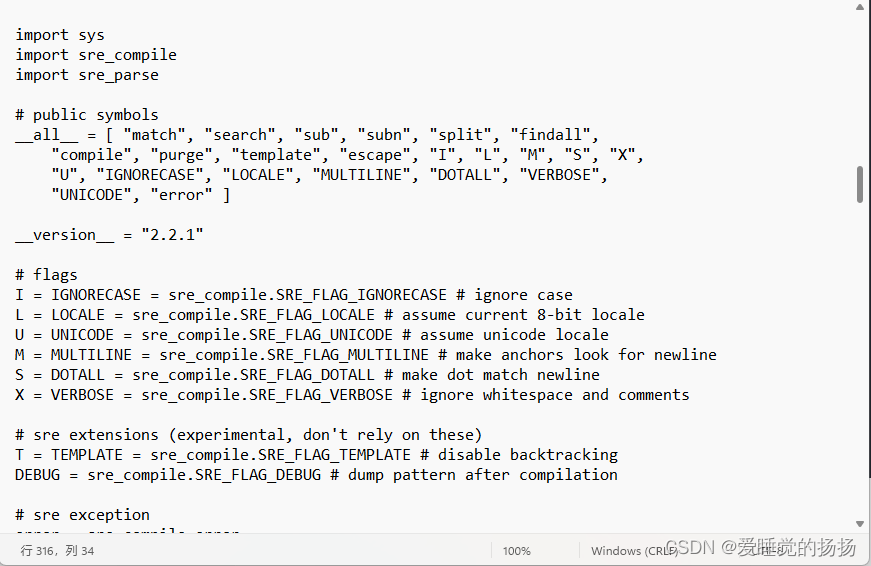
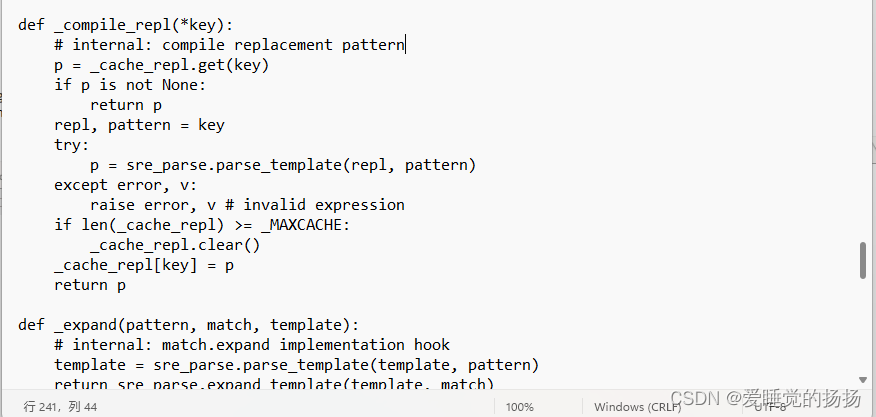
进行对比,我发现他们的re源码中竟然有sre_parse而不是_parser,那问题肯定就出在我自己身上了
我猜测应该是我在配置python解释器的时候所有的项目都只用一个python3.11的解释器,而且我都是在GitHub上直接拿人家的项目,缺少哪个安装包直接就在pycharm上安装且没有使用虚拟环境从而导致版本冲突
所以我在这里建议大家使用Python项目的时候一定要养成使用虚拟环境的好习惯,否则你真的可能连自己错在哪里都不知道(当然如果你按步骤下来都没有问题那肯定更好了,毕竟报错的只是少部分人)
最后怎样避免版本冲突使用虚拟环境的方法,大家自行在网上查找吧,说实话我自己除了编写poc/exp以外对pycharm也不是很了解
关闭。这个问题是opinion-based.它目前不接受答案。想要改进这个问题?更新问题,以便editingthispost可以用事实和引用来回答它.关闭4年前。Improvethisquestion我想在固定时间创建一系列低音和高音调的哔哔声。例如:在150毫秒时发出高音调的蜂鸣声在151毫秒时发出低音调的蜂鸣声200毫秒时发出低音调的蜂鸣声250毫秒的高音调蜂鸣声有没有办法在Ruby或Python中做到这一点?我真的不在乎输出编码是什么(.wav、.mp3、.ogg等等),但我确实想创建一个输出文件。
我想为Heroku构建一个Rails3应用程序。他们使用Postgres作为他们的数据库,所以我通过MacPorts安装了postgres9.0。现在我需要一个postgresgem并且共识是出于性能原因你想要pggem。但是我对我得到的错误感到非常困惑当我尝试在rvm下通过geminstall安装pg时。我已经非常明确地指定了所有postgres目录的位置可以找到但仍然无法完成安装:$envARCHFLAGS='-archx86_64'geminstallpg--\--with-pg-config=/opt/local/var/db/postgresql90/defaultdb/po
尝试通过RVM将RubyGems升级到版本1.8.10并出现此错误:$rvmrubygemslatestRemovingoldRubygemsfiles...Installingrubygems-1.8.10forruby-1.9.2-p180...ERROR:Errorrunning'GEM_PATH="/Users/foo/.rvm/gems/ruby-1.9.2-p180:/Users/foo/.rvm/gems/ruby-1.9.2-p180@global:/Users/foo/.rvm/gems/ruby-1.9.2-p180:/Users/foo/.rvm/gems/rub
我已经从我的命令行中获得了一切,所以我可以运行rubymyfile并且它可以正常工作。但是当我尝试从sublime中运行它时,我得到了undefinedmethod`require_relative'formain:Object有人知道我的sublime设置中缺少什么吗?我正在使用OSX并安装了rvm。 最佳答案 或者,您可以只使用“require”,它应该可以正常工作。我认为“require_relative”仅适用于ruby1.9+ 关于ruby-主要:Objectwhenrun
从给定URL下载文件并立即将其上传到AmazonS3的更直接的方法是什么(+将有关文件的一些信息保存到数据库中,例如名称、大小等)?现在,我既不使用Paperclip,也不使用Carrierwave。谢谢 最佳答案 简单明了:require'open-uri'require's3'amazon=S3::Service.new(access_key_id:'KEY',secret_access_key:'KEY')bucket=amazon.buckets.find('image_storage')url='http://www.ex
我的最终目标是安装当前版本的RubyonRails。我在OSXMountainLion上运行。到目前为止,这是我的过程:已安装的RVM$\curl-Lhttps://get.rvm.io|bash-sstable检查已知(我假设已批准)安装$rvmlistknown我看到当前的稳定版本可用[ruby-]2.0.0[-p247]输入命令安装$rvminstall2.0.0-p247注意:我也试过这些安装命令$rvminstallruby-2.0.0-p247$rvminstallruby=2.0.0-p247我很快就无处可去了。结果:$rvminstall2.0.0-p247Search
由于fast-stemmer的问题,我很难安装我想要的任何rubygem。我把我得到的错误放在下面。Buildingnativeextensions.Thiscouldtakeawhile...ERROR:Errorinstallingfast-stemmer:ERROR:Failedtobuildgemnativeextension./System/Library/Frameworks/Ruby.framework/Versions/2.0/usr/bin/rubyextconf.rbcreatingMakefilemake"DESTDIR="cleanmake"DESTDIR=
当我尝试安装Ruby时遇到此错误。我试过查看this和this但无济于事➜~brewinstallrubyWarning:YouareusingOSX10.12.Wedonotprovidesupportforthispre-releaseversion.Youmayencounterbuildfailuresorotherbreakages.Pleasecreatepull-requestsinsteadoffilingissues.==>Installingdependenciesforruby:readline,libyaml,makedepend==>Installingrub
protect_from_forgery默认Rails6应用程序不包含在我的应用程序Controller中,但是有嵌入式ruby在主应用程序布局中。这是否意味着protect_from_forgery方法已经被抽象并且在应用程序Controller中不再明确需要?我买了实用程序员的Rails6一书,我唯一能找到的是“csrf_meta_tags()方法设置了防止跨站点请求伪造攻击所需的所有幕后数据”。 最佳答案 对于rails5.2和更高版本,默认情况下在ActionController::Base上启用。查看此提交:https
我正在尝试使用boilerpipe来自JRuby。我看过guide从JRuby调用Java,并成功地将它与另一个Java包一起使用,但无法弄清楚为什么同样的东西不能用于boilerpipe。我正在尝试基本上从JRuby中执行与此Java等效的操作:URLurl=newURL("http://www.example.com/some-location/index.html");Stringtext=ArticleExtractor.INSTANCE.getText(url);在JRuby中试过这个:require'java'url=java.net.URL.new("http://www
